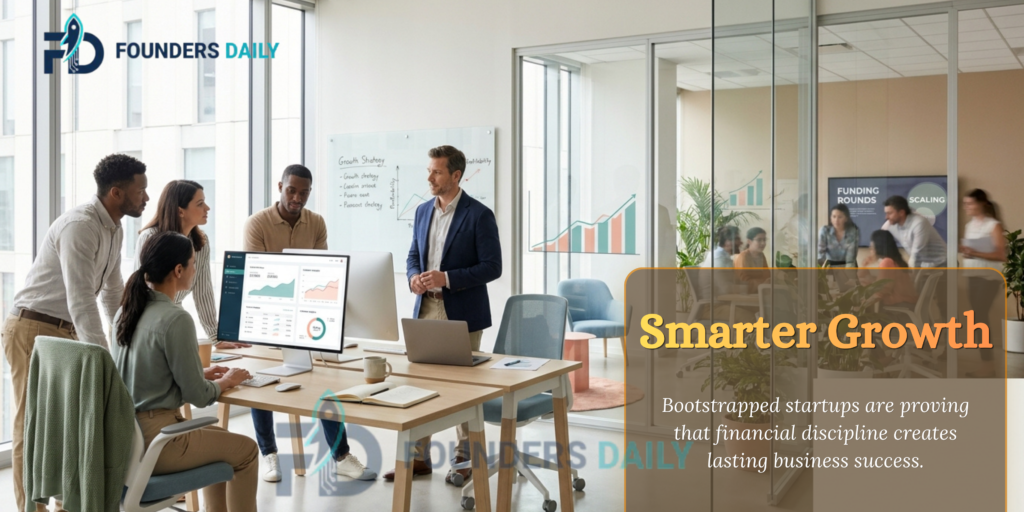
In the startup world, venture capital often gets all the attention. Headlines celebrate billion-dollar funding rounds, aggressive expansion plans, and founders raising millions before turning profitable. Yet behind the noise, another category of companies quietly builds sustainable businesses, loyal customer bases, and long-term wealth. These are bootstrapped companies.
Over the last few years, many founders have started questioning whether venture capital is truly the only path to success. Rising startup shutdowns, mass layoffs, and pressure-driven growth models have exposed the weaknesses of hyper-funded businesses. At the same time, several bootstrapped companies have continued growing steadily without external investors, proving that profitability and discipline still matter in modern entrepreneurship.
The debate between bootstrapped companies and VC-backed startups is no longer just about funding. It is about control, culture, sustainability, customer focus, and the kind of business founders actually want to build. Many entrepreneurs are now realizing that bootstrapped companies often outperform heavily funded startups in areas that truly matter over the long term.
This article explores what bootstrapped companies do better than VC-backed ones, why these businesses often survive economic downturns more effectively, and what modern founders can learn from their approach in 2026 and beyond.
Also Read: The Founder’s Guide to Financial Discipline in 2026
Understanding the Difference Between Bootstrapped and VC-Backed Companies
Before comparing the two models, it is important to understand how they operate differently.
A bootstrapped company grows using its own revenue, savings, or founder capital. Instead of relying on investors, the business funds operations through customer payments and profits. Every hiring decision, marketing campaign, and product expansion depends on financial discipline and real demand.
A VC-backed startup, on the other hand, raises capital from venture investors in exchange for equity. The company receives funding to grow rapidly, acquire market share, and scale aggressively. In return, investors expect high returns, usually within a specific time horizon.
Neither model is universally right or wrong. Companies like Mailchimp and Zoho became global success stories through bootstrapping, while firms like Uber and Airbnb used venture capital to dominate massive markets.
The real question is not which model is more glamorous. The real question is which model creates stronger businesses over time.
Bootstrapped Companies Build With Profitability in Mind
One of the biggest strengths of bootstrapped companies is their obsession with profitability. Since there is no investor money acting as a safety net, founders must ensure the business generates revenue early.
This changes the entire mindset of the company.
Bootstrapped founders usually focus on solving practical customer problems instead of chasing vanity metrics. They cannot afford to spend recklessly on growth campaigns that produce no real return. Every expense matters because survival depends on sustainable cash flow.
This discipline often creates healthier companies.
During the startup boom between 2020 and 2024, many VC-backed firms prioritized user growth over profitability. Some offered massive discounts, burned huge marketing budgets, and expanded teams too quickly. When funding markets tightened, these businesses struggled to survive because their economics were weak from the beginning.
Bootstrapped companies operate differently. They usually grow slower, but their foundation is stronger. They learn how to make money before scaling operations. This approach reduces dependency on external funding and creates resilience during economic uncertainty.
A great example is Basecamp. The company built a profitable software business without chasing endless funding rounds. Instead of focusing on hypergrowth, it concentrated on sustainable revenue and customer satisfaction. Years later, the company remains influential because it built stability first.
Customer Focus Becomes Stronger Without Investor Pressure
Bootstrapped companies often develop deeper customer relationships because customers become their primary source of survival.
VC-backed startups frequently optimize for investor expectations. Growth charts, acquisition numbers, and expansion metrics become top priorities because future funding depends on showing rapid momentum. While customer experience still matters, investor reporting can sometimes dominate decision-making.
Bootstrapped businesses usually think differently.
Since there are no investors demanding quarterly growth spikes, founders stay closer to customer feedback. They improve products based on actual user needs rather than building features mainly designed to impress investors or competitors.
This customer-centric approach creates stronger brand trust over time.
Many profitable SaaS businesses succeeded because they solved specific customer pain points exceptionally well instead of trying to become the next billion-dollar unicorn overnight. Customers value reliability, support, and consistent improvement more than flashy marketing campaigns.
In 2026, consumers are becoming even more selective about where they spend money. Trust, transparency, and product quality matter more than aggressive advertising. Bootstrapped companies naturally align with this shift because they are built around customer retention instead of short-term valuation growth.
Bootstrapped Founders Retain More Control
One of the most overlooked advantages of bootstrapping is founder independence.
When entrepreneurs raise venture capital, they often give away significant equity and decision-making power. Investors may influence hiring, product direction, expansion strategies, and even leadership changes. In some cases, founders lose operational control of the businesses they originally created.
Bootstrapped founders maintain ownership and freedom.
This allows them to make decisions based on long-term vision instead of investor timelines. They can experiment more carefully, maintain company culture, and avoid unnecessary pressure to pursue risky growth strategies.
Control becomes especially important during difficult periods.
A bootstrapped company can decide to slow hiring, improve margins, or focus on customer retention without external pressure. A VC-backed company may face investor demands to continue aggressive scaling even when market conditions change.
This independence also affects founder psychology. Many entrepreneurs today are prioritizing sustainable lifestyles, meaningful work, and balanced growth instead of burnout-driven startup culture. Bootstrapping supports that mindset more effectively.
Hiring Is Usually More Intentional in Bootstrapped Companies
Bootstrapped businesses tend to hire slower and more strategically.
Since resources are limited, every employee must contribute real value. Founders carefully evaluate roles, productivity, and long-term necessity before expanding teams. This creates leaner organizations with stronger accountability.
VC-backed startups sometimes expand rapidly after funding rounds. Large capital inflows encourage fast hiring because investors expect rapid scaling. While this can accelerate growth, it can also create inefficiencies.
The tech layoffs seen across global startups between 2023 and 2025 highlighted this problem clearly. Many companies realized they had hired too aggressively during funding booms. Teams became bloated, operational costs exploded, and layoffs became inevitable when funding slowed.
Bootstrapped companies were generally less affected because they had already built operational discipline into their culture.
Smaller teams also encourage better communication and ownership. Employees understand the business more deeply because they are directly connected to outcomes. This often creates stronger company culture and higher productivity.
Bootstrapped Companies Usually Develop Better Financial Discipline
Financial discipline is one of the biggest competitive advantages in business.
Bootstrapped founders understand cash flow intimately because every rupee or dollar directly impacts survival. They monitor expenses carefully, negotiate better deals, and avoid unnecessary spending.
This habit creates smarter businesses over time.
VC-backed startups can sometimes fall into the trap of easy money. Large funding rounds may reduce urgency around efficiency. Expensive offices, oversized teams, aggressive advertising, and untested expansion plans become easier to justify when capital is abundant.
But markets eventually change.
When economic slowdowns happen, disciplined companies survive longer because they already know how to operate efficiently. Bootstrapped companies usually understand profitability metrics better because they have lived through financial constraints from the beginning.
This does not mean all VC-backed companies are financially irresponsible. Many successful venture-funded firms maintain excellent discipline. However, bootstrapping naturally forces founders to prioritize efficiency from day one.
Sustainable Growth Often Beats Hypergrowth
The startup ecosystem has long glorified hypergrowth. Founders were encouraged to scale as quickly as possible, dominate markets, and prioritize expansion over stability.
But rapid growth can create serious operational problems.
Companies that scale too quickly often struggle with customer support, product consistency, employee burnout, and internal communication. Growth becomes chaotic instead of strategic.
Bootstrapped companies usually grow more sustainably.
Because expansion depends on revenue, growth naturally aligns with operational capacity. This allows businesses to strengthen systems gradually while maintaining service quality.
Sustainable growth also creates healthier expectations.
Instead of chasing unrealistic valuations, bootstrapped founders focus on building durable businesses. Their goal is often long-term profitability rather than short-term exits.
In many cases, this slower approach produces stronger outcomes. A company that grows steadily for fifteen years can ultimately become more valuable than a startup that explodes quickly and collapses under pressure.
Bootstrapped Businesses Adapt Faster During Crises
Economic downturns reveal the true strength of businesses.
During uncertain periods, bootstrapped companies often adapt faster because they are already used to operating efficiently. Their teams are lean, their expenses are controlled, and their strategies are usually grounded in customer demand.
VC-backed startups can face additional pressure during crises because they depend heavily on investor sentiment. If funding markets weaken, companies may suddenly struggle to raise capital. This creates panic-driven cost cutting and operational instability.
Bootstrapped businesses rely more on customers than investors, which gives them greater flexibility.
During the global economic shifts of recent years, many profitable bootstrapped companies remained stable while heavily funded startups faced layoffs and shutdowns. Their disciplined approach helped them survive volatility more effectively.
This resilience matters even more in 2026 as global markets continue facing uncertainty from AI disruption, changing consumer behavior, and evolving digital economies.
Innovation Can Thrive Without Massive Funding
Many people assume innovation requires large investment. While capital certainly helps in some industries, bootstrapped companies often innovate more creatively because they must work within constraints.
Limited resources encourage sharper thinking.
Instead of throwing money at problems, bootstrapped founders focus on efficiency, differentiation, and customer experience. They prioritize features that genuinely matter instead of building unnecessary complexity.
Some of the most respected software products in the world were created by small, resourceful teams rather than heavily funded organizations.
Bootstrapped companies also tend to avoid innovation theater. They are less likely to chase trends purely for media attention because survival depends on delivering actual value.
In the AI era, this principle is becoming increasingly important. Businesses that use artificial intelligence strategically to improve customer outcomes will outperform companies that adopt AI merely for hype.
Why Many Founders Are Returning to Bootstrapping in 2026
The entrepreneurial mindset is changing.
A decade ago, raising venture capital was often considered the ultimate validation for startups. Today, many founders view profitability and independence as more meaningful achievements.
Several factors are driving this shift.
First, startup founders have witnessed the downside of aggressive venture-backed growth. Burnout, layoffs, dilution, and investor pressure have made many entrepreneurs reconsider the traditional path.
Second, technology has reduced startup costs dramatically. Cloud infrastructure, AI tools, no-code platforms, and digital distribution allow small teams to build scalable businesses without massive funding.
Third, customers increasingly value authenticity and quality over hype. Sustainable brands are gaining trust because consumers are tired of overpromised products and unstable businesses.
As a result, more founders are choosing to build profitable businesses slowly instead of chasing rapid valuation growth.
This does not mean venture capital is disappearing. VC funding still plays a critical role in industries requiring large-scale infrastructure, research, or network effects. However, founders today are becoming more selective about whether external funding truly aligns with their goals.
The Real Lesson Founders Should Learn
The biggest lesson from bootstrapped companies is not that venture capital is bad.
The real lesson is that strong fundamentals matter more than hype.
A company with loyal customers, healthy margins, operational discipline, and clear market demand will always have a stronger foundation than a company built purely on investor excitement.
Bootstrapped founders are forced to master these fundamentals early. They learn how to generate revenue, manage cash flow, retain customers, and build sustainable systems because they have no other choice.
These skills create durable businesses.
Modern entrepreneurship is moving toward a more balanced approach where founders prioritize resilience alongside growth. Instead of chasing vanity metrics, successful companies are focusing on profitability, trust, and long-term value creation.
That shift may define the next generation of great businesses.
Also Read: Bootstrapped vs Funded: The Real Economics Founders Ignore in 2026
Conclusion
The startup ecosystem is evolving rapidly, and founders are beginning to rethink what success actually means. For years, venture funding dominated entrepreneurial conversations, but the rise of resilient bootstrapped companies is changing the narrative.
Bootstrapped businesses often outperform VC-backed startups in profitability, customer relationships, financial discipline, operational efficiency, and long-term sustainability. They may grow slower, but they frequently build stronger foundations.
In 2026, the smartest founders are not blindly following startup trends. They are building businesses aligned with their vision, values, and market realities. For many entrepreneurs, that means embracing sustainable growth instead of chasing endless funding rounds.
The future of entrepreneurship may not belong only to the loudest startups. It may belong to the companies quietly building real value, one customer at a time.