Introduction
The shift did not happen slowly. It happened almost overnight. One day, professionals were discussing artificial intelligence as a future trend. The next day, it became a daily work tool. This is exactly why AI is reshaping white-collar jobs faster than expected, and the pace is only accelerating.
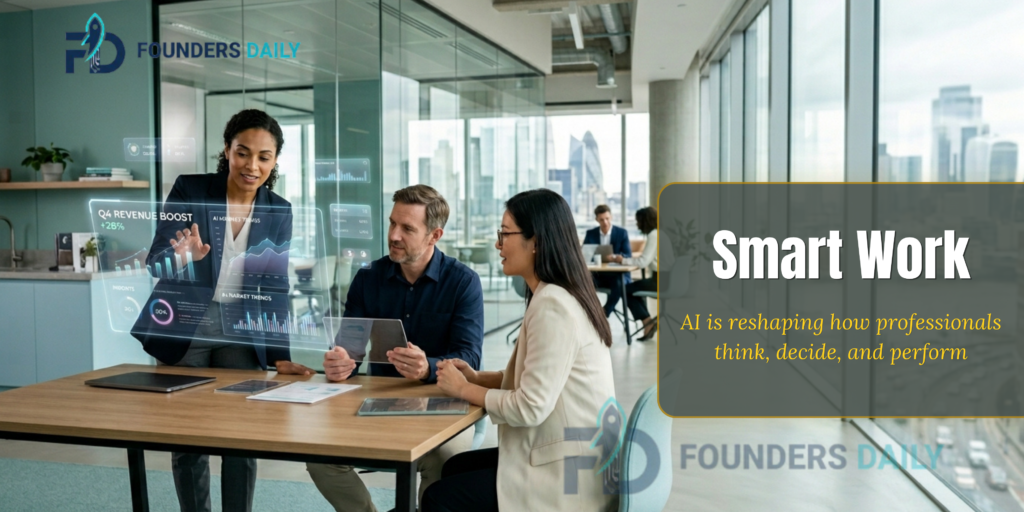
Across industries, from finance and consulting to marketing and legal services, professionals are noticing a subtle but powerful change. Tasks that once required hours of focused effort are now completed in minutes. Reports are generated instantly. Data is analyzed in real time. Even creative outputs are being assisted by machines. The nature of white-collar work is no longer what it used to be.
This transformation is not just about technology replacing human effort. It is about redefining how work gets done. In this article, you will understand how AI is reshaping white-collar jobs, why the shift is happening so quickly, what roles are being affected, and most importantly, how professionals can adapt to this new reality.
Also Read: Minimal Skincare Trend Gains Momentum as Magical Blends Introduces 60-Second Summer Routine
The Silent Transformation of White-Collar Work
There was a time when automation was limited to factory floors and repetitive manual processes. White-collar roles were considered safe because they required thinking, judgment, and expertise. Today, that assumption no longer holds true.
AI is reshaping white-collar jobs by entering areas that were once considered complex. Tasks like financial analysis, legal research, content creation, and even coding are now supported by intelligent systems. This does not mean that humans are becoming irrelevant. Instead, it means that the way humans contribute is changing.
A financial analyst today spends less time gathering data and more time interpreting it. A marketer focuses less on execution and more on strategy. A consultant relies on AI-generated insights but uses human judgment to make final decisions. This shift is happening quietly but rapidly, making AI an invisible yet powerful force in the workplace.
Why AI Is Reshaping White-Collar Jobs So Fast
The speed of this transformation is not accidental. It is driven by a combination of business pressure, technological advancement, and changing workforce expectations.
Companies today operate in highly competitive environments where speed and efficiency determine success. AI offers the ability to process massive amounts of data quickly, which directly improves decision-making. Businesses are no longer willing to rely solely on manual processes when faster and more accurate alternatives exist.
At the same time, the cost advantage of AI cannot be ignored. Organizations are under constant pressure to optimize operations. AI tools allow companies to reduce costs without compromising output quality. This is one of the main reasons why AI is reshaping white-collar jobs across industries like finance, customer support, and operations.
Another key factor is the explosion of data. Modern businesses generate enormous amounts of information every day. Without AI, this data is difficult to manage and even harder to use effectively. AI systems make sense of this complexity, turning raw data into actionable insights.
How Different Industries Are Experiencing This Shift
The impact of AI is not uniform across all sectors, but the direction of change is consistent. Every industry is experiencing some level of transformation.
In finance, AI is handling tasks like fraud detection, risk analysis, and reporting. This reduces manual effort while improving accuracy. Professionals in this field are now expected to focus more on strategic decision-making rather than routine calculations.
In marketing, AI tools are optimizing campaigns, generating content, and analyzing customer behavior. Marketers are shifting their focus towards creativity, storytelling, and brand positioning. The role is becoming more strategic and less operational.
The legal industry is also evolving. AI is assisting with document review, contract analysis, and legal research. Lawyers are able to save time and focus on advisory roles, client interaction, and complex case strategies.
Human resources is another area where AI is reshaping white-collar jobs. Recruitment processes are becoming faster and more efficient through AI-driven screening and matching systems. HR professionals are now investing more time in employee engagement, culture, and leadership development.
The Emergence of New Career Opportunities
While there is concern about job displacement, there is also a significant rise in new opportunities. AI is reshaping white-collar jobs, but it is also creating roles that did not exist a decade ago.
There is a growing demand for professionals who understand AI systems. Roles like data analysts, AI specialists, and machine learning engineers are becoming increasingly important. These positions often come with high salaries, making them attractive for individuals looking to future-proof their careers.
At the same time, hybrid roles are emerging. These roles combine domain expertise with AI knowledge. For example, a marketer who understands AI tools or a finance professional who can work with data analytics platforms has a clear advantage in the job market.
Creative and strategic roles are also gaining importance. As AI takes over repetitive tasks, humans are expected to focus on innovation, problem-solving, and long-term planning. This shift highlights that AI is not eliminating jobs but redefining them.
What This Means for Professionals
The biggest takeaway from this transformation is that adaptability is no longer optional. Professionals must evolve along with technology to stay relevant.
Understanding AI tools is becoming a basic requirement. This does not mean everyone needs to become a programmer. However, having a working knowledge of how AI systems operate can significantly improve productivity and decision-making.
Critical thinking is another skill that is becoming more valuable. AI can process data, but it cannot fully understand context or make nuanced decisions. Professionals who can interpret insights and apply them effectively will stand out.
Communication and collaboration are also becoming essential. As roles shift towards strategy, professionals must be able to explain ideas clearly and work effectively with teams.
Continuous learning is perhaps the most important factor. The pace at which AI is reshaping white-collar jobs means that skills can become outdated quickly. Professionals must be willing to learn, unlearn, and relearn to keep up with industry changes.
A Real-World Perspective
To understand this shift better, consider a mid-level professional working in a corporate environment. A few years ago, their day would involve preparing reports, analyzing data manually, and presenting findings.
Today, much of this work is handled by AI tools. Reports are generated automatically. Data analysis is faster and more accurate. This allows the professional to focus on insights, strategy, and decision-making.
The job still exists, but the nature of work has changed. This is the clearest example of how AI is reshaping white-collar jobs in a practical sense.
The Human Edge in an AI-Driven Workplace
Despite rapid advancements, AI has limitations. It lacks emotional intelligence, creativity, and ethical judgment. These are areas where humans continue to have an advantage.
Organizations are increasingly valuing these human qualities. Professionals who can combine technical knowledge with empathy and creativity will be in high demand.
AI may handle execution, but humans define purpose. This balance ensures that human roles remain essential even as technology evolves.
Also Read: Leadership Under Pressure: How Great Leaders Make Decisions With Incomplete Data
Conclusion
AI is reshaping white-collar jobs faster than expected, and the transformation is far from over. What we are witnessing is not a replacement of human effort but a redefinition of it.
The future belongs to professionals who understand how to work alongside AI rather than compete with it. Those who adapt will find new opportunities, while those who resist may struggle to keep pace.
The question is no longer whether AI will impact your job. The question is how you will respond to that change.