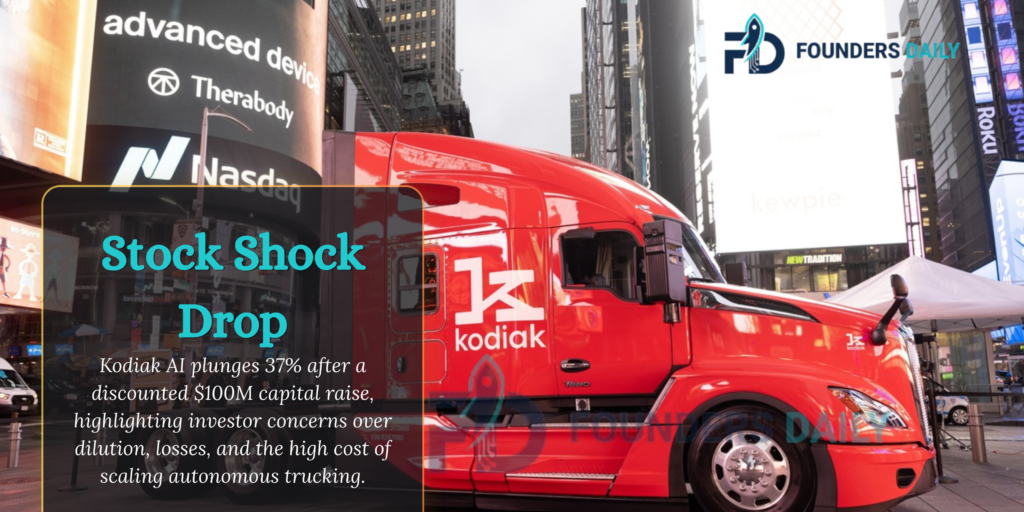
Kodiak AI saw its stock plunge 37% in after-hours trading after the autonomous trucking company announced a $100 million capital raise at a significantly discounted share price, raising concerns among investors about valuation and ongoing cash burn.
The company disclosed that it sold new shares at $6.50 each, well below its previous closing price of $9.10. The financing package also included warrants, giving investors the right to purchase additional shares later at prices as low as $6 per share.
The funding was led by existing investor Ares Management along with several unnamed institutional investors.
While the financing provides fresh capital to support Kodiak’s ambitious autonomous trucking plans, the discounted terms sent a clear signal to the market: investors are willing to fund the company’s long-term vision, but not at its current market valuation.
Also Read: Cloudflare Cuts 1,100 Jobs, Says AI Has Made Several Roles Obsolete Despite Record Revenue
Why Investors Reacted Sharply
The sharp stock decline reflects concerns over two key issues: dilution and profitability.
When a public company raises money by issuing new shares at a price significantly below the prevailing market price, existing shareholders face dilution. Their ownership percentage is reduced, and the discounted price can suggest that institutional investors view the current valuation as too high.
For Kodiak, the market reaction was particularly severe because the company remains in a high-spending growth phase with limited revenue.
Kodiak reported first-quarter 2026 revenue of $1.8 million, up from $1.4 million in the same quarter a year earlier. However, its operating loss widened dramatically to $37.8 million, nearly double the prior year’s figure.
These numbers underscore the challenge facing autonomous vehicle startups: developing and validating self-driving technology requires enormous capital investment long before meaningful commercial revenue is achieved.
Expanding Commercial Momentum
Despite its financial losses, Kodiak has made significant progress in building commercial partnerships.
On the same day as the funding announcement, the company revealed a new agreement with Roehl Transport.
Under this partnership, Kodiak-equipped trucks will transport freight between Dallas and Houston on four round trips each week. The trucks will operate autonomously for the full route, although a trained safety operator will remain behind the wheel during this phase.
Kodiak founder and CEO Don Burnette said the company is preparing to launch fully driverless trucking on public highways later this year.
“We’re excited about the progress that we’re making as we march toward our driverless launch later this year,” Burnette said.
Kodiak’s existing highway customers include Werner Enterprises, J.B. Hunt Transport Services, Bridgestone, Martin Brower, and C.R. England.
Beyond Highway Freight
Kodiak is also expanding beyond traditional trucking applications.
The company recently launched a pilot with West Fraser Timber Co. in Alberta, Canada, where Kodiak-equipped autonomous trucks will be tested in log-hauling operations.
In another notable development, Kodiak announced a collaboration with General Dynamics Land Systems to develop autonomous military ground vehicles.
These partnerships illustrate the versatility of Kodiak’s self-driving technology across commercial, industrial, and defense sectors.
Driver-as-a-Service Business Model
Currently, Kodiak owns the trucks, supplies the safety drivers, and manages freight operations for its customers.
Once driverless operations begin, the company plans to transition to a “driver-as-a-service” model.
Under this structure, customers will own and operate the trucks, while Kodiak provides the autonomous software and remote operational support.
This asset-light approach could significantly improve the company’s economics by reducing capital expenditures while generating recurring software and service revenue.
Kodiak already uses this model with Atlas Energy Solutions for autonomous deployments in the Permian Basin of Texas.
Measuring Readiness for Driverless Launch
To provide transparency into its development progress, Kodiak introduced an internal metric called the Autonomy Readiness Measure.
The score ranges from zero to 100 and reflects how much of the company’s internal safety validation process has been completed.
As of April 2026, Kodiak reported an 86% readiness score.
Burnette said the company will not remove the human safety driver until validation work is fully complete, even though the trucks are already operating under the conditions expected for future driverless deployment.
From Startup to Public Company
Kodiak, formerly known as Kodiak Robotics, became a public company in September 2025 through a merger with Ares Acquisition Corporation II, an affiliate of Ares Management.
The transaction valued the company at approximately $2.5 billion.
As part of the merger, Kodiak raised $275 million, including $145 million in PIPE financing and roughly $62.9 million in trust proceeds after investor redemptions.
The new $100 million raise adds to that capital base but also highlights the ongoing need for funding as the company advances toward commercialization.
Also Read: Building a Brand in a Noisy Digital World
The Road Ahead
Kodiak’s latest financing underscores both the promise and the financial intensity of autonomous trucking.
The company has built a strong roster of customers, expanded into multiple industries, and appears close to launching driverless freight services on public highways.
At the same time, it continues to burn tens of millions of dollars each quarter and remains far from profitability.
For investors, the discounted raise was a reminder that breakthrough technology alone does not eliminate financing risk.
For the autonomous trucking industry, however, Kodiak’s continued ability to attract institutional capital suggests confidence that self-driving trucks may soon move from pilot projects to large-scale commercial operations.