
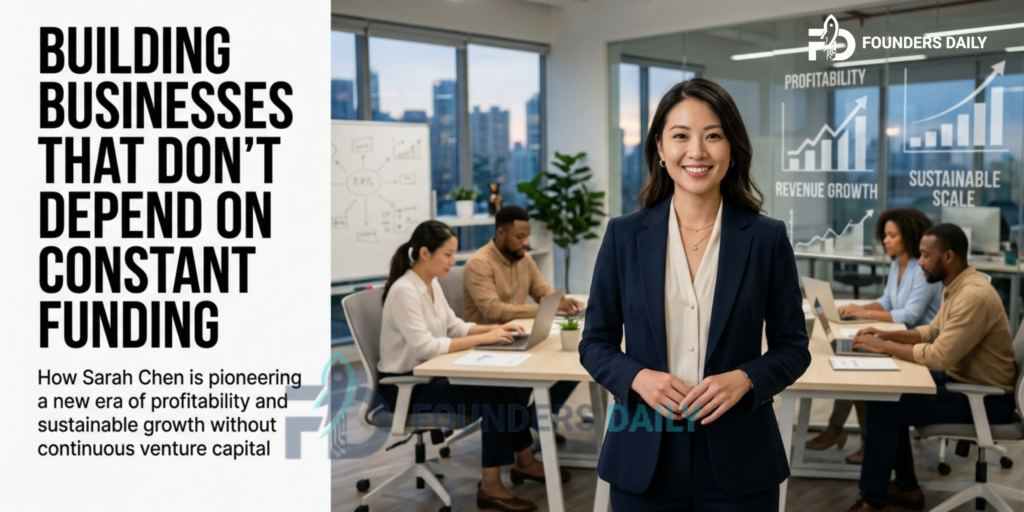
Why the Most Resilient Companies Are Being Built Without Endless Capital
For more than a decade, startup success seemed closely tied to fundraising. Headlines celebrated companies that raised millions of dollars before generating meaningful revenue. Venture capital became a symbol of growth, ambition, and market validation. Yet the business landscape is changing rapidly. In 2026, many founders are discovering that building businesses that don’t depend on constant funding is no longer just an alternative strategy. It is becoming a competitive advantage.
The global startup ecosystem has entered a new phase. Investors are demanding stronger fundamentals, customer acquisition costs continue to rise, and profitability has returned to the center of business conversations. As a result, founders are increasingly focusing on sustainable growth rather than relying on continuous rounds of external capital.
The companies attracting the most respect today are often not the ones raising the largest funding rounds. Instead, they are businesses that have mastered cash flow management, built loyal customer bases, and developed sustainable business models capable of generating long term value. This shift is redefining how entrepreneurs think about growth, scalability, and business resilience.
In this article, we explore why building businesses that don’t depend on constant funding has become one of the most important strategies for modern founders. We will examine the principles behind sustainable growth, the lessons from successful companies, and the practical frameworks entrepreneurs can use to build stronger businesses in an increasingly uncertain economic environment.
Also Read: What Bootstrapped Companies Do Better Than VC-Backed Ones
The End of Growth at Any Cost
For years, startup culture celebrated aggressive expansion. Many founders prioritized market share over profitability because investors rewarded rapid growth. Companies often spent heavily on customer acquisition, hiring, and expansion with the expectation that future funding rounds would cover losses.
However, economic uncertainty and changing investor expectations have exposed the weaknesses of this approach. Businesses that relied heavily on external capital often found themselves vulnerable when funding markets tightened. Growth slowed, valuations declined, and many companies were forced into difficult restructuring efforts.
Building businesses that don’t depend on constant funding requires a fundamentally different mindset. Instead of asking how quickly a company can scale, founders ask how efficiently growth can be achieved. Revenue becomes more important than valuation. Customer retention matters as much as acquisition. Profitability is viewed as a strategic asset rather than a future milestone.
This shift does not mean growth becomes less important. Rather, growth is supported by stronger foundations. Businesses become more adaptable because they are not dependent on investor sentiment or fundraising cycles to survive.
Why Sustainable Business Models Matter More Than Ever
A sustainable business model creates value consistently while generating enough revenue to support operations and future expansion. It allows companies to grow through customer demand rather than external financing.
One reason sustainable business models are becoming increasingly important is that market conditions change rapidly. Access to funding can fluctuate due to economic conditions, investor priorities, or industry trends. Businesses built entirely around fundraising often struggle when these external factors shift.
Companies with strong recurring revenue streams are generally more resilient. Subscription businesses, software platforms, membership communities, and recurring service providers often enjoy predictable cash flow. This stability allows founders to make long term decisions without constant concern about raising additional capital.
Sustainability also improves strategic flexibility. Founders can pursue opportunities that align with their vision instead of making decisions solely to satisfy investor expectations. This creates healthier businesses with stronger cultures and clearer long term objectives.
The Power of Customer Funded Growth
One of the most effective ways to build businesses that don’t depend on constant funding is through customer funded growth. This approach uses revenue generated from customers to finance expansion.
Many successful companies began with this philosophy. Instead of seeking large investments immediately, they focused on solving real customer problems and reinvesting profits into growth. Every new customer contributed directly to the company’s ability to expand its products, services, and market reach.
Customer funded growth creates discipline. Founders must deliver genuine value because revenue becomes the primary engine of progress. Teams focus on efficiency because every dollar spent must generate measurable results.
This model also strengthens customer relationships. Businesses become more attentive to customer needs because satisfaction directly influences future growth. Over time, this creates stronger brand loyalty and more sustainable competitive advantages.
Building Strong Unit Economics from Day One
A critical factor in startup profitability is understanding unit economics. Simply put, unit economics measure how much value each customer generates compared to the cost of acquiring and serving them.
Many startups struggle because they prioritize growth without fully understanding these numbers. A company may appear successful on the surface while losing money with every customer acquired. Eventually, this creates financial pressure that requires continuous fundraising.
Founders who prioritize strong unit economics from the beginning build healthier businesses. They understand customer acquisition costs, customer lifetime value, gross margins, and retention rates. These metrics help identify whether growth is creating value or destroying it.
Strong unit economics provide a roadmap for sustainable scaling. They allow businesses to invest confidently in marketing, hiring, and product development because growth is supported by measurable financial fundamentals.
Cash Flow Is More Important Than Valuation
Startup ecosystems often celebrate valuations because they create headlines and attract attention. However, valuation does not pay salaries, invest in product development, or sustain operations.
Cash flow remains one of the most important indicators of business health. Companies with positive cash flow have greater flexibility during uncertain periods. They can invest strategically, respond to market opportunities, and withstand economic challenges more effectively.
Building businesses that don’t depend on constant funding requires founders to become excellent cash flow managers. This means monitoring expenses carefully, maintaining healthy reserves, and ensuring revenue growth remains consistent.
Successful entrepreneurs understand that profitability and cash flow often create more long term value than temporary valuation increases. While valuations may fluctuate, strong cash flow provides stability and independence.
Lessons from Profitable Companies
Many of the world’s most respected businesses achieved significant success without relying heavily on external funding. Their journeys offer valuable lessons for modern founders.
These companies focused on solving meaningful customer problems before pursuing aggressive expansion. They invested carefully, maintained operational discipline, and prioritized customer satisfaction. Instead of chasing rapid growth at any cost, they built systems capable of generating sustainable revenue.
A common theme among profitable startups is patience. They understood that long term success requires strong foundations. By focusing on profitability early, they created businesses capable of surviving market fluctuations and competitive pressures.
Their success demonstrates that founder-led growth can be a powerful alternative to dependence on continuous fundraising. While capital can accelerate growth, it is not always necessary for building a successful company.
Creating Multiple Revenue Streams
Another strategy for business sustainability involves diversifying revenue sources. Companies that rely entirely on a single product, customer segment, or income stream often face greater risk.
Diversification does not mean pursuing every opportunity. Instead, it involves developing complementary revenue streams that strengthen the overall business model.
For example, software companies may offer consulting services, training programs, premium support packages, or educational products. E-commerce brands may expand into subscriptions, memberships, or digital offerings. Service businesses may develop recurring revenue models that reduce dependence on one time projects.
Multiple revenue streams improve stability and create additional growth opportunities. They also reduce vulnerability to changes in market conditions.
The Founder Mindset Behind Sustainable Growth
Building businesses that don’t depend on constant funding requires a different leadership mindset. Founders must embrace patience, discipline, and strategic thinking.
Many entrepreneurs feel pressure to imitate highly funded startups because those stories dominate media coverage. However, successful founders understand that every business has unique circumstances and opportunities.
The most effective leaders focus on creating value rather than chasing appearances. They measure success through customer impact, profitability, retention, and sustainable growth. They make decisions based on long term outcomes rather than short term excitement.
This mindset often leads to stronger organizations because teams become aligned around meaningful objectives rather than fundraising milestones.
Why Investors Also Value Sustainable Businesses
Interestingly, businesses that do not depend on constant funding often become more attractive to investors. Investors increasingly seek companies with proven business models, strong cash flow management, and healthy unit economics.
A startup that demonstrates sustainable growth reduces investment risk. It shows that the business can generate value independently and is not entirely reliant on future capital injections.
As a result, founders who focus on profitability and sustainability often gain greater negotiating power when they choose to raise capital. Investors view them as partners rather than companies seeking rescue funding.
This creates a stronger relationship between founders and investors because both parties are focused on long term value creation.
The Future of Entrepreneurship
The future of entrepreneurship will likely belong to companies that balance ambition with sustainability. Funding will remain an important tool, but it will no longer be viewed as the primary measure of success.
Entrepreneurs are increasingly recognizing that resilient businesses are built through customer trust, operational excellence, and financial discipline. They understand that sustainable growth creates greater freedom, stronger cultures, and more durable competitive advantages.
As markets continue evolving, businesses capable of generating consistent value without relying on constant funding will be better positioned to navigate uncertainty and capture opportunities.
The next generation of successful companies may not be defined by how much money they raise. They may be defined by how effectively they create value, manage resources, and serve customers over the long term.
Conclusion
Building businesses that don’t depend on constant funding is no longer a niche strategy. It is becoming one of the defining characteristics of resilient companies in 2026 and beyond. While external capital can accelerate growth, long term success ultimately depends on the ability to create consistent value for customers and generate sustainable revenue.
Founders who prioritize startup profitability, strong unit economics, and customer funded growth position themselves for greater stability and flexibility. They gain the freedom to make strategic decisions based on long term vision rather than short term funding requirements.
In a world where uncertainty has become the norm, sustainable business models offer a powerful path forward. The companies that thrive in the coming decade will not necessarily be the ones that raise the most money. They will be the ones that build lasting value, manage resources wisely, and grow with purpose.