
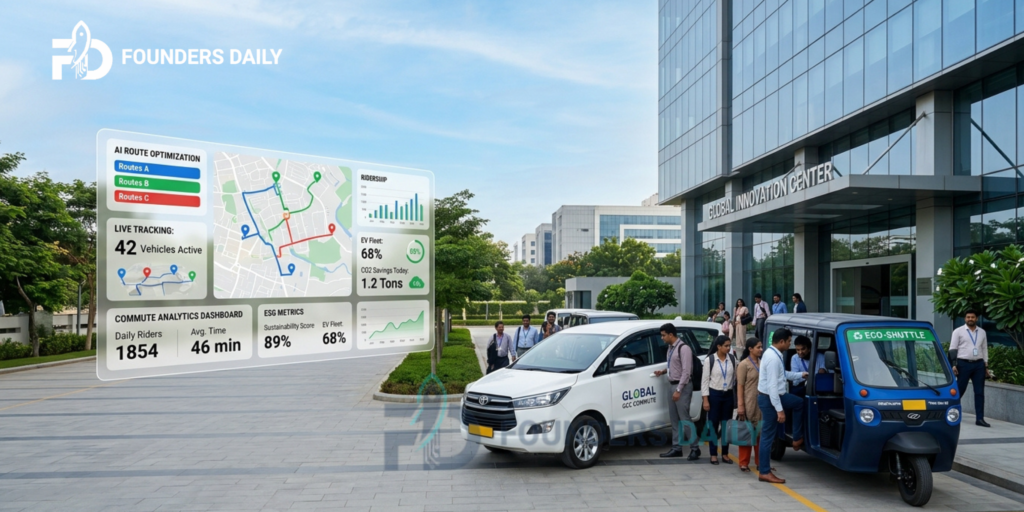
Mumbai: Routematic, in partnership with Research NXT, on Monday released a research report highlighting significant gaps in corporate commute systems across Global Capability Centres (GCCs) in India, even as employee experience, safety, and ESG priorities gain momentum.
Titled “Navigating Corporate Commute for GCCs in India: Benchmarking Corporate Commute Maturity,” the report examines how GCCs are managing employee transportation amid rapid expansion and evolving workplace expectations.
Also Read: AI Will Not Replace You. But Someone Using AI Will.
The study, based on a survey of 100 professionals and in-depth interviews with senior leaders across transport, facilities, procurement, and workplace operations, indicates that 60% of GCCs continue to operate without a fully integrated transport management system, relying on fragmented or manual processes.
The findings point to a widening maturity gap in corporate commute management within India’s GCC ecosystem.
According to the report, employee experience has emerged as the top priority (35%) in commute programs, surpassing safety (26%), compliance (21%), and cost optimisation (18%). Company-provided cabs remain the dominant mode of transportation, accounting for 46% of employee commute.
The report also notes that hybrid work models have increased operational complexity, with 36% of organisations reporting fluctuating daily commute demand. At the same time, predictive capabilities remain largely absent, leaving most systems reactive rather than data-driven.
Vendor performance issues, budget constraints, and employee dissatisfaction were identified as the key challenges in managing large-scale employee mobility.
“Global Capability Centres in India are rapidly evolving from support hubs into strategic engines of innovation and transformation,” said Sriram Kannan, Founder and CEO of Routematic. “Employee commute has moved from a background function to a boardroom priority. Organisations that adopt intelligent, transparent, and people-centric mobility systems will gain a clear competitive advantage.”
The report outlines a maturity framework for corporate commute programs, ranging from manual coordination to predictive, AI-driven mobility management. It highlights the need for unified platforms for governance and reporting, predictive compliance systems, AI-driven route optimisation, and integration of electric vehicles for emissions tracking and ESG alignment.
“Predictability removes one of the biggest variables in daily operations. When employees arrive on time and without stress, productivity starts earlier,” said Protick Basu, Vice President, Workspace, ANSR.
Garvita Sandhu, Director, Administration at PayU, said that in an ideal scenario, organisations would deploy intelligent systems capable of verifying drivers and vehicles through direct integration with government databases.
Also Read: Minimal Skincare Trend Gains Momentum as Magical Blends Introduces 60-Second Summer Routine
The report covers major GCC hubs including Bengaluru, Hyderabad, Pune, Chennai, Mumbai, and Delhi-NCR, offering benchmarks on commute efficiency, scale, and sustainability readiness.