
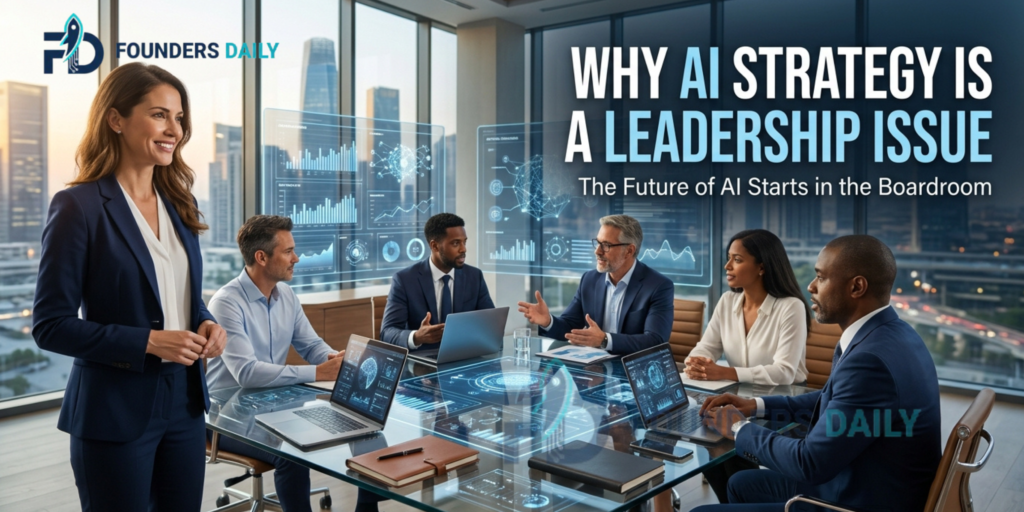
The Companies Winning With AI Are Treating It as a Business Decision, Not a Technology Project
Artificial intelligence has quickly moved beyond the walls of technology departments. What was once considered a specialized tool for engineers and data scientists is now influencing how organizations make decisions, serve customers, allocate resources, and compete in rapidly changing markets. Yet despite its growing importance, many organizations continue to view AI primarily as a technology initiative rather than a leadership responsibility.
That mindset may be one of the biggest obstacles to successful AI adoption.
Across industries, executives are investing billions in artificial intelligence solutions. Companies are experimenting with generative AI, predictive analytics, automation platforms, and intelligent customer experiences. However, while technology adoption continues to accelerate, many organizations struggle to achieve meaningful business outcomes. The challenge is rarely about the technology itself. More often, it stems from a lack of strategic alignment, leadership ownership, and organizational readiness.
The reality is simple. Artificial intelligence is no longer just a technology conversation. It has become a leadership conversation. The organizations generating the greatest value from AI are not necessarily those with the most advanced algorithms. They are the ones whose leaders understand how AI supports business objectives, organizational transformation, and long-term competitive advantage.
Also Read: The New Economics of Startup Hiring
The Shift From Technology Tool to Business Strategy
Every major business transformation eventually becomes a leadership challenge.
The internet was once viewed as an IT initiative. Digital transformation was initially treated as a technology project. Cloud computing was first discussed primarily among technical teams. Over time, each of these developments evolved into strategic business priorities requiring executive leadership and organizational alignment.
Artificial intelligence is following a similar path, but at a much faster pace.
Unlike previous technology shifts, AI has the potential to influence virtually every function within an organization. Marketing teams use AI to personalize customer experiences. Human resources departments use it to improve recruitment processes. Finance teams apply it to forecasting and risk management. Operations teams leverage it to optimize productivity and efficiency.
Because AI impacts so many aspects of business performance, leadership involvement becomes essential. Decisions about AI are no longer limited to software implementation. They involve culture, ethics, governance, workforce planning, customer trust, and strategic priorities.
In other words, AI strategy is ultimately business strategy.
Why Delegating AI Entirely to Technology Teams Is Risky
Many organizations make a common mistake when approaching artificial intelligence. They assume responsibility belongs entirely to technical experts.
Technology teams undoubtedly play a critical role in implementation. They evaluate platforms, manage infrastructure, and ensure systems function effectively. However, technical expertise alone cannot determine how AI should support business goals.
Consider a company implementing AI-powered customer service tools. The technology team can deploy the platform successfully, but leadership must answer broader questions. How should customer experience change? What level of automation is appropriate? How will employees adapt to new workflows? How should success be measured?
Without executive guidance, AI projects often become disconnected from business outcomes.
This disconnect explains why some organizations invest heavily in AI initiatives without achieving meaningful returns. The technology works, but the strategy is unclear.
Strong leadership ensures that AI investments remain aligned with organizational objectives rather than becoming isolated technology experiments.
AI Is Reshaping Competitive Advantage
The competitive landscape is changing rapidly.
Historically, businesses built advantages through capital, talent, distribution networks, or operational scale. While these factors remain important, artificial intelligence is creating new opportunities for organizations to compete differently.
A smaller company equipped with effective AI systems can often operate with the efficiency of a much larger competitor. Startups can analyze customer behavior more effectively. Retailers can improve inventory management. Manufacturers can predict maintenance issues before disruptions occur.
These capabilities are not merely operational improvements. They directly influence market position and business performance.
As a result, leaders must think beyond technology implementation and consider how AI supports competitive strategy. Organizations that fail to integrate AI into strategic decision-making risk losing relevance in increasingly intelligent markets.
The question is no longer whether AI matters. The question is how leadership will use AI to create sustainable business value.
The Human Side of Artificial Intelligence
One of the biggest misconceptions surrounding artificial intelligence is that it is primarily about machines.
In reality, successful AI adoption depends heavily on people.
Employees often worry about automation, job security, and changing workplace expectations. Customers may have concerns about privacy, transparency, and trust. Stakeholders frequently seek clarity regarding ethical considerations and governance frameworks.
These concerns cannot be addressed through technology alone.
Leadership plays a crucial role in building confidence and creating a culture that embraces innovation responsibly. Employees need to understand how AI will support their work rather than simply replace existing processes. Teams require training, communication, and opportunities to develop new skills.
Organizations that focus exclusively on technology while ignoring human factors often encounter resistance and slow adoption.
The most successful leaders recognize that artificial intelligence is as much about organizational change as it is about technological advancement.
Why AI Governance Starts at the Top
As artificial intelligence becomes more powerful, governance becomes increasingly important.
Issues related to bias, transparency, security, and accountability have moved into mainstream business discussions. Regulators, customers, investors, and employees all expect organizations to use AI responsibly.
This creates a leadership responsibility that extends far beyond technology management.
Executives must establish clear policies regarding data usage, ethical standards, decision-making frameworks, and risk management practices. They must determine where AI can be trusted to operate autonomously and where human oversight remains essential.
Strong governance helps organizations avoid reputational damage while building long-term trust.
More importantly, governance enables sustainable innovation. Companies that establish responsible AI frameworks can scale adoption more confidently because they have clear guidelines for decision-making.
This is one reason why AI strategy belongs in boardrooms rather than solely within technology departments.
AI and the Future of Leadership
Leadership itself is evolving.
For decades, leaders relied on experience, intuition, and historical data to guide decision-making. While these qualities remain valuable, artificial intelligence introduces new possibilities for insight and analysis.
Modern executives now have access to real-time data, predictive forecasting, and intelligent decision-support systems. These tools can improve strategic planning, operational efficiency, and market responsiveness.
However, technology does not replace leadership judgment.
AI can identify patterns, generate recommendations, and analyze scenarios. It cannot fully understand organizational culture, human relationships, customer emotions, or societal implications. Those responsibilities remain firmly within the domain of leadership.
The most effective leaders will combine technological intelligence with human intelligence. They will use AI to enhance decision-making rather than delegate responsibility.
This balance may become one of the defining leadership capabilities of the coming decade.
Building an AI-Ready Organization
Organizations often focus heavily on AI tools while overlooking organizational readiness.
Technology alone cannot create transformation. Success requires alignment across leadership teams, departments, and employees.
Leaders must establish a clear vision for how artificial intelligence supports business objectives. They must identify measurable outcomes, prioritize high-impact use cases, and communicate expectations consistently throughout the organization.
Equally important is workforce development. Employees need opportunities to learn new skills and adapt to changing workflows. Investing in people remains just as important as investing in technology.
Organizations that approach AI strategically often see stronger adoption rates, better employee engagement, and more sustainable business outcomes.
In contrast, organizations that pursue AI without leadership alignment frequently struggle to realize its full potential.
What Founders and Executives Should Do Next
The rise of artificial intelligence presents both opportunities and challenges. While technology capabilities continue to advance rapidly, long-term success depends on leadership effectiveness.
Founders and executives should begin by reframing their perspective on AI. Instead of asking what technology to implement, they should ask what business problems need solving. Instead of focusing solely on automation, they should focus on value creation.
Leadership teams should also develop clear governance frameworks, invest in workforce readiness, and establish measurable success metrics. Most importantly, they should treat AI as a strategic capability rather than a standalone project.
The organizations that gain the greatest advantage from artificial intelligence will be those whose leaders actively shape its direction.
Also Read: Startup Funding Will Become More Selective
Conclusion
Artificial intelligence is transforming industries, redefining competition, and reshaping the future of work. Yet the most important decisions surrounding AI are not technical decisions. They are leadership decisions.
Technology teams can build systems, deploy platforms, and manage infrastructure. Leadership teams determine how those capabilities create value, support strategy, and strengthen organizational performance.
The companies leading the AI era are not simply adopting new technologies. They are developing new leadership capabilities.
As artificial intelligence becomes increasingly embedded in business operations, one reality is becoming clear. AI strategy is no longer a technology issue. It is a leadership issue, and the organizations that recognize this distinction will be best positioned to thrive in the years ahead.