
Introduction
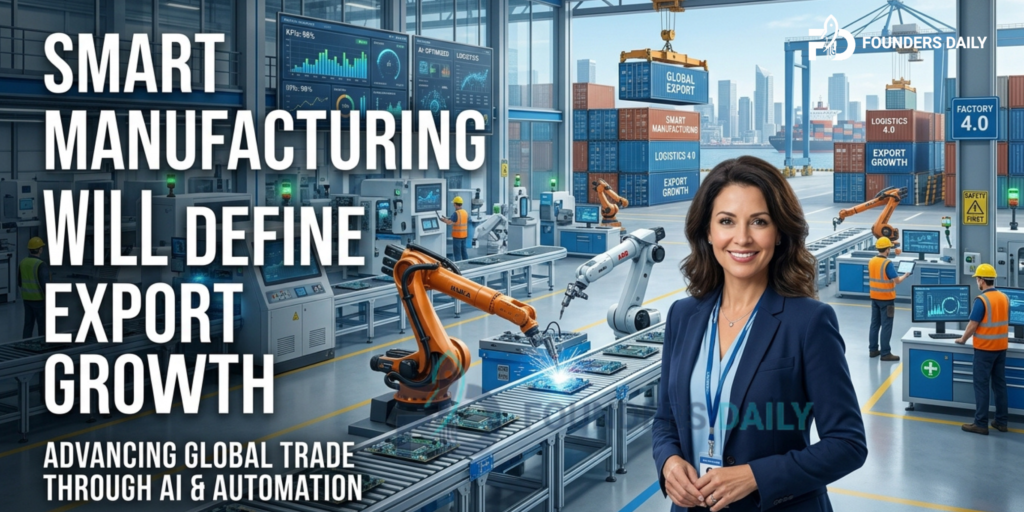
Global trade is entering a new era. For decades, countries competed on labor costs, production capacity, and access to raw materials. Today, those factors still matter, but they are no longer enough to drive sustainable export growth. The countries and companies that will lead the next wave of international trade are those investing in smart manufacturing.
From artificial intelligence and industrial automation to connected factories and real-time supply chain intelligence, smart manufacturing is transforming how products are designed, produced, and delivered across global markets. Businesses are no longer competing solely on price. They are competing on speed, quality, customization, compliance, and operational efficiency.
This shift is particularly important for emerging manufacturing economies such as India, Vietnam, Indonesia, and Mexico. As global supply chains evolve and buyers demand greater transparency, smart manufacturing is becoming a critical driver of export competitiveness.
In this article, we explore why smart manufacturing will define export growth, how manufacturers can benefit from digital transformation, and what business leaders must do today to remain competitive in the global marketplace.
Also Read: Manufacturing Talent Shortage Is the Next Big Risk in 2026
What Is Smart Manufacturing?
Smart manufacturing refers to the use of advanced digital technologies to improve production processes, increase efficiency, reduce waste, and enhance decision making across manufacturing operations.
Unlike traditional factories that rely heavily on manual oversight and reactive management, smart manufacturing environments use real-time data, connected machines, automation systems, and intelligent software to optimize production continuously.
Modern manufacturing facilities increasingly deploy technologies such as artificial intelligence, machine learning, industrial Internet of Things devices, robotics, predictive maintenance systems, and digital twins. Together, these technologies create highly connected production ecosystems capable of adapting quickly to changing market conditions.
The goal is not simply automation. The goal is creating intelligent manufacturing systems that can respond to demand fluctuations, identify inefficiencies, predict equipment failures, and maintain consistent product quality at scale.
For export-oriented businesses, these capabilities provide a significant competitive advantage.
Why Export Growth Depends on Manufacturing Competitiveness
International buyers have become more demanding than ever before. They expect suppliers to deliver high-quality products, maintain regulatory compliance, ensure traceability, and meet strict delivery timelines.
Traditional manufacturing systems often struggle to meet these expectations consistently. Delays, quality issues, equipment downtime, and inefficient processes can quickly impact export performance and customer relationships.
Smart manufacturing helps solve these challenges by creating greater visibility across production operations. Manufacturers can monitor performance in real time, identify bottlenecks early, and improve decision making through data-driven insights.
As global competition intensifies, manufacturing competitiveness is increasingly linked to technology adoption. Countries that modernize their manufacturing infrastructure are better positioned to capture export opportunities in high-value sectors such as electronics, automotive components, medical devices, aerospace, and advanced engineering products.
Export growth is no longer determined only by production volume. It is increasingly determined by production intelligence.
How Smart Manufacturing Improves Export Performance
Higher Product Quality and Consistency
Quality remains one of the most important factors in global trade. International buyers expect consistent standards regardless of production volume.
Smart manufacturing systems use sensors, machine vision, and automated inspection technologies to monitor quality throughout the production process. Instead of identifying defects after production is completed, manufacturers can detect and correct issues immediately.
This proactive approach significantly reduces rejection rates, minimizes waste, and improves customer satisfaction. For exporters, maintaining consistent quality strengthens reputation and increases the likelihood of long-term contracts.
A manufacturer supplying components to global automotive companies, for example, cannot afford variations in quality. Smart manufacturing helps ensure every product meets exact specifications, regardless of production scale.
Faster Production Cycles
Speed has become a critical competitive advantage in international trade.
Global buyers increasingly prefer suppliers that can respond quickly to changing demand conditions. Smart manufacturing enables faster production planning, automated workflows, and real-time resource allocation.
When production systems are connected and data-driven, manufacturers can reduce delays, optimize machine utilization, and improve throughput without compromising quality.
Faster production cycles allow exporters to fulfill orders more efficiently and respond quickly to market opportunities. This agility becomes particularly valuable during periods of supply chain disruption or unexpected demand growth.
Improved Cost Efficiency
Cost competitiveness remains essential for export success.
Smart manufacturing helps reduce operational costs through automation, predictive maintenance, energy optimization, and better resource management.
For example, predictive maintenance systems can identify potential equipment failures before they occur. This reduces unplanned downtime and prevents costly production interruptions.
Similarly, energy monitoring systems help manufacturers optimize power consumption, which can significantly lower operating expenses in energy-intensive industries.
Lower production costs improve profit margins while enabling exporters to remain competitive in price-sensitive international markets.
The Role of Artificial Intelligence in Export Growth
Artificial intelligence is becoming one of the most influential technologies in modern manufacturing.
AI systems analyze large volumes of production data to identify patterns, predict outcomes, and recommend operational improvements. These insights enable manufacturers to make smarter decisions and improve performance across multiple areas.
AI can forecast demand more accurately, optimize inventory levels, enhance quality control processes, and support predictive maintenance initiatives.
Consider a manufacturing company exporting industrial equipment to multiple countries. Demand patterns may vary across regions and seasons. AI-powered forecasting models help the company anticipate demand fluctuations and adjust production schedules accordingly.
The result is improved inventory management, reduced waste, and greater responsiveness to customer needs.
As global markets become more complex, AI-driven manufacturing capabilities will play an increasingly important role in supporting export growth.
Industry 4.0 and the Future of Global Trade
Industry 4.0 represents the next stage of industrial development, characterized by digital connectivity, automation, and intelligent decision making.
The concept integrates technologies such as artificial intelligence, robotics, cloud computing, advanced analytics, and industrial Internet of Things systems.
For exporters, Industry 4.0 offers a pathway toward greater productivity and resilience.
Connected factories can monitor operations across multiple facilities, coordinate production activities in real time, and maintain visibility throughout the supply chain. This level of integration helps manufacturers respond quickly to disruptions and changing customer requirements.
Industry 4.0 also supports greater customization. Manufacturers can produce highly specialized products without sacrificing efficiency, allowing them to serve niche international markets more effectively.
As global trade evolves, Industry 4.0 capabilities will become increasingly important for maintaining export competitiveness.
Why India Has a Major Opportunity in Smart Manufacturing
India is uniquely positioned to benefit from the global shift toward smart manufacturing.
The country already possesses a strong industrial base, a large workforce, growing digital infrastructure, and increasing government support for manufacturing development.
Initiatives focused on manufacturing expansion, technology adoption, and export promotion have created a favorable environment for industrial growth. At the same time, global companies are actively diversifying supply chains and seeking alternative manufacturing destinations.
This creates a significant opportunity for Indian manufacturers.
By investing in smart manufacturing technologies, Indian businesses can improve productivity, enhance quality standards, and strengthen their position in global markets.
The opportunity extends beyond large corporations. Small and medium-sized enterprises can also benefit from digital transformation through cloud-based manufacturing solutions, affordable automation technologies, and data-driven operational improvements.
The companies that embrace modernization today are likely to become tomorrow’s export leaders.
Smart Supply Chains Are Becoming Essential
Manufacturing and supply chains are no longer separate functions. They are increasingly interconnected.
Export success depends not only on producing goods efficiently but also on delivering them reliably across complex global networks.
Smart supply chains use real-time data, predictive analytics, and digital visibility tools to improve coordination between suppliers, manufacturers, logistics providers, and customers.
This visibility helps businesses identify risks early, optimize inventory levels, and improve delivery performance.
For exporters, supply chain resilience has become a strategic priority. Global disruptions over recent years have highlighted the importance of flexibility and transparency across international supply networks.
Companies that combine smart manufacturing with smart supply chain management are better positioned to meet customer expectations and maintain business continuity.
Sustainability Is Strengthening Export Competitiveness
Environmental sustainability is becoming a major factor in international trade decisions.
Many global buyers now evaluate suppliers based on environmental performance, carbon emissions, energy efficiency, and sustainability practices.
Smart manufacturing supports sustainability by reducing waste, optimizing energy consumption, and improving resource utilization.
Connected systems provide detailed insights into environmental performance, enabling manufacturers to identify opportunities for improvement and demonstrate compliance with sustainability requirements.
This capability is increasingly important as international regulations and customer expectations continue to evolve.
Manufacturers that invest in sustainable production practices often gain access to new markets, strengthen customer relationships, and improve brand reputation.
In many industries, sustainability has shifted from a competitive advantage to a business necessity.
Challenges in Adopting Smart Manufacturing
Despite its benefits, implementing smart manufacturing is not without challenges.
Many organizations face concerns related to investment costs, workforce training, technology integration, and cybersecurity risks.
Legacy systems can make digital transformation more complex, particularly for established manufacturers with older infrastructure. Additionally, successful implementation requires strong leadership commitment and a clear strategic vision.
Workforce development is another important consideration. Employees must develop new skills to work effectively with advanced technologies and data-driven systems.
However, these challenges should not discourage adoption. The long-term benefits often outweigh the initial investment, especially for businesses focused on export growth and global competitiveness.
Organizations that approach transformation strategically can achieve significant improvements in productivity, quality, and profitability.
What Business Leaders Should Do Next
The transition toward smart manufacturing does not happen overnight. It requires a phased approach that aligns technology investments with business objectives.
Leaders should begin by evaluating current manufacturing capabilities and identifying areas where digital technologies can deliver measurable value. Pilot projects often provide an effective starting point, allowing companies to test solutions before scaling implementation.
Investing in workforce development is equally important. Technology alone cannot drive transformation. Success depends on people who can leverage new tools effectively.
Collaboration with technology providers, research institutions, and industry partners can also accelerate adoption and reduce implementation risks.
Most importantly, business leaders should view smart manufacturing as a long-term strategic investment rather than a short-term operational expense.
The companies making these investments today are positioning themselves for stronger export growth tomorrow.
Also Read: The Economics of Profitable SaaS Businesses
Conclusion
The future of global trade will be shaped by manufacturers that combine operational excellence with digital intelligence. Smart manufacturing is no longer a futuristic concept. It is becoming the foundation of export competitiveness across industries and markets.
Companies that embrace automation, artificial intelligence, connected systems, and data-driven decision making can improve quality, reduce costs, strengthen supply chain resilience, and respond more effectively to customer demands. These advantages translate directly into stronger export performance.
For countries seeking sustainable economic growth and businesses pursuing international expansion, the message is clear. Smart manufacturing will define export growth in the coming decade. The organizations that act now will be best positioned to lead the next chapter of global commerce.