
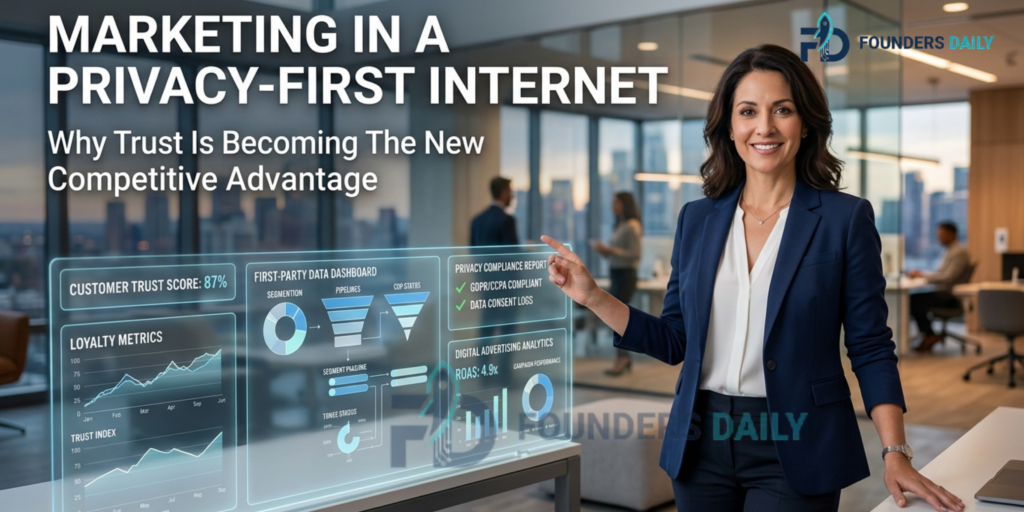
The End of an Era in Digital Marketing
For most of the internet’s history, marketing was built on a simple premise. The more businesses knew about consumers, the more effectively they could sell to them.
Every click, search, website visit, and online interaction became a valuable signal. Marketers invested billions of dollars into technologies designed to understand consumer behavior with increasing precision. Sophisticated advertising platforms emerged, powered by tracking mechanisms that followed users across websites, devices, and applications. The result was an advertising ecosystem capable of delivering highly personalized experiences at an unprecedented scale.
For years, this approach seemed unstoppable.
Yet something changed.
Consumers became more aware of how their data was being collected and used. High-profile data breaches exposed vulnerabilities that many people had previously ignored. Governments introduced stricter regulations aimed at protecting personal information. Technology companies responded by limiting tracking capabilities and providing users with greater control over their privacy.
Gradually, the rules of digital marketing began to shift.
Today, businesses are entering a new reality. It is a world where privacy is no longer a secondary concern discussed only by regulators and technology experts. It has become a mainstream expectation. Customers increasingly want transparency, control, and accountability from the brands they engage with.
This transformation is creating one of the most significant changes in marketing since the rise of social media.
The organizations that recognize this shift early are discovering something unexpected. Privacy is not simply a compliance issue. It is becoming a competitive advantage.
Also Read: Decision-Making Frameworks for Modern Leaders
Why the Traditional Marketing Playbook Is Losing Effectiveness
For years, marketers relied heavily on third-party data to fuel customer acquisition and advertising performance. Third-party cookies enabled brands to track behavior across multiple websites, build audience profiles, and serve highly targeted advertisements.
The system generated remarkable results.
Companies could identify potential customers, predict interests, and optimize campaigns with incredible accuracy. Marketing teams became increasingly dependent on data-driven targeting strategies because the economics made sense. Better targeting often meant better returns.
However, dependence created vulnerability.
As browsers began restricting third-party cookies and mobile operating systems introduced stronger privacy controls, many businesses discovered how reliant they had become on data they did not directly own. Attribution models became less accurate. Audience targeting became more difficult. Customer journeys became harder to track.
For some organizations, the impact was immediate.
Marketing teams that once enjoyed near-perfect visibility suddenly found themselves operating with blind spots. Performance metrics became more challenging to interpret. Customer acquisition costs increased. Traditional optimization methods delivered diminishing returns.
What appeared to be a technological adjustment was actually a strategic disruption.
The organizations struggling the most were often those that had built their growth models around surveillance rather than relationships.
The Rise of the Trust Economy
Every major shift in business creates new winners and losers.
The privacy-first internet is no different.
While some organizations view privacy regulations and tracking limitations as obstacles, others see an opportunity to strengthen customer relationships. These businesses understand a fundamental truth about modern consumers.
People are increasingly willing to share information when they trust the organization requesting it.
Trust has always been important in business. What is changing is its role in marketing.
In the past, trust was often considered a brand-building objective. Today, it is becoming a data strategy.
Consumers are more likely to subscribe to newsletters, join loyalty programs, participate in communities, and share preferences when they believe a company will use that information responsibly. The value exchange becomes transparent. Customers understand what they receive in return for their data.
This shift changes the nature of marketing itself.
Instead of collecting information without meaningful interaction, businesses are being encouraged to earn access through relevance, credibility, and customer value.
The brands that succeed in this environment are not necessarily the ones with the largest advertising budgets. They are the organizations that consistently demonstrate trustworthiness.
Why First-Party Data Is Becoming a Strategic Asset
As privacy expectations rise, first-party data has emerged as one of the most valuable assets in modern marketing.
Unlike third-party data, first-party data comes directly from customer interactions. It includes website activity, email engagement, purchase history, customer feedback, subscriptions, and other information voluntarily shared through direct relationships.
The importance of this data extends far beyond compliance.
First-party data provides businesses with a more sustainable foundation for growth. Because the relationship exists directly between the company and the customer, organizations maintain greater control over how information is collected, analyzed, and activated.
More importantly, first-party data is often more accurate.
When customers willingly share information, businesses gain insights rooted in genuine engagement rather than inferred behavior. This improves personalization while reducing dependence on external platforms.
Many of today’s most successful digital businesses have already embraced this approach.
Subscription platforms, community-driven brands, software companies, and direct-to-consumer businesses increasingly focus on building owned audiences. Email newsletters, memberships, exclusive content, and loyalty programs are becoming strategic priorities because they create direct relationships that cannot be disrupted by changes in platform policies.
The lesson is clear.
In a privacy-first internet, owning customer relationships may be more valuable than renting audience access.
Artificial Intelligence Is Changing the Conversation
At the same time that privacy concerns are reshaping marketing, artificial intelligence is introducing a new layer of complexity.
AI systems can process enormous volumes of information, identify patterns, automate personalization, and improve decision-making at scale. These capabilities create exciting opportunities for marketers seeking greater efficiency and relevance.
However, they also raise important questions.
How should customer data be used to train AI systems?
What level of transparency should businesses provide when algorithms influence customer experiences?
How can organizations balance personalization with privacy?
These questions are becoming increasingly important because consumers are paying closer attention.
The future of marketing will not be determined solely by technological capability. It will depend on whether businesses can use technology responsibly while maintaining customer trust.
Organizations that treat AI as a tool for enhancing customer value rather than maximizing data extraction will likely gain a long-term advantage.
The challenge is not whether AI should be used.
The challenge is whether it can be used in ways that strengthen rather than weaken trust.
Marketing Leaders Must Become Trust Architects
The most successful marketing leaders of the next decade may look very different from those of the past.
Historically, marketers were evaluated based on reach, impressions, clicks, and conversion rates. Those metrics remain important, but they are no longer sufficient.
Today’s leaders must also think about transparency, ethics, data stewardship, and customer confidence.
In many ways, the role of marketing is expanding.
Modern marketers are becoming architects of trust. They are responsible not only for driving growth but also for shaping how customers perceive the relationship between value and privacy.
This responsibility requires a different mindset.
The question is no longer how much customer data can be collected.
The question is how much trust can be earned.
Organizations that answer that question successfully will build stronger brands, deeper customer relationships, and more sustainable competitive advantages.
Also Read: Why Profitable Startups Stay Invisible
Conclusion
The transition to a privacy-first internet represents far more than a regulatory adjustment or a technological challenge. It marks a fundamental shift in the relationship between businesses and consumers.
For years, digital marketing was powered by visibility. Success depended on collecting more information, tracking more behavior, and optimizing more interactions.
The future will be different.
The organizations that thrive will be those that prioritize trust alongside technology. They will invest in direct customer relationships, develop stronger first-party data strategies, and approach artificial intelligence with responsibility and transparency.
Privacy is not the end of effective marketing.
It is the beginning of a more sustainable model.
In the years ahead, the brands that earn trust will ultimately earn growth. And in a privacy-first internet, that may become the most valuable competitive advantage of all.