Why Smart Talent Strategies Are Replacing Headcount Growth
For much of the startup boom over the past decade, hiring was often viewed as a direct measure of success. A growing team signaled momentum, investor confidence, and market expansion. Founders proudly announced hiring plans, recruitment targets, and workforce growth as indicators of business health. In many cases, scaling quickly meant hiring aggressively.
That equation is changing.
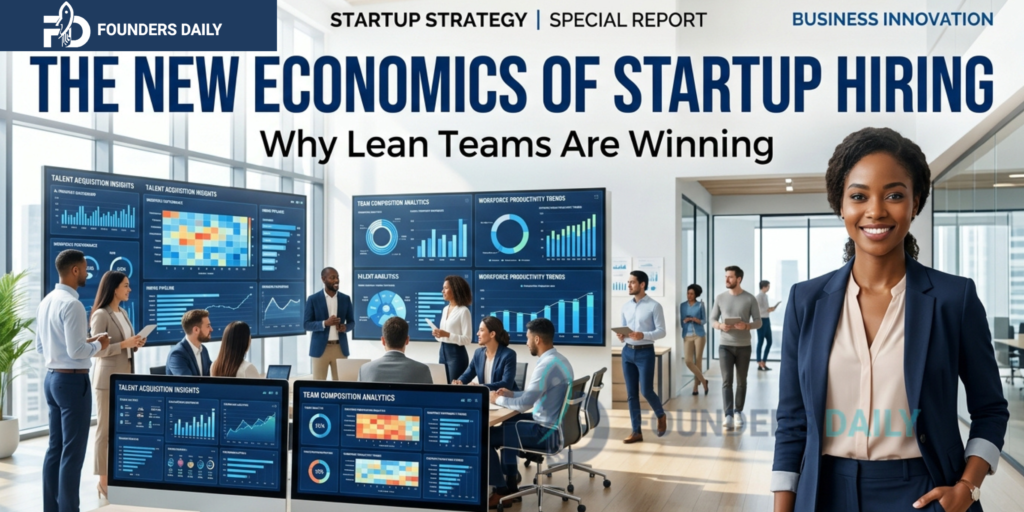
Today, startup leaders are operating in a very different environment. Capital is more selective, investors are emphasizing profitability, and advances in artificial intelligence are transforming how work gets done. As a result, the economics of startup hiring are being rewritten. The conversation is shifting from how many people a company employs to how effectively a team creates value.
The startups that succeed in the coming decade may not be the ones with the largest teams. Instead, they are likely to be the organizations that build lean, highly productive workforces supported by technology, automation, and specialized talent.
Also Read: Leadership Without Authority: Influencing at Scale in Modern Organizations
Why Traditional Startup Hiring Models Are Losing Relevance
For years, venture-backed companies prioritized speed above almost everything else. When funding was abundant, startups focused on capturing market share quickly. Expanding sales teams, growing marketing departments, and increasing operational capacity were common growth strategies.
However, this approach often created hidden inefficiencies. Larger teams increased management complexity, communication challenges, and operating costs. Many companies discovered that adding more employees did not always translate into higher productivity.
Recent economic shifts have forced founders to reassess these assumptions. Investors increasingly expect sustainable growth rather than growth at any cost. Businesses are under pressure to improve capital efficiency while maintaining competitive performance.
This has created a new mindset around hiring. Instead of asking how many people are needed to scale, founders are asking how work can be accomplished more efficiently.
The Rise of Productivity Per Employee
One of the most important metrics gaining attention in startup ecosystems is productivity per employee.
Rather than focusing solely on workforce size, companies are evaluating how much value each team member contributes to the organization. This approach encourages leaders to invest in systems, tools, and processes that maximize output without necessarily increasing headcount.
Technology plays a major role in this shift. Cloud platforms, automation software, AI-powered tools, and collaborative work environments enable smaller teams to accomplish tasks that previously required much larger departments.
A marketing professional equipped with advanced AI tools can now perform research, content development, campaign optimization, and audience analysis at a scale that was difficult to imagine just a few years ago. Similarly, software engineers can leverage AI-assisted coding tools to accelerate development cycles and improve productivity.
The result is a fundamental change in workforce economics.
How Artificial Intelligence Is Reshaping Hiring Decisions
Artificial intelligence is not replacing people as often as headlines suggest. Instead, it is changing the type of talent companies need.
Many repetitive and administrative tasks can now be automated. This allows employees to focus on strategic, creative, and high-value activities. Consequently, startups are becoming more selective about hiring decisions.
Rather than building large operational teams, businesses are seeking individuals who can combine domain expertise with technological proficiency. Adaptability, problem-solving ability, and digital fluency are becoming increasingly valuable skills.
The emergence of AI-powered workflows also means companies can achieve more with fewer resources. Tasks that once required multiple employees may now be managed by a smaller team supported by intelligent software.
For founders, this creates an opportunity to build agile organizations capable of scaling efficiently without significantly increasing fixed costs.
The Growing Importance of Specialized Talent
Another defining characteristic of the new economics of startup hiring is the growing demand for specialized expertise.
Modern startups often operate in highly competitive and technically complex markets. Whether the focus is artificial intelligence, fintech, health technology, climate innovation, or enterprise software, companies increasingly require professionals with deep knowledge and specialized capabilities.
As a result, hiring strategies are becoming more targeted. Instead of recruiting generalists across multiple functions, organizations are investing in experts who can drive measurable business outcomes.
This trend reflects a broader shift toward quality over quantity. A single highly skilled professional can often create more value than several less specialized employees.
For startups operating with limited resources, making the right hiring decisions has become more important than ever.
Flexible Workforce Models Are Becoming Mainstream
The traditional concept of a permanent full-time workforce is also evolving.
Many startups now combine full-time employees with freelancers, consultants, contractors, and project-based specialists. This hybrid workforce model provides greater flexibility while allowing companies to access expertise on demand.
For example, an early-stage startup may not require a full-time chief financial officer, legal advisor, or growth strategist. Instead, these functions can be supported through fractional leadership arrangements.
This approach reduces fixed expenses while ensuring access to experienced professionals.
Remote work has accelerated this trend by expanding access to global talent pools. Companies are no longer limited to hiring within a specific geographic region. They can recruit skilled professionals from around the world, creating opportunities to build diverse and cost-effective teams.
Why Founders Are Prioritizing Talent Density
The concept of talent density has become increasingly influential among startup leaders.
Talent density refers to the concentration of high-performing individuals within an organization. Companies with strong talent density often achieve superior results despite maintaining relatively small team sizes.
High-performing employees tend to elevate overall organizational performance. They contribute innovative ideas, execute efficiently, and help establish strong workplace cultures.
Many successful startups are focusing on building smaller teams composed of exceptional talent rather than larger teams with mixed performance levels.
This strategy not only improves productivity but also simplifies communication, decision-making, and operational management.
In a competitive business environment, talent density can become a significant competitive advantage.
What This Means for Startup Employees
The new economics of startup hiring creates both opportunities and challenges for professionals.
On one hand, individuals with strong technical skills, business expertise, and adaptability are likely to remain highly valuable. Companies are willing to invest in talent capable of delivering meaningful business impact.
On the other hand, employees can no longer rely solely on traditional job descriptions. Continuous learning is becoming essential.
As technology evolves, professionals must develop skills that complement automation rather than compete with it. Strategic thinking, creativity, emotional intelligence, leadership, and complex problem-solving remain difficult to automate and increasingly important in modern workplaces.
The future workforce will likely be defined by individuals who can combine human capabilities with technological tools effectively.
The Founder Perspective
For founders, hiring decisions have always carried significant consequences. Every new employee represents an investment of capital, time, and organizational resources.
In today’s environment, those decisions require even greater discipline.
Successful leaders are focusing on workforce design rather than workforce expansion. They are evaluating which roles create the greatest strategic value and how technology can enhance organizational productivity.
The objective is no longer simply building larger companies. The objective is building stronger companies.
Organizations that achieve this balance are often better positioned to navigate economic uncertainty, respond to market changes, and maintain sustainable growth.
Also Read: Why Innovation Cycles Are Getting Shorter and What Founders Must Do to Stay Ahead
Conclusion
The economics of startup hiring are undergoing a profound transformation. The era when headcount growth automatically signaled success is fading. In its place, a new model is emerging, one that prioritizes productivity, specialization, adaptability, and technological enablement.
Artificial intelligence, remote work, flexible workforce structures, and investor expectations are reshaping how startups think about talent acquisition and organizational design.
For founders, the challenge is clear. Building a successful company no longer depends on hiring the most people. It depends on hiring the right people, empowering them with the right tools, and creating systems that maximize their impact.
The startups that understand this shift today will be better prepared to compete, innovate, and grow in the years ahead.