
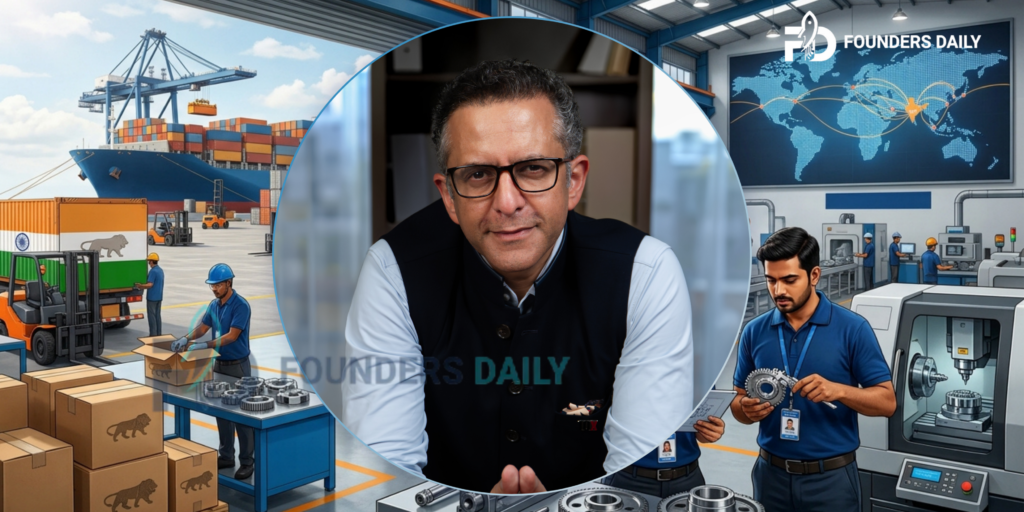
By Gaurav Bhagat, Founder, Gaurav Bhagat Academy
For decades, India’s export growth has largely been associated with some of the country’s biggest business groups. Large automobile manufacturers, engineering companies, and industrial conglomerates have played a defining role in taking Indian products to international markets. However, evolving global supply chains are changing the dynamics of international trade, creating opportunities for a different set of exporters.
Increasingly, India’s Micro, Small, and Medium Enterprises (MSMEs) are emerging as important contributors to the country’s export ecosystem. Their ability to respond quickly to changing market demands, produce specialised goods, and serve niche global markets positions them differently from large-scale manufacturers.
Also Read: The 2026 Founder Burnout Wave
The Numbers Behind India’s Changing Export Landscape
The shift is supported by economic data rather than speculation. According to figures presented in the Union Budget and other economic reports, MSMEs contribute 31.1% to India’s GDP, account for 35.4% of the country’s manufacturing output, and provide employment to 32.82 crore people.
Their contribution to exports has also grown significantly over recent years. MSME exports have increased from ₹3.95 lakh crore to ₹12.39 lakh crore, while the sector now contributes approximately 45.7%–48.5% of India’s total merchandise exports.
These figures highlight the expanding role of MSMEs within India’s export economy.
Unlike large corporations that often rely on extensive production cycles and complex organisational structures, MSMEs typically operate with greater flexibility. Their smaller scale allows them to respond more quickly to changing customer requirements and market conditions.
Why Scale Alone Is No Longer the Competitive Advantage
Global trade has evolved beyond an environment where scale is the only competitive differentiator. While large manufacturers continue to benefit from production capacity and established supply chains, today’s international buyers increasingly value flexibility, diversification, and faster execution.
Customised Production for Global Buyers
International buyers are placing greater emphasis on flexible sourcing arrangements rather than standardised mass production.
Whether manufacturing precision-engineered tools, advanced electronic components, or customised green packaging, MSMEs often have the ability to modify production lines within days. In contrast, larger organisations may require longer approval processes and compliance cycles before implementing similar changes.
The Impact of the China+1 Strategy
Global companies continue to diversify their sourcing strategies to reduce supply-chain risk.
Instead of depending entirely on a single manufacturing destination, buyers are increasingly exploring regional manufacturing clusters. In India, engineering hubs such as Coimbatore and textile centres such as Ludhiana illustrate how specialised MSME ecosystems can support diversified sourcing requirements.
Meeting the Demands of Cross-Border E-Commerce
The expansion of cross-border B2B and B2C e-commerce has increased expectations around speed, inventory management, and order fulfilment.
The policy decision to remove the ₹10 lakh value cap per consignment for courier exports creates new opportunities for artisanal businesses, direct-to-consumer brands, and micro-manufacturing enterprises seeking access to overseas markets.
Growth Challenges Continue to Limit MSMEs
Despite these advantages, several structural challenges continue to restrict the growth potential of India’s MSME exporters.
One of the most significant constraints remains access to affordable finance. While large corporations can raise funds through low-cost corporate bonds and established financial channels, many small exporters continue to face working capital shortages. Capital often remains tied up during shipping cycles, freight payments, and letters of credit, limiting their ability to scale operations.
Compliance is another major challenge.
Large organisations generally have dedicated legal and compliance teams to navigate international environmental, social, and governance (ESG) regulations. Smaller exporters, particularly those operating from Tier-II cities, often find it considerably more difficult to comply with evolving international certification standards, carbon border regulations, and other export-related requirements.
Building the Next Generation of Global MSME Exporters
Expanding India’s export capacity will require practical reforms that address these structural constraints.
Strengthening Trade Liquidity Through TReDS
Working capital remains fundamental to export growth.
Mandatory compliance by CPSEs with the Trade Receivables Discounting System (TReDS) requires stronger implementation. Greater integration between TReDS, GeM, and trade receivables that can be traded as financial instruments could improve liquidity for MSME exporters.
Accelerating Digital Export Infrastructure
Removing the courier export value cap represents an important policy step.
The next stage could involve establishing dedicated E-commerce Export Hubs (EEHs) near key logistics centres. These hubs could facilitate faster customs clearance for low-value shipments using AI-based risk management systems, reducing manual intervention and improving operational efficiency.
Supporting Compliance Through Institutional Assistance
Meeting international quality and sustainability standards requires stronger institutional support.
Expanding the ZED (Zero Defect, Zero Effect) scheme to provide subsidised international quality audits could help smaller manufacturers improve export readiness. Similarly, establishing trade desks at the district level under the Districts as Export Hubs initiative could improve access to trade lawyers, logistics aggregators, and carbon accounting services for MSMEs.
Also Read: Why Only Disciplined Startups Will Survive
The Road Ahead
India’s export success may increasingly depend on the collective strength of its MSME ecosystem rather than only its largest corporate groups.
Millions of small manufacturing units, specialised family-owned engineering businesses, and technology-driven niche manufacturers already contribute significantly to the country’s export performance. Strengthening access to liquidity, improving digital infrastructure, and simplifying compliance frameworks could further enhance their global competitiveness.
As international supply chains continue to diversify, MSMEs are positioned to play an increasingly important role in shaping the next phase of India’s export growth.