
Introduction
India is entering a defining phase of its economic journey, and one sector is quietly becoming the backbone of this transformation. Manufacturing growth in India is no longer just a policy ambition or a talking point. It is rapidly evolving into the country’s most reliable long-term growth engine. While the digital economy and services sector have driven momentum over the last decade, manufacturing is now stepping forward to create real, scalable, and sustainable impact.
Across the world, companies are rethinking where they build, produce, and scale. Global supply chain disruptions, rising geopolitical risks, and the need for diversification have forced businesses to look beyond traditional manufacturing hubs. India is emerging as a strong alternative, not only because of cost advantages but also because of its growing infrastructure, policy support, and talent pool.
This shift is creating a powerful opportunity. Manufacturing growth in India is not just about factories or exports. It is about job creation, economic stability, technological advancement, and long-term resilience. In this article, we will explore why manufacturing is becoming central to India’s future, how it is reshaping industries, and what it means for businesses, investors, and professionals.
Why Manufacturing Growth India Is Becoming Critical
Manufacturing has always played a central role in the economic success of developed nations. Countries that dominate global trade have built strong manufacturing ecosystems that support innovation, exports, and employment. India is now moving in the same direction with a renewed sense of urgency.
One of the most important reasons manufacturing growth in India matters is its ability to generate large-scale employment. Unlike highly specialized sectors, manufacturing creates opportunities across different skill levels. From shop-floor workers to engineers and supply chain professionals, it builds a wide employment base that strengthens the economy at multiple levels. This is especially important for a country like India, where a young and growing population needs consistent job opportunities.
Another critical factor is economic resilience. When a country produces more within its borders, it reduces dependence on imports and external supply chains. This becomes extremely valuable during global disruptions. Recent years have shown how fragile supply chains can be, and countries with strong domestic manufacturing capabilities have been better positioned to manage uncertainty.
At the same time, manufacturing contributes directly to GDP growth and export expansion. A strong manufacturing sector increases production capacity, attracts foreign investments, and enhances competitiveness in global markets. This is why policymakers are placing significant emphasis on strengthening the manufacturing sector in India.
The Rise of India Manufacturing Growth in a Changing World
The global manufacturing landscape is undergoing a major transformation, and India is at the center of this shift. Companies are actively looking to diversify their manufacturing bases, and India offers a compelling combination of scale, cost efficiency, and long-term potential.
India manufacturing growth is being driven by a mix of global and domestic factors. On the global front, businesses are adopting a “China plus one” strategy, aiming to reduce overdependence on a single geography. India is benefiting from this trend, attracting investments across industries such as electronics, automotive, pharmaceuticals, and textiles.
Domestically, government initiatives have created a favorable environment for manufacturing. Programs like Make in India and Production Linked Incentive schemes are encouraging companies to invest, expand, and innovate. These policies are not just about incentives but about building a long-term ecosystem that supports growth.
Infrastructure development is another major contributor. Improved highways, dedicated freight corridors, and modern industrial parks are reducing logistical challenges and making operations more efficient. Over time, these improvements are expected to significantly enhance India’s manufacturing competitiveness.
Industrial Growth India and the Policy Push
The role of policy in driving industrial growth India cannot be overstated. Over the past few years, there has been a clear shift in focus toward creating a business-friendly environment that supports manufacturing expansion.
The Production Linked Incentive scheme has been one of the most impactful measures. By linking incentives directly to production output, it encourages companies to scale operations and increase exports. This approach has attracted both domestic and international players, strengthening the overall manufacturing ecosystem.
Ease of doing business has also improved steadily. Simplified compliance processes, digital approvals, and faster clearances have reduced the time and effort required to set up and run manufacturing units. While challenges remain, the overall direction is positive and encouraging.
Additionally, large-scale investments in infrastructure are creating a strong foundation for future growth. From ports and logistics hubs to industrial corridors, these developments are making it easier for manufacturers to operate efficiently and compete globally.
Manufacturing Sector India and Emerging Opportunities
The manufacturing sector India is entering a phase of rapid evolution, creating new opportunities across industries. One of the biggest advantages India offers is its dual market potential. Companies can manufacture for global exports while also catering to a large and growing domestic market.
This combination is particularly attractive for investors and businesses looking for long-term growth. Sectors such as electronics manufacturing, renewable energy equipment, electric vehicles, and pharmaceuticals are seeing significant momentum. These industries are not only aligned with global demand but also supported by strong domestic consumption.
Another important factor is the availability of skilled talent. India has a large pool of engineers, technicians, and professionals who can support advanced manufacturing processes. This is becoming increasingly important as manufacturing shifts toward automation and technology-driven operations.
At the same time, innovation is gaining momentum within the sector. Startups and established companies are exploring new manufacturing techniques, integrating digital tools, and improving efficiency. This is gradually transforming India into a hub for smart manufacturing and advanced production systems.
Technology and the Future of Manufacturing Growth India
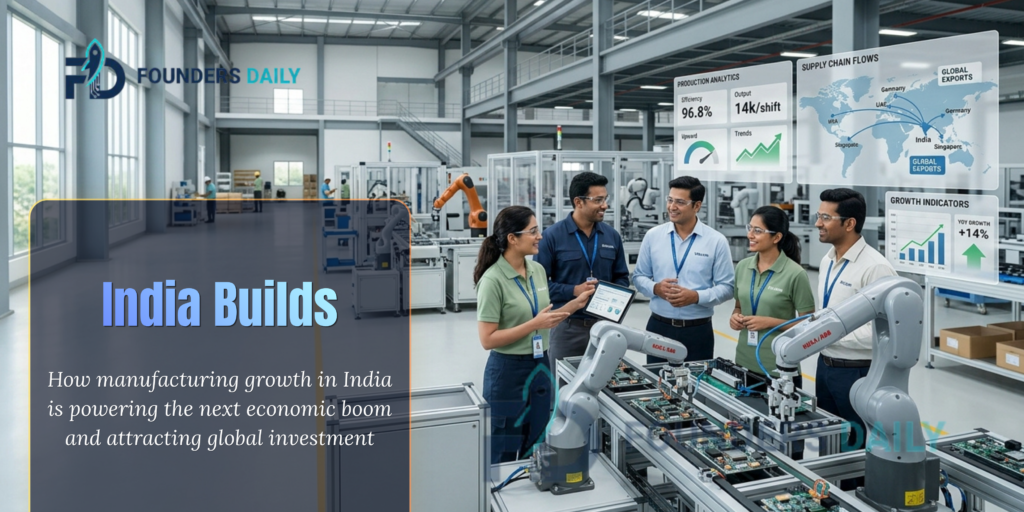
Technology is playing a transformative role in shaping the future of manufacturing growth India. It is no longer limited to automation but extends to data-driven decision-making, predictive analytics, and intelligent systems.
Artificial intelligence is being used to optimize production processes, predict demand, and reduce operational inefficiencies. This allows manufacturers to improve productivity while maintaining quality standards. Similarly, data analytics is enabling real-time monitoring of operations, helping companies identify issues before they escalate.
Automation and robotics are also becoming more common, especially in large-scale manufacturing units. While there are concerns about job displacement, these technologies are actually creating new roles that require higher skills and better expertise.
Digital transformation is another key trend. Smart factories, connected supply chains, and integrated systems are becoming the norm. Companies that embrace these changes are likely to gain a significant competitive advantage in the coming years.
Challenges in Manufacturing Sector India
Despite the strong growth momentum, the manufacturing sector India still faces several challenges that need to be addressed for sustained success. Infrastructure gaps in certain regions continue to be a concern, particularly in areas that are not part of major industrial corridors.
Regulatory complexity, although improving, can still create hurdles for businesses. Simplifying processes further and ensuring consistency across states will be crucial for attracting more investments.
Skill development is another area that requires attention. As manufacturing becomes more technology-driven, there is a growing need for upskilling the workforce. Training programs and industry collaboration will play an important role in bridging this gap.
Addressing these challenges will be essential to ensure that manufacturing growth in India remains strong and sustainable over the long term.
Why Manufacturing Is Attracting Investors
Investors are increasingly viewing manufacturing as a strategic opportunity. The sector offers a unique combination of stability, scalability, and long-term growth potential.
One of the key reasons is the alignment with global trends. As supply chains diversify, companies that can provide reliable manufacturing capabilities are likely to benefit significantly. India’s positioning makes it an attractive destination for such investments.
Government support and policy incentives further reduce risks, making it easier for investors to commit capital. Additionally, manufacturing has strong linkages with other sectors such as logistics, retail, and technology, creating a multiplier effect across the economy.
Also Read: The Next Phase of India’s Startup Ecosystem
Conclusion
Manufacturing growth India is no longer a secondary story. It is becoming the central narrative of the country’s economic future. As global dynamics shift and new opportunities emerge, India is positioning itself as a reliable and competitive manufacturing hub.
For businesses, this is a moment to invest and scale. For professionals, it is an opportunity to build future-ready skills. And for the economy, it is a pathway toward sustainable and inclusive growth.
The momentum is building steadily. The foundation is being strengthened. The real question now is who will take advantage of this transformation early and lead the next phase of growth.