
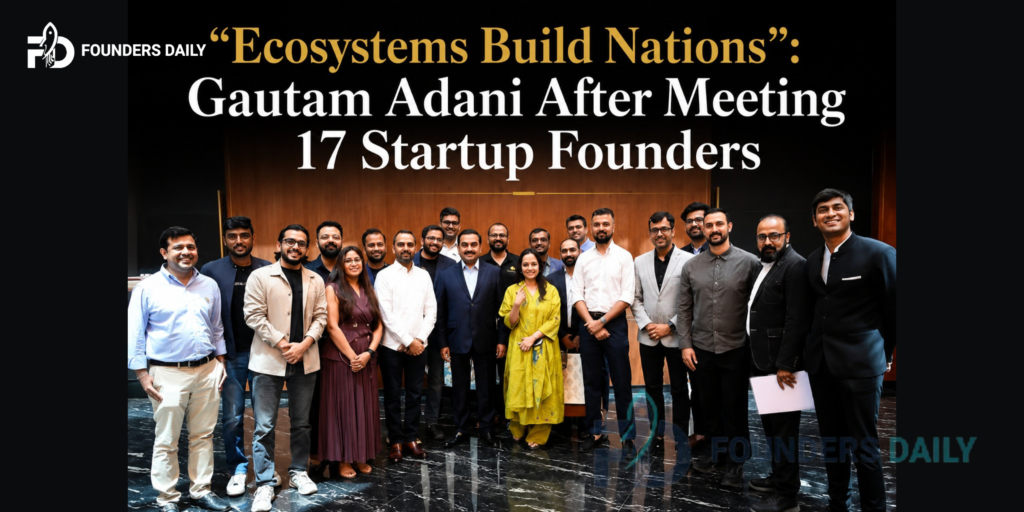
Adani Group Chairman Gautam Adani has underlined the growing importance of collaboration between entrepreneurs, infrastructure providers, investors, and technology leaders in shaping India’s next phase of economic growth, following an interaction with 17 startup founders working across emerging technology sectors.
Sharing details of the meeting on social media, Adani described the founders as some of India’s most promising entrepreneurs, many of whom are building businesses at the frontiers of deep technology. The interaction was held with members of the Griffin Founders collective, a network of startup founders working across sectors including artificial intelligence, space technology, enterprise software, digital infrastructure, and advanced technologies.
“Met 17 of India’s most compelling startup founders earlier today, most of them building at the frontiers of deep tech,” Adani wrote.
What stood out from the meeting, he said, was not merely the innovation being developed by the entrepreneurs but the broader lesson about how nations create lasting competitive advantages.
“It was inspiring, but more than that, it was a reminder. The next India will not be built in silos. It will be built at the intersection of founders, infrastructure, capital, energy, logistics, AI, space and talent,” Adani said.
His concluding remark quickly gained attention across the startup ecosystem: “Founders build companies. Ecosystems build nations.”
The statement reflects a broader shift in how business leaders and policymakers increasingly view economic development. While startups are often celebrated for innovation and disruption, industry experts argue that sustainable growth requires a supporting ecosystem that includes physical infrastructure, access to capital, regulatory support, talent development, digital connectivity, and reliable energy networks.
India’s Startup Ecosystem Reaches New Scale
India today has one of the largest startup ecosystems in the world, with more than 150,000 registered startups and over 100 unicorns across sectors ranging from fintech and e-commerce to SaaS, artificial intelligence, healthtech, and climate technology.
Over the last decade, the country has emerged as a major global innovation hub, producing companies that now serve customers across continents.
However, startup founders increasingly recognize that scaling globally requires more than innovative ideas. Businesses need access to world-class infrastructure, logistics capabilities, data centres, energy security, manufacturing capacity, and financing networks.
It is this interconnected approach that Adani appears to be emphasizing.
Industry observers noted that many of India’s most successful technology companies have benefited from the rapid expansion of digital infrastructure, affordable internet access, cloud computing, and improved logistics systems.
As startups move into more complex sectors such as artificial intelligence, robotics, semiconductor technologies, aerospace, and advanced manufacturing, the need for integrated ecosystems becomes even more critical.
Infrastructure and Intelligence Are Converging
The interaction with startup founders comes shortly after Adani outlined a similar vision in his annual message for FY26.
In that communication, the billionaire industrialist argued that the traditional separation between infrastructure and technology is disappearing.
Historically, infrastructure and innovation were often viewed as separate domains. Roads, ports, airports, and power plants formed one layer of economic development, while software, research, and digital technologies formed another.
According to Adani, that distinction is rapidly fading.
“Before AI can think, energy must flow. Before data can move, infrastructure must stand,” he noted in his annual address.
This philosophy has increasingly shaped the strategy of the Adani Group, which has built businesses spanning ports, airports, logistics, renewable energy, power transmission, data centres, manufacturing, and digital infrastructure.
Rather than viewing these as independent verticals, Adani has repeatedly described them as components of a larger integrated platform connecting the physical and digital economies.
The rise of artificial intelligence further strengthens this argument. AI systems require massive computing infrastructure, uninterrupted electricity, data centres, fibre networks, semiconductor supply chains, and logistics capabilities. Without these foundational elements, even the most advanced software innovations cannot scale effectively.
Deep-Tech Startups Driving India’s Next Growth Phase
The founders who participated in the interaction are reportedly building companies in deep-tech domains, a segment increasingly seen as the next major growth driver for India’s startup ecosystem.
Unlike consumer internet businesses, deep-tech startups focus on solving complex scientific and engineering challenges through advanced technologies.
Areas attracting significant investment include:
- Artificial intelligence
- Space technology
- Robotics
- Quantum computing
- Semiconductor technologies
- Cybersecurity
- Defence technologies
- Clean energy solutions
- Advanced manufacturing
The Indian government has also been actively promoting innovation in these sectors through various initiatives aimed at boosting research, startup funding, technology development, and manufacturing capabilities.
Industry analysts believe India could emerge as a major global player in deep-tech innovation over the next decade, supported by its engineering talent pool and growing domestic market.
Building the Next India
Adani’s comments arrive at a time when India is positioning itself as both a manufacturing hub and an innovation-driven economy.
The country’s ambitions extend beyond being a service-led economy to becoming a leader in technology development, industrial production, renewable energy, and digital transformation.
For that vision to succeed, collaboration between large enterprises and startups will become increasingly important.
Large corporations provide scale, infrastructure, capital, and market access. Startups bring agility, innovation, and the ability to solve emerging challenges quickly.
Many experts believe the most successful economies of the future will be those capable of connecting these strengths into a cohesive ecosystem.
While the meeting focused on entrepreneurship and innovation, Adani’s remarks carried a broader message about nation-building.
The idea that ecosystems create long-term economic success is becoming increasingly relevant in a world where competitiveness depends not on individual companies alone but on networks of institutions, entrepreneurs, investors, researchers, and infrastructure providers working together.
As India aims to become a developed economy by 2047, the country’s ability to foster such interconnected ecosystems may ultimately determine how successfully it translates entrepreneurial energy into long-term national growth.
Also Read: Innovation Is About Execution Not Ideas
For Gautam Adani, the interaction with 17 startup founders appears to have reinforced that belief: individual companies may create value, but enduring economic transformation happens when innovation, infrastructure, capital, and talent come together as part of a larger ecosystem.