New Delhi: Piyush Goyal held a series of high-level meetings and strategic engagements in Toronto aimed at strengthening economic and investment relations between India and Canada, while accelerating discussions around the proposed India-Canada Comprehensive Economic Partnership Agreement (CEPA).
The visit comes at a significant time for bilateral relations as both countries seek to reset economic engagement and deepen cooperation across trade, investment, technology, infrastructure, clean energy, and financial services.
During the opening ministerial plenary session titled “From Political Reset to Commercial Delivery,” Goyal joined Maninder Sidhu to outline a renewed roadmap for economic collaboration between the two nations.
Both sides reaffirmed their shared ambition of expanding bilateral trade to USD 50 billion by 2030 while targeting the conclusion of CEPA negotiations by the end of the year.
Also Read: Manufacturing Talent Shortage Is the Next Big Risk in 2026
CEPA Seen as Major Economic Catalyst
The proposed Comprehensive Economic Partnership Agreement is expected to become one of the most significant economic agreements between India and Canada in recent years.
According to Goyal, the agreement has the potential to unlock new opportunities across multiple sectors while improving market access, investment flows, and business collaboration.
The minister emphasized that India continues to strengthen its ease-of-doing-business ecosystem and remains committed to creating an investor-friendly environment for global companies and institutions.
He invited Canadian businesses, pension funds, institutional investors, and corporations to participate actively in India’s long-term growth story.
“India and Canada have enormous potential to expand economic cooperation through trust, innovation, and shared prosperity,” Goyal said during his engagements.
Investment Talks with Major Canadian Institutions
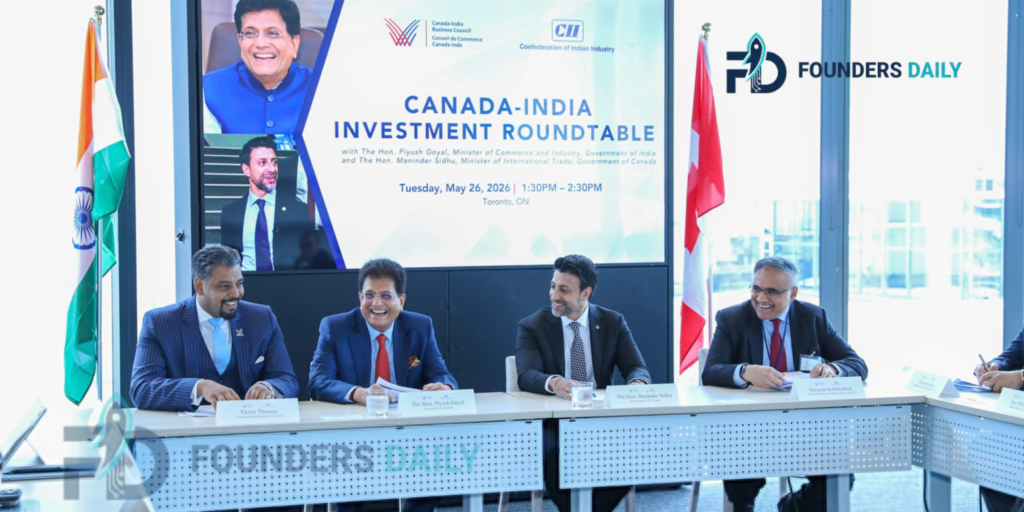
As part of the visit, Goyal co-chaired the Canada-India Investment Roundtable alongside Maninder Sidhu.
The discussions involved leading Canadian pension funds, sovereign and institutional investors, members of the Canada-India Business Council, and senior business leaders.
The talks focused on India’s rapidly expanding infrastructure sector, financial market reforms, manufacturing growth, digital economy, and supply-chain diversification initiatives.
Goyal highlighted emerging opportunities in:
- Artificial intelligence
- Digital infrastructure
- Clean energy
- Manufacturing
- Financial services
- Semiconductor and technology ecosystems
- Supply chain resilience
The minister also stressed the importance of stronger collaboration in financial markets to support sustainable long-term economic growth for both countries.
Meetings with Top Business Leaders
During his Toronto visit, Goyal held separate meetings with several prominent global business executives and investors.
He met V. Prem Watsa to discuss India’s economic growth trajectory and opportunities across infrastructure, manufacturing, logistics, clean energy, and financial services.
Goyal acknowledged Fairfax Financial Holdings for its long-standing investments in India, including its involvement in Bengaluru International Airport.
The minister also held discussions with:
- Philip Witherington regarding India’s expanding financial services sector.
- Kevin Strain on collaboration opportunities in insurance, healthcare financing, retirement solutions, and long-term investments.
- Raymond Chun on banking, fintech, digital payments, and investment facilitation.
These meetings reflect India’s broader strategy of attracting long-term institutional capital and strengthening financial partnerships with global firms.
Focus on Critical Minerals and Supply Chains
One of the major strategic areas discussed during the visit was critical minerals and rare earth processing.
Goyal met Rahim Suleman to explore cooperation in rare earth processing, advanced materials, and supply-chain resilience.
Critical minerals have become increasingly important globally due to rising demand from electric vehicles, batteries, renewable energy infrastructure, and advanced manufacturing industries.
India has been actively seeking partnerships to reduce dependence on limited global supply chains and strengthen domestic capabilities in strategic materials.
Food Processing and Agriculture Collaboration
Goyal also met Max Koeune to discuss expanding cooperation in food processing, cold-chain logistics, sustainable agriculture, and supply-chain innovation.
McCain Foods has maintained a long-standing presence in India and works extensively with Indian farmers through potato sourcing programs.
The discussions highlighted opportunities for improving food processing infrastructure and agricultural value chains between the two countries.
Tribute to Air India Flight 182 Victims
During his visit, Goyal paid tribute at the Air India Flight 182 Memorial located at Humber Bay Park.
The memorial honors the victims of the 1985 Air India Flight 182 bombing, one of the deadliest aviation terror attacks in history.
Goyal met family members of victims and reiterated India and Canada’s shared commitment to ensuring such tragedies are never repeated.
Address to Indian Diaspora
At a community reception hosted by the Consulate General of India in Toronto, Goyal addressed members of the Indian diaspora and highlighted India’s economic transformation under the leadership of Narendra Modi.
He emphasized that the Indian diaspora continues to play a critical role in strengthening ties between India and Canada through contributions in business, technology, academia, entrepreneurship, and community leadership.
Goyal also underlined how CEPA could unlock new opportunities in:
- Trade and investment
- Innovation partnerships
- Startup collaboration
- Education and talent mobility
- Technology and research cooperation
Goyal’s visit signals a broader attempt by both nations to rebuild and strengthen economic engagement after recent diplomatic tensions.
Also Read: Innovation Is About Execution Not Ideas
With trade ambitions of USD 50 billion by 2030 and renewed momentum around CEPA negotiations, both India and Canada appear focused on creating a more stable and forward-looking economic partnership.
As global supply chains shift and countries seek stronger strategic alliances in technology, clean energy, and manufacturing, India-Canada economic relations could enter a new phase driven by investment, innovation, and long-term commercial collaboration.