
Introduction
For a long time, the success of education startups was built on a simple promise. Record high-quality courses, scale distribution, and reach millions of learners online. It worked, and it worked well. Platforms grew rapidly, investors poured capital into the sector, and digital education became one of the fastest-growing industries globally.
But in 2026, something fundamental has shifted. Learners are no longer impressed by access alone. They are surrounded by content, flooded with courses, and yet still struggling to achieve meaningful outcomes. This growing gap between learning and real-world impact is forcing a critical rethink.
This is exactly why education startups must move beyond courses. The conversation is no longer about how many courses a platform offers, but about what actually changes for the learner after completing them. The future of edtech is not content-led. It is outcome-driven, experience-focused, and deeply integrated with real-world applications.
In this article, we will explore why this shift is happening, what it means for founders and operators, and how education startups can build more sustainable, high-impact models that align with how people truly learn and grow.
Also Read: Why Work-Life Balance for Founders Looks Different in 2026
The Course Economy Is Reaching Its Limits
Over the past decade, the edtech ecosystem has been driven by scale. The more courses a platform had, the more value it seemed to offer. From coding bootcamps to marketing certifications, almost every skill became productized into structured modules that could be consumed on demand.
However, as more players entered the market, the differentiation started to disappear. Today, learners can find hundreds of similar courses for the same topic across multiple platforms. Pricing wars, discounts, and aggressive marketing have turned education into a commoditized offering rather than a differentiated experience.
The deeper issue, however, is not competition. It is effectiveness. Completion rates across online courses remain low, and even among those who complete them, the translation of knowledge into real skills is inconsistent. This is where the traditional model begins to break down.
Education startups must move beyond courses because the market no longer rewards content alone. It rewards transformation. And transformation requires more than videos and quizzes.
The Growing Gap Between Learning and Outcomes
One of the most critical challenges in modern education is the disconnect between learning and results. A learner may spend weeks completing a course, but still feel unprepared to apply that knowledge in a real-world setting. This creates frustration and reduces trust in the platform.
In 2026, learners are becoming far more outcome-oriented. They are asking sharper questions before enrolling. Will this help me get a job. Will this improve my income. Will this make me better at what I do. If the answer is unclear, the course loses its value, regardless of how well it is produced.
This shift is forcing education startups to rethink their entire value proposition. It is no longer enough to teach concepts. Platforms need to ensure that learners can apply those concepts in meaningful ways. This requires a deeper integration between education and execution.
When startups fail to address this gap, they risk becoming irrelevant in a market that is increasingly driven by results rather than promises.
Why Passive Learning Is Failing Modern Learners
The traditional online course model is largely passive. Learners watch videos, take notes, complete assignments, and move on. While this structure works for some, it fails to engage a large portion of users who need interaction, feedback, and accountability.
Modern learners are not just consuming content. They are navigating careers, managing responsibilities, and looking for efficient ways to grow. Passive learning often lacks the structure needed to keep them engaged, especially when motivation drops.
This is where the shift becomes obvious. Education startups must move beyond courses by designing experiences that are active rather than passive. This includes real-time feedback, collaborative projects, peer learning, and guided pathways that keep learners involved throughout the journey.
When learning becomes interactive, it becomes more effective. And when it becomes effective, it creates real value.
The Rise of Outcome-Driven Education Models
A clear trend emerging in 2026 is the rise of outcome-driven education. These are programs designed not just to teach, but to deliver measurable results. Instead of focusing on content completion, they focus on what the learner achieves at the end of the journey.
For example, instead of offering a generic programming course, some platforms now offer structured programs where learners build real applications, contribute to live projects, and receive feedback from industry professionals. The goal is not just learning, but readiness.
This approach changes everything. It aligns the interests of the platform with the goals of the learner. It also builds trust, because the value is tied to outcomes rather than promises.
Education startups must move beyond courses and embrace this model if they want to stay competitive in an increasingly results-driven market.
Community Is Becoming the Core of Learning
One of the most overlooked aspects of traditional online education is isolation. Learners often go through courses alone, without meaningful interaction or support. This reduces engagement and increases the likelihood of dropout.
In contrast, community-driven learning creates a completely different experience. When learners are part of a group, they feel accountable. They ask questions, share insights, and support each other. This not only improves completion rates but also enhances understanding.
Many modern education startups are now building strong communities as part of their core offering. These communities act as support systems, networking platforms, and collaborative spaces where learning extends beyond the course material.
This shift highlights an important point. Education startups must move beyond courses because learning is not just an individual activity. It is a social process.
Personalization Is No Longer Optional
Every learner is different. They come with different backgrounds, goals, and learning speeds. A standardized course cannot effectively address this diversity.
This is why personalization is becoming a critical component of modern education. Using data and technology, platforms can now tailor learning experiences based on individual needs. This includes customized content, adaptive pacing, and targeted feedback.
Personalization not only improves learning outcomes but also enhances user satisfaction. When learners feel that the platform understands their needs, they are more likely to stay engaged and complete their journey.
For education startups, this means moving away from one-size-fits-all models and investing in systems that support individualized learning experiences.
Technology Is Enabling, Not Leading the Change
There is no doubt that technology plays a significant role in the evolution of education. Artificial intelligence, analytics, and automation are transforming how content is delivered and consumed.
However, the real shift is not technological. It is conceptual. Technology is simply enabling a deeper transformation in how education is designed.
Education startups must move beyond courses not because technology demands it, but because learners expect more. Technology helps meet those expectations, but it cannot replace the need for thoughtful design and human connection.
The most successful platforms will be those that combine advanced technology with strong human elements such as mentorship, feedback, and community support.
The Risk of Staying Stuck in the Old Model
Startups that continue to rely solely on course-based models may find it increasingly difficult to sustain growth. As competition intensifies and learner expectations evolve, the limitations of this approach become more visible.
Low engagement, poor outcomes, and declining trust can quickly impact retention and revenue. In a market where alternatives are abundant, learners will naturally gravitate towards platforms that offer more value.
This is why adaptation is not optional. It is essential. Education startups must move beyond courses to remain relevant, competitive, and impactful in the long term.
What the Next Generation of Edtech Will Look Like
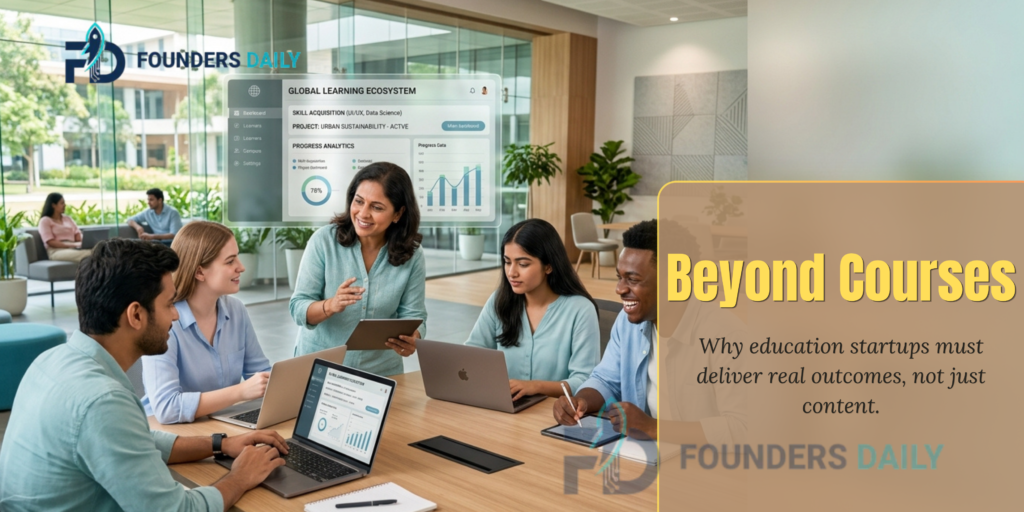
The future of education startups lies in building ecosystems rather than products. Ecosystems that support learners at every stage, from skill acquisition to application to career growth.
These ecosystems will combine multiple elements. Content, community, mentorship, real-world projects, and continuous learning pathways. Together, they create a holistic experience that goes far beyond traditional courses.
This approach not only improves outcomes but also builds long-term relationships with users. Instead of one-time transactions, platforms can create ongoing engagement and value.
Also Read: AI Is Reshaping White-Collar Jobs Faster Than Expected
Conclusion
Education startups must move beyond courses because the definition of value has changed. Learners are no longer looking for information. They are looking for transformation.
The platforms that succeed in this new environment will be those that understand this shift and build experiences that go beyond content. Experiences that deliver outcomes, create engagement, and support continuous growth.
Because in the end, education is not about what you learn. It is about what you become.