
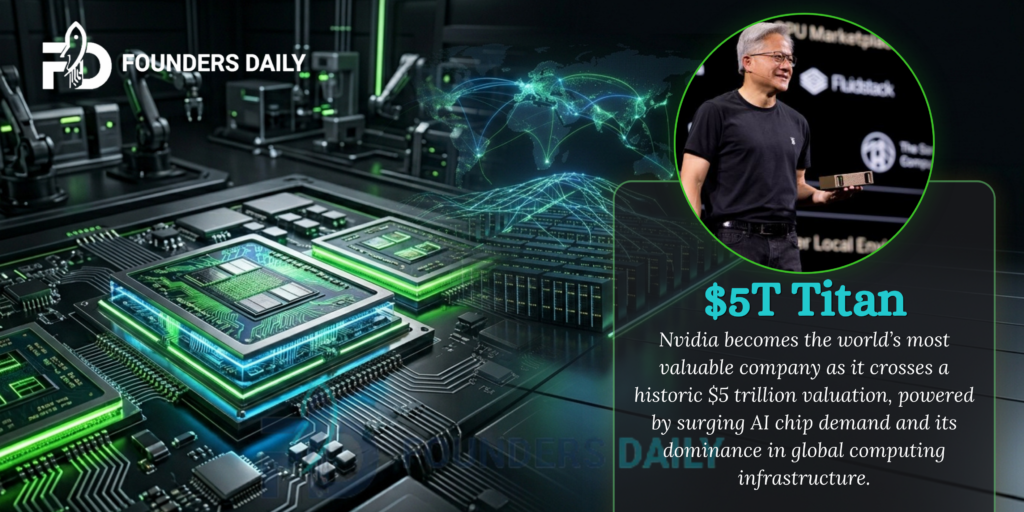
Nvidia has reached a historic milestone, becoming the world’s most valuable publicly traded company after its market capitalization surpassed $5 trillion. The achievement cements Nvidia’s position at the center of the global artificial intelligence revolution and underscores how one chipmaker has become the most critical infrastructure provider for the modern technology industry.
Shares of Nvidia closed at $208.27, up 4.3% in the latest trading session, pushing the company’s valuation beyond the $5 trillion mark for the first time. No semiconductor company in history has ever achieved this level of market value.
With this milestone, Nvidia now sits roughly $1 trillion ahead of Alphabet, its nearest rival by market capitalization, and remains just 2% below its all-time intraday high of $212.19 reached in October last year.
Also Read: Kodiak AI Raises $100 Million at Discounted Share Price, Stock Plunges 37%
From Gaming Graphics to AI Infrastructure Giant
Founded in 1993 by Jensen Huang, Chris Malachowsky, and Curtis Priem, Nvidia began as a graphics chip company focused on improving gaming performance. Over the past three decades, the company transformed itself from a niche semiconductor maker into the foundational hardware provider powering artificial intelligence, cloud computing, robotics, and autonomous systems.
Nvidia’s graphics processing units (GPUs) were originally designed to handle complex visual calculations for video games. However, researchers later discovered that the same architecture was ideally suited for training and running large-scale AI models.
That technological advantage has placed Nvidia at the center of nearly every major AI initiative worldwide.
Why Nvidia Has Become So Valuable
The company’s extraordinary valuation reflects its dominant role in supplying high-performance AI chips to the world’s largest technology companies.
Organizations including Microsoft, Google, Meta Platforms, Amazon, OpenAI, and Anthropic rely heavily on Nvidia’s GPUs to train and deploy advanced AI models.
These companies are investing unprecedented sums to build data centers capable of supporting generative AI applications, large language models, and intelligent agents.
Industry estimates suggest that the four largest hyperscalers, Microsoft, Google, Amazon, and Meta, are expected to spend nearly $700 billion in capital expenditures this year, with a significant portion allocated to AI infrastructure and Nvidia chips.
For now, much of this spending ultimately flows to Nvidia’s headquarters in Santa Clara.
The Nvidia Paradox
One of the most remarkable aspects of Nvidia’s rise is that many of its largest customers are simultaneously its most determined future competitors.
Google has developed its Tensor Processing Units (TPUs), Amazon has introduced Trainium and Inferentia chips, Microsoft is building Maia processors, and Meta continues to invest in custom silicon.
These efforts are designed to reduce dependence on Nvidia over time.
Yet in the short term, these same companies continue to purchase massive quantities of Nvidia GPUs because no alternative currently matches Nvidia’s software ecosystem, performance, and scale.
This creates what many analysts describe as the “Nvidia paradox”: the companies trying hardest to replace Nvidia are also the ones fueling its explosive growth.
Momentum Across the Semiconductor Industry
Nvidia’s surge was accompanied by a broad rally in semiconductor stocks.
Intel reported stronger-than-expected earnings, posting adjusted earnings per share of 29 cents compared with analyst expectations of one cent. Revenue came in at $13.58 billion, comfortably above estimates of $12.42 billion.
The positive results boosted sentiment across the sector.
Advanced Micro Devices rose more than 14%, while Qualcomm gained over 8%. The Philadelphia Semiconductor Index extended its winning streak to 18 consecutive sessions, reflecting strong investor confidence in continued AI-driven demand.
Recent Developments Strengthening Nvidia’s Position
Nvidia has continued to expand beyond chip design into complete AI infrastructure solutions.
The company recently ramped production of its next-generation Blackwell platform, which combines powerful GPUs, networking, and software to support increasingly sophisticated AI workloads.
Blackwell systems are expected to drive the next wave of data center spending as enterprises and cloud providers seek greater computing efficiency and performance.
Nvidia is also growing its presence in robotics, autonomous vehicles, healthcare, industrial automation, and sovereign AI initiatives, where governments and organizations build domestic AI capabilities using Nvidia technology.
Its CUDA software platform remains a key competitive advantage. Thousands of developers and enterprises worldwide build AI applications using CUDA, making it difficult for alternative chip providers to displace Nvidia even when comparable hardware becomes available.
Financial Performance and Investor Confidence
Nvidia’s financial growth has been unprecedented.
Over the past two years, the company has delivered record revenue and profits as demand for AI accelerators outpaced supply. Gross margins have remained exceptionally strong, reflecting both technological leadership and limited competition at the highest end of the market.
Investors increasingly view Nvidia not simply as a semiconductor manufacturer but as a critical infrastructure company akin to a utility provider for the AI economy.
Its products power the foundational computing layer upon which next-generation software and services are being built.
Risks to Nvidia’s Dominance
Despite its extraordinary success, Nvidia faces several long-term challenges.
Large customers are developing in-house chips to reduce reliance on a single supplier. Governments worldwide are tightening export restrictions on advanced semiconductors. Competitors such as AMD, Intel, and emerging AI chip startups are investing aggressively.There are also broader questions about whether current AI spending levels can be sustained indefinitely.
However, most analysts believe Nvidia’s technology lead, software ecosystem, and manufacturing relationships give it a substantial advantage for the foreseeable future.
Also Read: Why Decision-Making Will Be Harder in 2026
A Historic Moment in Technology
Crossing a $5 trillion valuation is more than a financial milestone. It symbolizes a profound shift in global markets toward artificial intelligence as the defining technology trend of the decade.
Nvidia has become the central supplier to nearly every major AI initiative, benefiting from unprecedented spending by cloud providers, startups, enterprises, and governments.
What began as a graphics chip company serving gamers has evolved into the backbone of the AI economy.
As businesses race to build smarter systems and more capable digital infrastructure, Nvidia stands at the heart of this transformation — and, for now, as the most valuable company in the world.