Introduction
For decades, companies relied on a familiar corporate structure. Executives set strategy at the top, employees executed tasks at the bottom, and middle management acted as the bridge between the two. These managers translated strategy into action, supervised teams, reported progress, and kept organizations moving in the right direction. It was a model that shaped corporate culture for generations.
But today something is changing. Across industries, middle management is breaking under pressure from technology, remote work, lean organizations, and new leadership models. Many companies are questioning whether traditional layers of management still make sense in a world where data flows instantly and teams operate more independently.
In many organizations, middle managers feel trapped between expectations from executives and the demands of employees. At the same time, automation and collaboration tools are replacing some of the coordination tasks that once defined their role. As a result, companies are redesigning how work flows, how teams communicate, and how leadership actually functions.
This shift raises an important question. If middle management is changing or disappearing, what comes next for organizations, leaders, and employees?
In this article, we explore why middle management is breaking, how technology and workplace culture are reshaping leadership structures, and what the future of management may look like in the coming decade.
Why Middle Management Became Essential in the First Place
To understand why middle management is breaking today, it helps to understand why it existed in the first place. Traditional organizations relied heavily on hierarchical communication. Information moved slowly and required multiple layers of oversight. Executives developed strategies, but they depended on middle managers to translate those strategies into operational actions.
In large companies, middle managers played several important roles. They supervised teams, tracked productivity, coordinated projects, and reported progress to senior leaders. They also acted as mentors and problem solvers for employees who needed guidance.
This structure worked well when organizations were stable and processes changed slowly. A manager could oversee a department, ensure compliance with company policies, and maintain communication between leadership and workers. The system created order and accountability in complex organizations.
However, the digital economy operates very differently. Information moves instantly, teams collaborate across continents, and employees often work remotely. In this environment, the traditional responsibilities of middle management are evolving rapidly.
Also Read: The New Playbook for Building Profitable Startups
The Pressure Building on Middle Management
Today many companies are discovering that middle management is breaking because the role has become increasingly complex and sometimes contradictory. Middle managers are expected to deliver results, support employees, implement strategy, manage budgets, and respond quickly to change. At the same time, they often have limited authority to make decisions.
This pressure is particularly visible in technology companies and fast growing startups. Teams move quickly, products evolve rapidly, and employees expect more autonomy. In such environments, traditional command and control management structures slow down decision making.
Many middle managers also spend significant time on administrative tasks. Reporting, performance reviews, compliance documentation, and meetings consume hours that could otherwise be spent guiding teams and improving processes. As these responsibilities grow, managers feel disconnected from both leadership and employees.
Research in organizational psychology also shows that middle managers experience high levels of stress and burnout. They are responsible for delivering results while simultaneously protecting their teams from unrealistic expectations. This constant balancing act is one reason why many talented professionals hesitate to pursue management roles.
Technology Is Reshaping the Role of Middle Managers
One of the biggest reasons middle management is breaking is the rise of advanced technology. Digital tools now automate many of the tasks that managers traditionally handled.
Project management platforms allow teams to track progress without constant supervision. Communication tools enable employees to connect directly with executives or colleagues across departments. Data analytics dashboards provide real time insights into performance metrics that once required manual reporting.
For example, a product development team using collaborative software can monitor tasks, share updates, and coordinate timelines without relying heavily on a manager to relay information. This transparency reduces the need for multiple layers of oversight.
Artificial intelligence is also beginning to influence management processes. AI driven analytics can evaluate productivity trends, forecast resource needs, and identify operational bottlenecks. These insights allow leaders to make faster decisions without depending on traditional reporting structures.
However, technology does not eliminate the need for leadership. Instead, it changes the type of leadership that organizations require.
The Rise of Flat Organizations
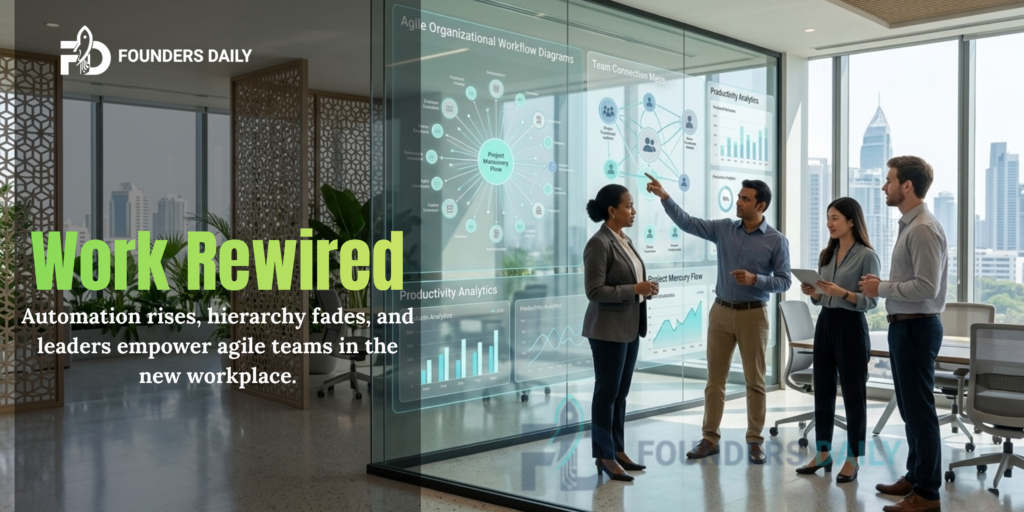
As middle management structures evolve, many companies are experimenting with flatter organizational models. In these environments, fewer layers separate executives from frontline employees. Teams operate with greater autonomy and collaborate directly with decision makers.
Flat organizations encourage faster communication and quicker decision making. Instead of waiting for instructions to pass through multiple management levels, employees can discuss challenges directly with leadership or cross functional teams.
Startups often adopt this approach naturally because they begin with small teams and limited resources. However, even large corporations are now exploring ways to reduce hierarchical complexity. By empowering teams and simplifying reporting structures, companies hope to improve agility and innovation.
The shift toward flatter structures does not mean that leadership disappears. Instead, leadership becomes more distributed. Team leaders, project owners, and specialists share responsibility for guiding work rather than relying solely on traditional managers.
From Managers to Coaches
If middle management is breaking, what replaces it? One emerging answer is a shift from traditional management to coaching oriented leadership.
In the past, managers often focused on monitoring performance and enforcing processes. Today successful organizations expect leaders to support growth, encourage collaboration, and develop talent.
A coaching oriented leader spends less time issuing instructions and more time helping employees solve problems independently. They ask thoughtful questions, provide feedback, and create an environment where teams can experiment and learn.
This approach aligns well with modern workplace expectations. Many professionals want autonomy, meaningful work, and opportunities for growth. Leaders who act as mentors rather than supervisors are more likely to build engaged teams.
Companies that embrace this model often see improvements in innovation and employee satisfaction. When individuals feel trusted and supported, they contribute ideas more freely and take ownership of their work.
The Changing Skill Set for Middle Managers
Although middle management is breaking in its traditional form, the skills associated with effective leadership remain valuable. What is changing is the nature of those skills.
Future leaders will need strong communication abilities because collaboration across teams is becoming more important. They must also understand data and analytics to interpret performance insights generated by digital tools.
Emotional intelligence is another essential capability. In remote and hybrid workplaces, leaders must build trust without relying on physical proximity. They must understand the needs and motivations of diverse team members and create inclusive environments.
Strategic thinking also becomes more important. Instead of focusing solely on operational tasks, leaders must help teams connect daily work with broader organizational goals.
These skills transform the role of middle managers from supervisors into facilitators of progress.
Real World Examples of Organizational Change
Several companies illustrate how management structures are evolving. Technology firms often reduce management layers to accelerate product development cycles. Teams collaborate directly with senior leaders through digital communication platforms.
Some companies experiment with cross functional squads. Each squad includes members from engineering, design, marketing, and product management. Rather than reporting through separate departments, the team works together toward a shared objective.
Other organizations introduce rotating leadership roles. Employees take turns leading projects or initiatives based on their expertise. This model distributes leadership responsibility and encourages skill development across the organization.
These experiments demonstrate that the future of management may involve more flexibility and collaboration than traditional hierarchies allowed.
What This Means for Employees
The transformation of middle management has significant implications for employees. In flatter organizations, individuals often have greater responsibility for decision making and problem solving. This autonomy can be empowering but also requires stronger self management skills.
Employees must communicate clearly, manage priorities, and collaborate effectively with colleagues from different functions. Continuous learning becomes essential because roles evolve quickly as technology and markets change.
At the same time, the shift creates new opportunities for career growth. Instead of following a rigid path from employee to manager to executive, professionals can develop expertise in specialized areas or lead projects that showcase their strengths.
For many people, this flexibility makes work more meaningful and dynamic.
The Future of Leadership in Organizations
Looking ahead, the evolution of middle management is likely to continue as technology and workplace culture advance. Organizations will experiment with hybrid leadership structures that combine traditional management with collaborative team models.
Artificial intelligence will provide deeper insights into productivity and resource allocation. Digital platforms will enable seamless communication across departments and geographical locations. These tools will reduce administrative burdens and allow leaders to focus on strategy and talent development.
At the same time, human leadership qualities will remain essential. Empathy, creativity, ethical decision making, and the ability to inspire others cannot be automated easily. Companies that balance technological efficiency with human centered leadership will likely perform best.
Ultimately, the future of management is not about eliminating leaders. It is about redefining how leadership works.
Also Read: Why Founder Burnout Is a Business Risk
Conclusion
The traditional corporate hierarchy is undergoing one of the most significant transformations in modern business history. As technology accelerates communication and teams become more autonomous, middle management is breaking in its traditional form.
However, this shift does not signal the end of leadership. Instead, it represents an opportunity to build organizations that are more agile, collaborative, and human centered. Companies that embrace coaching oriented leadership, empower teams, and leverage digital tools effectively will shape the next generation of workplaces.
For professionals and organizations alike, the challenge is clear. Adapt to the evolving role of leadership or risk being left behind in a rapidly changing business environment.
The future of work will belong to leaders who guide rather than control, collaborate rather than command, and inspire rather than supervise.