
Introduction
For much of the past two decades, marketing funnels served as the dominant framework for customer acquisition and growth. The logic was straightforward. Capture attention, nurture interest, and convert demand at scale. This model influenced how marketing teams were structured, how budgets were allocated, and how success was measured across industries.
In 2026, however, growing evidence suggests that this linear view of marketing no longer reflects how buyers actually behave. Customer acquisition costs continue to rise, conversion efficiency is under pressure, and resistance to brand-led persuasion is increasing. These are not temporary market fluctuations. They point to a deeper structural disconnect between traditional marketing funnels and modern decision-making.
Today’s buyers operate inside fragmented digital environments shaped by peer recommendations, creator-led narratives, private communities, and AI-driven discovery. Decisions form gradually, often invisibly, and rarely follow a predictable sequence. Awareness, consideration, and conversion no longer occur in order. In many cases, they overlap or occur independently.
This shift raises a fundamental question for founders and growth leaders. If customers no longer move linearly, can marketing strategies still be built around funnels designed for a different era.
Why Traditional Marketing Funnels Are Losing Relevance
The traditional marketing funnel emerged in a time when brands exercised greater control over distribution and messaging. Media channels were limited, competition was narrower, and consumer journeys followed relatively stable patterns. In that environment, linear models provided clarity and operational efficiency.
That environment no longer exists. In 2026, customers encounter brands across dozens of touchpoints before any direct interaction occurs. A buyer may first notice a brand through a social post, later hear it discussed on a podcast, read community opinions months later, and only then consider engaging directly. None of these interactions follow a predefined funnel path.
The end of traditional marketing funnels is largely driven by this loss of control. Customers now design their own journeys. Brands that continue to optimize for staged progression often miss the moments where trust and preference are actually formed.
The Rise of Non Linear Customer Journeys
Decisions Are Contextual, Not Sequential
Modern customer journeys are shaped by timing, relevance, and trust rather than funnel stages. Buyers frequently move back and forth between exploration and evaluation based on personal or organizational context.
In B2B environments, decision-makers often consume content for months without any immediate purchase intent. A single high-trust signal, such as a recommendation from a respected peer or an authoritative industry voice, can accelerate a decision almost instantly. Traditional marketing funnels struggle to explain this behavior because they assume gradual progression.
Trust Accumulates Across Touchpoints
Trust does not move downward like a funnel. It accumulates laterally across repeated interactions. Educational content, founder visibility, customer stories, consistent product experience, and transparent communication all contribute to credibility over time.
When marketing strategies focus narrowly on funnel optimization, these trust-building elements are often deprioritized. As a result, conversion-focused campaigns underperform despite increased spend.
Why Funnel-Based Marketing Is Underperforming in 2026
The weakening effectiveness of traditional marketing funnels is visible across performance metrics. Paid acquisition costs are rising across platforms. Retargeting efficiency is declining. Email engagement rates continue to fall. These trends indicate a framework-level problem rather than execution failure.
Funnel-based marketing prioritizes persuasion over understanding. As audiences become more marketing-literate, overtly optimized messaging triggers skepticism rather than interest. Over time, this erodes brand credibility, which is increasingly difficult to rebuild.
Equally important, traditional funnels undervalue post-purchase influence. Retention, repeat usage, referrals, and advocacy generate a disproportionate share of long-term revenue. Funnel models treat conversion as an endpoint, whereas modern growth depends on sustained relationships.
What Is Replacing Traditional Marketing Funnels
Marketing Ecosystems Over Linear Models
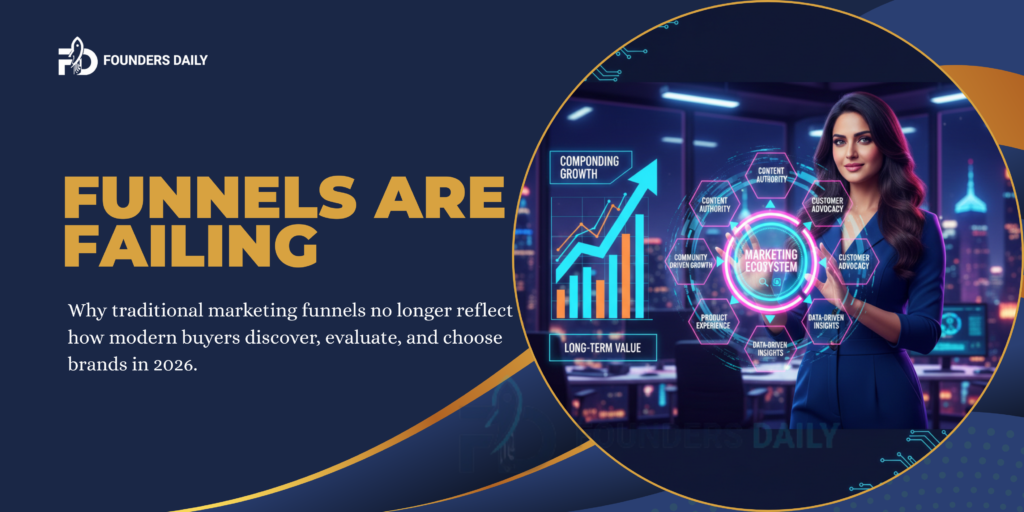
Leading organizations are moving away from funnels toward marketing ecosystems. A marketing ecosystem integrates content, community, product experience, customer success, social proof, and creator partnerships into a continuous system.
In this model, customers can enter from any point. A podcast appearance can drive conversion. A customer success story can generate awareness. Community discussions can influence decisions long after first exposure. Growth emerges from consistent value delivery rather than staged progression.
The Flywheel and Compounding Trust
The flywheel model emphasizes momentum rather than movement through steps. When customers receive value, they remain engaged. Engagement leads to advocacy. Advocacy drives organic acquisition.
This creates compounding growth over time and aligns closely with how trust and recommendations operate in real-world decision-making. Unlike funnels, flywheels reward long-term thinking rather than short-term optimization.
Content as the Strategic Core of Modern Marketing
Content is no longer a tactical asset assigned to awareness or consideration. In 2026, content functions as the primary vehicle for authority and trust.
A deeply researched article can educate early-stage readers while simultaneously converting decision-ready buyers. This is why depth, originality, and insight now outperform high-volume SEO content.
Google’s EEAT framework reinforces this shift. Content that demonstrates expertise, experience, authority, and trustworthiness aligns with how humans evaluate credibility. As a result, authoritative content not only ranks better but also converts more effectively.
Community and Creator Influence in Modern Decision Making
Private communities have become powerful decision-making environments. Slack groups, Discord servers, and WhatsApp communities operate on trust rather than promotion. Brands that participate authentically, without overt selling, earn long-term advocacy.
Similarly, creator-led discovery has replaced brand-led messaging in many sectors. Buyers increasingly trust individuals who demonstrate lived experience and domain expertise. Traditional marketing funnels are poorly equipped to account for this influence, while ecosystem-based strategies are built around it.
Founder Perspective Why This Shift Matters
For founders and growth leaders, the end of traditional marketing funnels represents a strategic inflection point. Teams that continue to rely on linear models face diminishing returns despite rising budgets.
Modern marketing success depends on credibility, consistency, and long-term engagement. Metrics such as retention, customer lifetime value, referrals, and brand search growth offer a clearer picture of sustainable performance than funnel conversion rates alone.
The Future of Marketing Strategy
Traditional marketing funnels may still serve limited tactical purposes, particularly in performance advertising. However, they can no longer anchor overall strategy.
The future belongs to brands that understand human behavior, invest in authority, and build systems that deliver value across time and context. Marketing is evolving from persuasion to presence.
Conclusion
The decline of traditional marketing funnels does not signal the absence of structure in modern marketing. It signals the end of simplified models that no longer reflect how people make decisions.
As buyer behavior becomes increasingly non-linear and trust-driven, effective marketing strategies must evolve beyond staged persuasion. Growth is now shaped by credibility built over time, consistent value delivery, and relevance across the moments that matter most.
The strategic challenge for modern brands is no longer how efficiently customers are moved from awareness to conversion. It is whether the brand remains credible, useful, and trusted when the decision is finally made.