
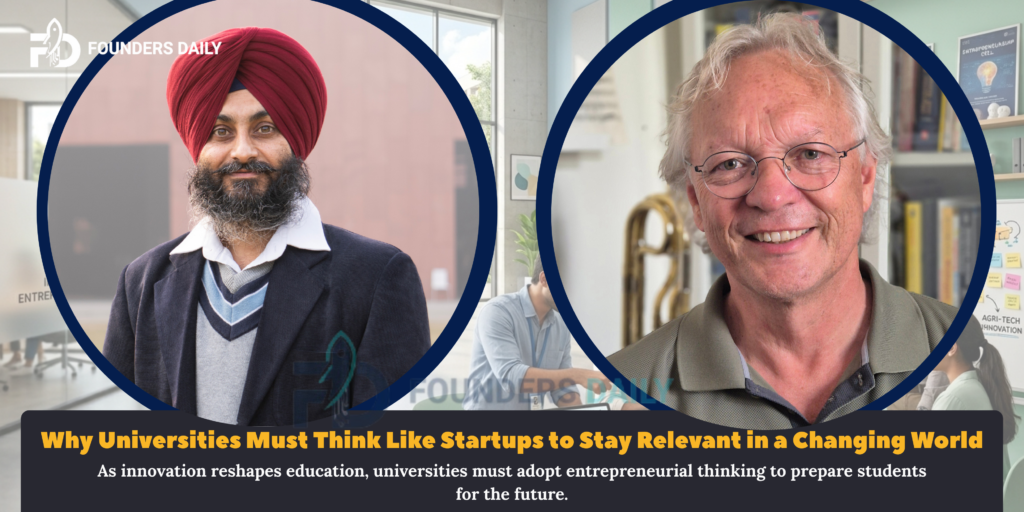
By Prof. Aard Groen, Distinguished Professor of Entrepreneurship and Valorisation, Thapar Institute for Engineering and Technology, and Prof. Mandeep Singh, Associate Dean – Entrepreneurship and Head, Venture Lab, Thapar Institute for Engineering and Technology.
For much of the past century, universities operated with a natural advantage. They were the central institutions responsible for knowledge creation, intellectual leadership, and talent development. A university degree was widely considered a reliable gateway to professional success.
Today, that environment is rapidly evolving.
Universities are no longer competing only with other academic institutions. They now face competition from global online learning platforms, corporate academies, AI-driven learning systems, and industry-led innovation centers. As these alternatives expand, students are increasingly questioning the return on investment of traditional higher education.
Employers are also changing how they evaluate talent. Rather than focusing solely on academic credentials, organizations are prioritizing adaptability, creativity, and real-world problem-solving capabilities. Governments and public institutions are similarly expecting universities to demonstrate clearer contributions to economic growth and societal development.
In this shifting landscape, institutions that remain rigid or slow to adapt risk losing their relevance.
A Changing Role for Universities
Universities that remain influential in the coming decades will likely share characteristics commonly associated with startups. These institutions will be mission-driven, responsive to emerging opportunities, and capable of adapting to technological and societal change.
Most importantly, they will operate as active participants in broader innovation ecosystems rather than as isolated academic entities.
This requires a shift in leadership thinking. University leaders increasingly need to adopt an entrepreneurial mindset similar to that of founders. Like startup leaders, they must interpret emerging trends, bring together talent across disciplines, and allocate resources toward areas with the greatest potential for long-term impact.
Such changes are already visible in several universities worldwide that are experimenting with new models of teaching, research, and collaboration with industry. In India as well, some institutions are beginning to integrate entrepreneurship and innovation more deeply into their academic structures instead of treating them as separate activities.
Also Read: AI Is No Longer a Business Feature. It Is the Business Model
Why Startup Thinking Matters in Higher Education
The parallels between startups and universities are not coincidental.
Startups succeed because they operate with clarity of purpose and a strong connection to real-world problems. They move quickly, experiment with ideas, learn from failure, and adapt their strategies based on feedback.
Traditional universities evolved under a different set of priorities. Stability was often valued over experimentation. Long-term tenure systems sometimes reduced incentives for risk-taking, and academic performance was frequently measured through publications rather than real-world outcomes.
However, the environment surrounding higher education has changed significantly.
Workforce trends highlight the scale of this transformation. Estimates from the OECD suggest that more than half of all jobs by 2030 will require advanced digital capabilities and complex problem-solving skills. The World Economic Forum has also indicated that many children currently in school may eventually work in professions that do not yet exist.
These shifts raise an important question for universities: how can institutions built around stable academic disciplines prepare students for a world defined by rapid change?
The Entrepreneurial University Model
One response gaining attention globally is the concept of the entrepreneurial university.
This idea does not simply refer to universities producing startups. Instead, it describes institutions where research, education, and societal engagement are closely interconnected.
In such environments, teaching encourages curiosity and experimentation. Research focuses on real-world challenges. Collaboration with industry and government becomes a central part of academic activity.
Entrepreneurial thinking in this context is primarily about mindset. Students learn how to identify opportunities, work with incomplete information, collaborate across fields, and transform ideas into practical solutions.
These capabilities are valuable not only for entrepreneurs but also for professionals working within corporations, public institutions, and emerging industries.
Integrating Innovation Into Academic Systems
Some universities have begun embedding entrepreneurial exposure directly within their academic structures. Instead of limiting entrepreneurship to optional courses or extracurricular clubs, institutions are incorporating innovation projects and problem-solving exercises into core curricula.
Students may participate in innovation labs, venture-building activities, or interdisciplinary projects alongside their primary academic studies.
However, early-stage enthusiasm alone is not enough.
Many universities organize hackathons, startup competitions, or innovation festivals to encourage creative thinking. While these initiatives create excitement, they often remain short-term experiences.
A more effective approach involves building long-term systems that allow ideas to evolve into viable technologies or ventures. Such systems include mentorship, research infrastructure, peer collaboration, and opportunities to interact with industry partners or investors.
When these structures are in place, the gap between academic discovery and real-world application becomes significantly smaller.
The Importance of Innovation Infrastructure
Physical and digital infrastructure plays a key role in enabling this transformation.
Laboratories, prototyping facilities, collaborative workspaces, and advanced digital resources create environments where experimentation becomes possible. When these resources are combined with mentorship and interdisciplinary collaboration, universities can become powerful platforms for innovation.
Yet infrastructure alone cannot create entrepreneurial institutions.
Governance systems must also adapt. Universities that encourage experimentation while maintaining academic rigor are more likely to thrive in changing environments.
Faculty members are also taking on expanded roles beyond traditional teaching and research. Many now contribute to applied projects, industry collaborations, and innovation initiatives within their institutions.
Redefining Success in Higher Education
Another important shift involves how universities measure success.
Traditional metrics such as research publications, patents, and graduation numbers remain valuable indicators of academic output. However, they do not fully capture the broader societal impact of higher education.
Increasingly, institutions are evaluating outcomes such as the careers graduates build, the industries they influence, and the societal challenges addressed through academic research.
This approach reflects how startups measure progress—by focusing on tangible outcomes and long-term impact rather than activity alone.
Also Read: How Startups Can Expand Globally in 2026 Without Heavy Funding
Designing Relevance for the Future
Universities do not need to become startups.
Their role in society extends beyond venture creation and includes knowledge preservation, intellectual inquiry, and cultural development. However, the qualities that define successful entrepreneurship—curiosity, adaptability, and the willingness to experiment—are becoming increasingly important in higher education.
Institutions that recognize emerging opportunities early, bring together talent across disciplines, and adapt their structures to evolving realities are more likely to remain relevant in the decades ahead.
In an era of rapid technological change, relevance in higher education can no longer be assumed.
It must be intentionally designed.