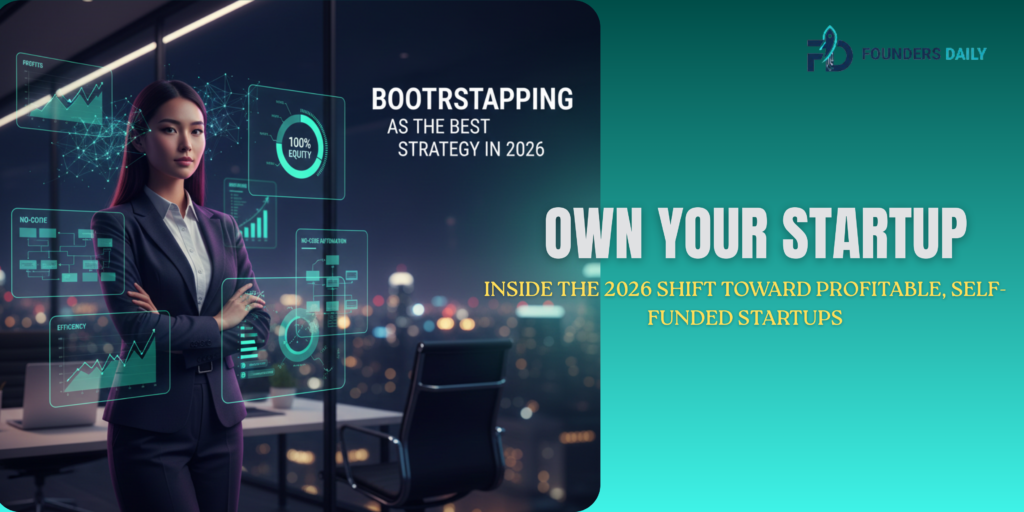
The global startup landscape has undergone a seismic shift over the last few years, moving away from the era of “growth at any cost” and toward a more disciplined, value-driven approach. As we navigate the complexities of this year, many founders are asking themselves if Bootstrapping the Best Strategy in 2026 is the only logical path forward for a sustainable business. In the past, the prestige of a venture capital round was the primary metric of success, but today, the narrative has flipped. We are seeing a new generation of entrepreneurs who prioritize ownership, profitability, and long-term autonomy over the quick adrenaline shot of external funding. This article will explore the economic realities of 2026, the technological advantages that make lean operations possible, and the psychological benefits of building a business on your own terms. Whether you are a first-time founder or a seasoned executive, understanding why Bootstrapping the Best Strategy in 2026 might be your greatest competitive advantage is essential for survival in this modern economy.
The problem that many legacy startups faced in the early 2020s was a total reliance on “cheap money” that dried up as interest rates remained stubbornly high. Consequently, companies that were built on the premise of losing money to gain market share found themselves in a precarious position when the next funding round failed to materialize. By contrast, those who embraced Bootstrapping the Best Strategy in 2026 from day one have built resilience into their DNA, focusing on unit economics and actual customer revenue rather than vanity metrics. In the following sections, we will break down the structural changes in the capital markets, the rise of AI-driven efficiency, and the strategic reasons why keeping 100% of your equity is more valuable than ever. You will learn how to navigate the pitfalls of self-funding while leveraging the latest tools to compete with the giants of your industry.
The Economic Landscape of 2026: Why Capital is No Longer Cheap
To understand why Bootstrapping the Best Strategy in 2026 has gained such massive traction, we first have to look at the macroeconomic environment that surrounds us. We are currently living in a post-ZIRP (Zero Interest Rate Policy) world where capital carries a significant cost, meaning venture capitalists are no longer throwing money at every “Uber for X” idea that crosses their desk. Investors have become incredibly selective, looking for proven profitability and high margins rather than just user growth. This shift has made the traditional path of raising a seed round, then a Series A, and so on, much more difficult and dilutive for the average founder. When the cost of capital is high, the terms of that capital become much more aggressive, often stripping founders of their control and forcing them into exit strategies that do not align with their original vision.
Furthermore, the general market volatility has made the IPO window more unpredictable than it was a decade ago. Founders who raise massive amounts of venture capital are often locked into a “unicorn or bust” trajectory, where anything less than a billion-dollar exit is considered a failure. In contrast, those who believe Bootstrapping the Best Strategy in 2026 allows for a “lifestyle” or “calm” business find that they can be incredibly successful with a ten or twenty-million dollar exit. This lower threshold for “winning” gives bootstrapped founders a peace of mind that their VC-backed counterparts simply do not have. Ultimately, the current economic climate rewards those who can survive on their own cash flow, making the self-funded model the ultimate hedge against market uncertainty.
The Death of the “Growth at All Costs” Mentality
The ghost of the WeWork and FTX era still haunts the boardrooms of 2026, leading to a profound skepticism of companies that burn through cash to buy growth. Most modern experts agree that Bootstrapping the Best Strategy in 2026 because it forces a founder to find product-market fit immediately. If you do not have a pile of investor cash to subsidize your mistakes, you are forced to listen to your customers and iterate on your product until it actually solves a problem they are willing to pay for. This creates a much stronger foundation for the business, as the growth is organic and driven by genuine demand rather than artificial marketing spend. Consequently, bootstrapped companies often have much higher customer retention rates and a more loyal user base.
Similarly, the psychological discipline required to manage a bootstrapped budget cannot be overstated. When every dollar spent comes directly from your own pocket or your customers’ pockets, you become a master of efficiency. You learn how to hire the right people, how to optimize your tech stack, and how to avoid the “feature creep” that plagues so many funded startups. This lean operation is not just a survival tactic; it is a competitive advantage that allows you to pivot much faster than a bloated, funded competitor. By the time a VC-backed company gets approval from their board to change direction, a bootstrapped founder has already shipped the update and captured the market.
The Technological Edge: How AI and Low-Code Fuel the Bootstrap Revolution
One of the primary reasons why Bootstrapping the Best Strategy in 2026 is more viable than ever is the incredible explosion of AI-driven productivity tools. Only a few years ago, building a complex software product required a massive team of expensive engineers and a significant infrastructure budget. Today, a single technical founder can use AI agents to write code, manage deployments, and even handle initial customer support. This has effectively lowered the “cost to build” by nearly 80% in some sectors. When the barrier to entry is this low, the need for a million-dollar seed round vanishes for many software-based businesses. You can now build a Minimum Viable Product (MVP) in a weekend that would have taken six months of development time in 2020.
Moreover, the rise of sophisticated low-code and no-code platforms has empowered non-technical founders to join the Bootstrapping the Best Strategy in 2026 movement. You no longer need to give away 20% of your company to a CTO just to get a prototype off the ground. These tools allow you to build complex databases, automated workflows, and beautiful user interfaces with minimal overhead. This democratization of technology means that the most important factor in a startup’s success is no longer the size of its bank account, but the speed of its execution and the depth of its market insight. In this environment, the founder who can leverage AI to do the work of ten people is the one who will dominate the market without ever taking a dime of outside investment.
Reducing Customer Acquisition Costs with Modern Content
Another massive shift that supports the idea of Bootstrapping the Best Strategy in 2026 is the evolution of organic marketing. Paid advertising on platforms like Meta and Google has become prohibitively expensive for many startups, leading to a “CAC (Customer Acquisition Cost) trap” where the cost to acquire a customer is higher than their lifetime value. However, the rise of “Founder-Led Sales” and personal branding has provided a way out. By building a public presence on platforms like LinkedIn, X, or specialized niche communities, founders can attract customers for free through thought leadership and transparency. This organic approach build a level of trust and authority that a paid ad can never achieve.
Specifically, the use of automated content engines and AI-assisted SEO allows bootstrapped companies to compete for the same keywords as the giants. You can now produce high-quality, long-form content that ranks on the first page of search engines without hiring a massive agency. This levels the playing field, allowing the small, agile, bootstrapped team to capture high-intent traffic and convert it into paying users. When you combine low-cost development with low-cost, high-impact marketing, the argument for Bootstrapping the Best Strategy in 2026 becomes undeniable. You are building a machine that generates its own fuel, rather than one that needs a constant infusion of external gas to keep moving.
Retaining Absolute Control: The Hidden Value of Equity in 2026
Perhaps the most compelling argument for Bootstrapping the Best Strategy in 2026 is the total control it grants the founder over their destiny. When you take venture capital, you are essentially selling a piece of your soul and your decision-making power. You now have a “boss” in the form of a board of directors whose primary goal is to see a 10x return on their investment within a specific timeframe. This pressure often forces founders to make short-term decisions that are bad for the long-term health of the company, such as over-hiring or cutting corners on product quality. In contrast, the bootstrapped founder answers only to their customers and their own conscience.
This autonomy allows you to build a company that aligns with your personal values and lifestyle. If you want to take a month off to travel, or if you want to spend more time refining a specific feature because you believe in it, you can do so without asking for permission. Furthermore, keeping 100% of the equity means that even a relatively “small” exit can be life-changing. If you sell a bootstrapped company for five million dollars, you keep almost all of it. If you sell a VC-backed company for fifty million dollars after multiple rounds of dilution and liquidation preferences, you might walk away with less than the bootstrapped founder. This “equity efficiency” is a core reason why Bootstrapping the Best Strategy in 2026 is the smarter financial play for the vast majority of entrepreneurs.
Avoiding the “Liquidation Preference” Trap
Many founders who raised money in the 2021 bubble are currently finding themselves in a “liquidation preference” trap, where their investors get paid back their entire investment (plus interest) before the founder sees a single penny. In 2026, as valuations have reset to more realistic levels, many of these funded companies are effectively worth less than the amount of money they raised. This means the founders are essentially working for free for their investors, with zero chance of a meaningful payout. This cautionary tale has made Bootstrapping the Best Strategy in 2026 a very attractive alternative for those who want to ensure their hard work actually benefits them and their families.
By choosing to self-fund, you bypass these complex legal entanglements entirely. Your cap table remains clean, your financial statements are simple, and your exit options are wide open. You can choose to sell to a competitor, a private equity firm, or even transition the company into an employee-owned model. This flexibility is a form of “strategic optionality” that is incredibly valuable in a fast-changing world. When you own the whole pie, you decide how it is sliced, when it is served, and who gets a seat at the table. This is the ultimate form of professional freedom, and it is the primary reason why so many elite founders are returning to their roots and embracing the bootstrap model.
The Challenges of Bootstrapping: Navigating the Hard Road
While the benefits are numerous, it would be intellectually dishonest to suggest that Bootstrapping the Best Strategy in 2026 is the “easy” path. In fact, it is often much harder in the beginning because you do not have the safety net of a bank account full of investor cash. You will likely face periods of intense stress where you wonder if you can make payroll or if you have enough runway to survive another month. This requires a level of emotional resilience and grit that is not found in everyone. You have to be willing to do every job in the company, from sales and marketing to janitorial duties and customer support, especially in the early stages.
Furthermore, the “speed to market” can be a concern if you are in a winner-takes-all category with heavy competition. If a rival startup raises fifty million dollars to capture the market, they might be able to outspend you on marketing and out-hire you for talent. However, the counter-argument is that most markets are not winner-takes-all. There is almost always a profitable niche for a high-quality, high-service alternative that doesn’t need to dominate the entire world to be successful. Choosing Bootstrapping the Best Strategy in 2026 means accepting that your growth might be slower, but it will be much more stable and sustainable in the long run.
Managing Cash Flow and Personal Risk
The most significant risk of self-funding is the personal financial exposure you might face. Many bootstrapped founders have to dip into their savings or take on personal debt to get their idea off the ground. This makes the stakes incredibly high, as a failure could have long-term consequences for your personal life. To mitigate this, successful founders in 2026 are using the “Bootstrap-First” model, where they keep their day job while building their startup on the side until it reaches a point of “ramen profitability.” This reduces the risk and allows you to build the foundation of the business without the pressure of needing an immediate paycheck.
Once the business is generating revenue, the focus shifts to meticulous cash flow management. You have to become an expert at understanding your “burn rate” and your “cash conversion cycle.” In 2026, many founders use automated financial AI to predict their cash needs and optimize their spending in real-time. This level of financial literacy is a byproduct of Bootstrapping the Best Strategy in 2026, and it is a skill that will serve you for the rest of your career, regardless of what happens with your current venture. You aren’t just building a product; you are becoming a world-class operator.
When Should You Consider Raising Capital?
Despite the strength of the bootstrap movement, there are still specific scenarios where raising outside capital makes sense. If your business requires massive upfront capital for research and development (such as in biotech or hardware), Bootstrapping the Best Strategy in 2026 might be physically impossible. Similarly, if you have discovered a massive, time-sensitive opportunity and you need to scale globally within months to prevent competitors from moving in, venture capital can be a powerful accelerant. The key is to treat VC like “rocket fuel”—you should only use it when you already have a working engine and a clear destination.
The modern “hybrid” approach involves bootstrapping until you have reached significant revenue and proven your business model, and then raising a “growth round” on your own terms. By waiting until you have leverage, you can negotiate much better terms and suffer much less dilution. This allows you to maintain the “bootstrap culture” of efficiency and discipline while having the capital needed to go after a massive market opportunity. Even in these cases, the lessons learned from the early days of self-funding remain the foundation of the company’s success. Whether you stay self-funded forever or eventually take investment, starting with the mindset that Bootstrapping the Best Strategy in 2026 is the best way to build a healthy business is always the right move.
The Rise of Alternative Funding for Bootstrappers
Interestingly, 2026 has seen the rise of “non-dilutive” funding options that are perfect for self-funded companies. Revenue-based financing, where you receive a loan and pay it back as a percentage of your future sales, allows you to get extra capital without giving away any equity. This is a perfect middle ground for those who believe Bootstrapping the Best Strategy in 2026 but need a little extra cash to hire a key employee or run a large marketing campaign. These new financial products are designed for the modern era of profitable, sustainable startups, and they provide a much safer alternative to the traditional venture capital path.
Similarly, we are seeing more founders use “Customer-Led Funding,” where they pre-sell their product or offer “lifetime deals” to their early supporters. This not only provides the cash needed to build the product but also validates the idea with real paying users. It turns your customers into your investors, which creates a much more aligned and healthy relationship. In the current year, the options for funding your dream are more diverse than ever, and most of them do not require you to sign away your company’s future on a napkin in a coffee shop.
Real-World Examples: The Bootstrap Success Stories of 2026
To illustrate why Bootstrapping the Best Strategy in 2026 is so effective, let’s look at a few fictional but representative success stories. Consider “Lumina AI,” a specialized data cleaning tool that was built by two engineers in their spare time. Instead of raising a seed round, they used AI coding assistants to build the product in three months and marketed it purely through technical blogs and GitHub contributions. Within a year, they reached $50,000 in Monthly Recurring Revenue (MRR) with zero employees. They have 100% ownership and are currently being courted for a multi-million dollar acquisition, all without ever stepping foot in a VC office.
Another example is “SustainaShop,” a boutique e-commerce platform for eco-friendly brands. The founder used low-code tools to build the platform and focused on “slow and steady” growth through a high-quality newsletter and community building. By the third year, the company was doing three million dollars in annual revenue with a 40% profit margin. While their competitors who raised massive funding rounds struggled with high overhead and investor pressure, SustainaShop remained a lean, profitable, and “calm” business. These stories are becoming more common every day, proving that Bootstrapping the Best Strategy in 2026 is not just a theory, but a proven blueprint for success.
The Psychological Advantage of the Self-Funded Founder
Finally, we must consider the mental health benefits of the self-funded path. The “hustle culture” and “burnout” associated with VC-backed startups are well-documented. The constant pressure to perform for others can lead to severe anxiety and a loss of passion for the work. In contrast, the bootstrapped founder has a sense of ownership and pride that is incredibly fulfilling. You know that every success is yours, and every failure is a lesson you can afford to learn. This psychological safety allows for more creativity and a longer-term perspective, which ultimately leads to better products and a better life.
When you believe that Bootstrapping the Best Strategy in 2026 is the right path, you are choosing a life of intentionality. You are building a business that serves you, rather than you serving the business. You can choose to stay small and profitable, or you can choose to reinvest your profits and grow into a global powerhouse. The choice is yours, and that choice is the ultimate prize in the game of entrepreneurship. In a world that is increasingly chaotic and unpredictable, having the ability to stand on your own two feet is the greatest security there is.
Conclusion: Building for the Long Term
The debate over startup funding has reached a definitive conclusion in this modern era: sustainability is the new scale. By choosing to embrace Bootstrapping the Best Strategy in 2026, you are making a commitment to your vision, your customers, and your own future. You are building a business that is resilient to economic shocks, fueled by genuine value, and owned entirely by the person who put in the sweat equity to make it real. While the road of self-funding is often steeper and more solitary, the view from the top is much clearer when you don’t have a board of directors standing in your way.
As you move forward with your entrepreneurial journey, remember that the most successful companies of the future will not be those that raised the most money, but those that solved the most problems with the least amount of waste. Use the incredible AI tools at your disposal, build your brand through transparent storytelling, and keep a hawk-like eye on your cash flow. If you do these things, you will find that you don’t need a venture capitalist to validate your dream. You are the architect of your own success, and in 2026, that is the most powerful position you can be in. Would you like me to help you draft a lean 12-month roadmap for your bootstrapped venture or perhaps research the best AI tools to automate your specific workflow?