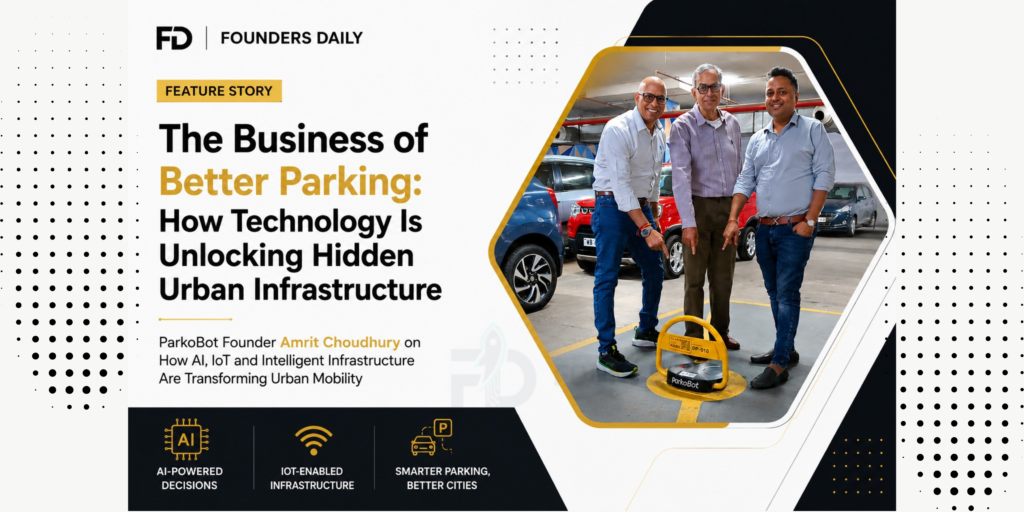
ParkoBot Founder Amrit Choudhury on How AI, IoT and Intelligent Infrastructure Are Transforming Urban Mobility
India’s urban mobility challenges are often viewed through the lens of expanding road networks, metro rail systems, electric vehicles and public transport. Yet, one of the most persistent causes of congestion continues to receive surprisingly little attention, parking. Every day, thousands of motorists spend valuable time driving in circles outside office complexes, hospitals, schools and commercial districts in search of an available parking space. The irony is that while public roads remain crowded with vehicles looking for parking, countless privately owned parking bays remain vacant for hours.
For Amrit Choudhury, Founder and CEO of ParkoBot, this is not simply a parking problem; it is an infrastructure utilisation problem. Instead of asking how cities can build more parking spaces, he believes the more important question is how existing parking infrastructure can be used more intelligently.
Founded in 2023, ParkoBot is building what it describes as India’s first AI and IoT-powered intelligent parking ecosystem. By combining proprietary smart parking hardware with a cloud-based digital platform, the company enables users to discover, reserve and securely access private parking spaces while allowing commercial property owners to monetise underutilised parking assets. The broader objective, says Choudhury, is to make cities more efficient by improving the utilisation of infrastructure that already exists.
The idea, however, did not begin with parking.
Also Read: Raymond Realty Limited Announces 8th Major Joint Development Project in Mumbai
Choudhury traces its origins to nearly a decade ago during his previous technology venture, where he worked with global companies including Samsung and Apple on enterprise mobility solutions. While working on digital transformation projects, he realised that parking represented one of the few everyday urban challenges that technology had largely failed to address.
His initial instinct was to explore whether public parking infrastructure could be digitised in collaboration with government agencies. Those conversations, however, revealed that large-scale public infrastructure transformation would take time. Rather than waiting for that shift, he began examining private parking infrastructure and discovered what he believes is the root cause of India’s parking crisis.
“There are thousands of private parking spaces that remain unused for several hours every day while drivers struggle to find parking nearby,” Choudhury says. “The problem isn’t necessarily that we don’t have enough parking spaces. It’s that we don’t utilise the ones we already have efficiently.”
That insight became the foundation for ParkoBot’s business model, an intelligent marketplace that allows unused private parking spaces to be securely shared whenever owners are not using them. Choudhury likens the concept to the transformation brought about by home-sharing platforms, where underutilised assets can generate value without requiring additional infrastructure.
Technology sits at the centre of this ecosystem, but Choudhury is quick to point out that software alone cannot solve the problem. Every parking space must first become digitally connected.
To achieve this, ParkoBot has developed a proprietary IoT-enabled Smart Space Lock that is installed at individual parking bays. The device operates exclusively through authorised bookings made via the ParkoBot application, automatically granting access to registered users without manual intervention. This not only improves convenience for motorists but also ensures that property owners retain complete control over access and security.
Artificial Intelligence adds another layer of intelligence to the experience. Rather than merely displaying nearby parking options, the platform analyses factors such as the user’s destination, walking distance, prevailing traffic conditions and pricing preferences before recommending the most suitable parking spaces. Integrated Google Maps navigation, along with indoor navigation capabilities for larger commercial developments, helps users locate their exact parking space with minimal effort.
“The objective isn’t simply to help people find parking,” Choudhury explains. “It’s to help them save time and make urban mobility more efficient.”
While the solution benefits motorists, ParkoBot’s business model is equally focused on unlocking value for commercial real estate owners.
According to Choudhury, office buildings, business parks, shopping malls and commercial developments often experience predictable fluctuations in parking demand throughout the day. During these periods, hundreds of parking spaces may remain unused despite strong demand in surrounding areas.
By bringing these idle assets onto a secure digital platform, property owners gain an opportunity to create an additional revenue stream without compromising operational control. Residential communities, on the other hand, require a different approach due to security considerations. ParkoBot’s residential offering is therefore designed primarily around visitor and guest parking rather than unrestricted public access.
The concept appears to be resonating with the real estate sector. Choudhury says the company is already working with several leading developers, commercial landlords, REITs and co-working operators. A number of real estate developers have also invested in the company, reflecting growing confidence in the commercial potential of intelligent parking infrastructure.
For Choudhury, this growing interest signals a broader shift in how parking is being perceived within commercial real estate.
“Parking is no longer just an operational necessity,” he says. “It’s an underutilised asset that can generate measurable value when managed through technology.”
Although smart parking is often associated with government-led Smart City initiatives, Choudhury believes the opportunity extends far beyond metropolitan centres. Congestion, he points out, is not limited to India’s largest cities. Temple towns, tourist destinations, educational institutions, healthcare hubs and rapidly expanding Tier II cities all experience concentrated parking demand despite having unused private parking inventory nearby.
He illustrates the point with a simple example. A busy school may attract hundreds of vehicles during morning hours, while an adjacent office building has large sections of its parking facility sitting empty until employees arrive later in the day. Connecting these two ecosystems through technology creates value for both motorists and property owners without requiring additional land or new construction.
“Whenever high parking demand exists alongside unused private inventory, there is an opportunity to improve utilisation,” he says. “That’s the gap we’re trying to bridge.”
The company’s platform also uses Artificial Intelligence to determine commercial pricing. Rather than adopting a fixed revenue-sharing model, ParkoBot evaluates factors such as congestion levels, demand patterns, utilisation rates and location before recommending pricing that maximises occupancy and returns for parking hosts.
Building such an ecosystem, however, has required overcoming more than technological challenges.
According to Choudhury, changing long-established perceptions around ownership has been one of the company’s biggest hurdles. Many property owners are reluctant to allow others to use their parking spaces, even when those spaces remain vacant for extended periods.
He compares the shift to the early evolution of co-working spaces. Businesses once believed every employee required a permanently assigned desk, yet flexible workspaces eventually demonstrated that shared infrastructure could significantly improve utilisation without compromising convenience. Choudhury believes parking is now undergoing a similar transformation as more owners begin to recognise that an unused parking space is a dormant asset capable of generating recurring income.
Looking ahead, ParkoBot’s ambitions extend beyond parking alone.
Electric vehicle charging represents the company’s next area of expansion. As EV adoption accelerates across India, access to convenient charging infrastructure remains one of the biggest barriers, particularly for commercial fleets and app-based mobility operators. ParkoBot is working with charging infrastructure providers to convert selected parking locations into overnight charging hubs, allowing vehicles to be parked, charged and ready for use the following morning.
Beyond EV charging, the company is also developing AI-enabled access control solutions that automate entry and exit for commercial buildings, reducing waiting times while improving security and operational efficiency. Choudhury sees these technologies as natural extensions of a broader intelligent mobility ecosystem where parking, access management and digital infrastructure work together seamlessly.
For India’s rapidly growing cities, the future of mobility will depend not only on building new infrastructure but also on making existing infrastructure significantly more efficient. Choudhury believes parking represents one of the clearest opportunities to achieve that goal.
“If we can make better use of the parking spaces that already exist,” he says, “we can reduce congestion, improve urban mobility and create smarter cities without having to build everything from scratch.”
Also Read: Pune to Host India’s Largest Integrated EV, Battery & Solar Energy Exhibition from 2–4 October 2026
In a country where urban land is scarce and infrastructure investments are increasingly expensive, that philosophy may prove just as important as building the next road or metro line. Sometimes, the smartest solution is not creating more space, but making every existing space count.