Why the Next Generation Will Be Hired for What They Can Build, Not Just What They Know
Introduction
For generations, education and employment followed a relatively predictable path. Students acquired knowledge, earned credentials, and entered the workforce with the expectation that academic achievement would translate into professional opportunity. Degrees became signals of competence, universities became gateways to careers, and employers relied heavily on educational qualifications when evaluating talent.
That model helped build the industrial economy and later supported the rise of the knowledge economy. But in 2026, a new reality is emerging.
Artificial intelligence can generate reports, write code, analyze data, create marketing campaigns, and answer complex questions in seconds. Information that once required years of study is now accessible through a smartphone. Knowledge has become more available than at any point in human history.
Also Read: The New CAC Formula: How AI Is Cutting Acquisition Costs by 70%
Yet despite unprecedented access to information, founders, CEOs, and hiring managers continue to report the same challenge.
Finding people who can execute.
Across startup ecosystems, technology companies, and global enterprises, organizations are increasingly searching for individuals who can solve problems, take ownership, navigate uncertainty, and deliver measurable outcomes. They are looking for operators.
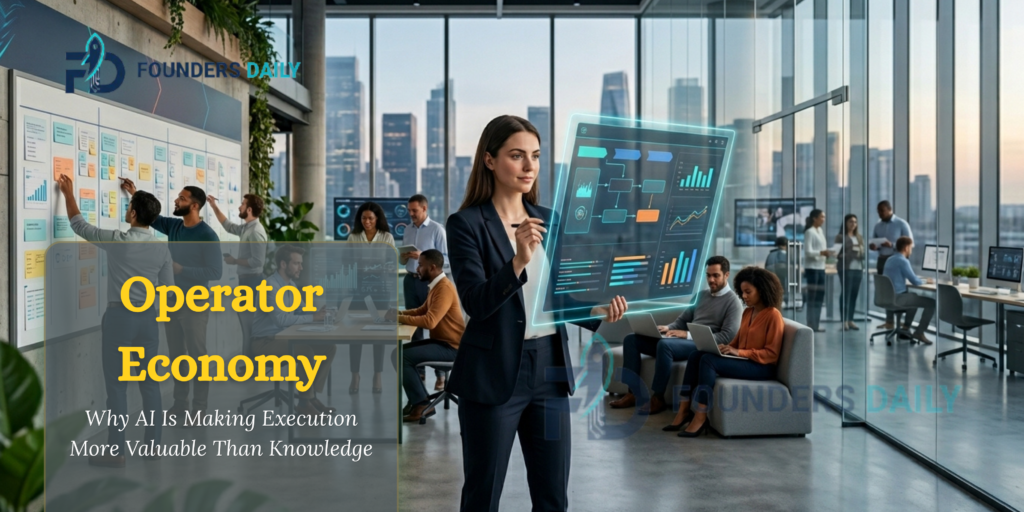
This shift is creating what can best be described as the Operator Economy, an environment where value is increasingly determined by the ability to apply knowledge rather than simply possess it.
The implications extend far beyond hiring. They raise important questions about education, workforce development, and the future of economic opportunity itself. If execution is becoming the most valuable skill in the modern economy, educational institutions must rethink how they prepare individuals for the world ahead.
The Day Knowledge Lost Its Scarcity
For centuries, access to knowledge represented one of the greatest barriers to advancement.
Books were expensive. Experts were scarce. Universities served as the primary source of specialized information. Individuals who possessed knowledge held a significant advantage because information itself was difficult to obtain.
The internet changed that dynamic.
Search engines made information accessible. Smartphones placed knowledge in people’s pockets. Online learning platforms opened classrooms to millions of learners around the world.
Artificial intelligence has accelerated this transformation even further.
Today, nearly anyone can access expert-level explanations, business frameworks, coding tutorials, and research insights within minutes. Information is no longer scarce.
Application is.
This distinction may appear subtle, but it has profound implications for how talent is evaluated.
When knowledge becomes abundant, competitive advantage shifts elsewhere. Organizations begin rewarding judgment, adaptability, creativity, communication, and execution. The ability to transform information into outcomes becomes more valuable than information itself.
For founders building companies in highly competitive markets, this shift is impossible to ignore. A startup does not succeed because its employees know the most. It succeeds because its team can move quickly, solve problems effectively, and execute consistently under pressure.
The modern economy increasingly rewards those same capabilities.
Why Founders Are Hiring Operators
Ask almost any founder about their most difficult challenge and talent will appear near the top of the list.
Not talent in the traditional sense.
Operational talent.
The kind of people who can identify opportunities, manage projects, communicate across functions, and create momentum without constant supervision.
Startups today operate in environments characterized by speed, uncertainty, and resource constraints. Teams are often smaller than they were a decade ago, yet expectations are significantly higher. Artificial intelligence and automation have increased productivity, but they have also raised the standard for human contribution.
As a result, founders increasingly prioritize ownership over credentials.
A candidate who has launched a product, built a community, managed a project, or created measurable business results often attracts more attention than someone whose achievements exist solely within academic settings.
This does not mean degrees have become irrelevant. Rather, it means degrees are no longer sufficient on their own.
The Operator Economy rewards proof of execution.
Employers want evidence that individuals can translate ideas into outcomes. They want people who understand how to work through ambiguity, recover from setbacks, and continuously improve systems and processes.
In many organizations, these qualities have become more valuable than technical expertise alone.
The Degree Is Not Dead. But Its Monopoly Is.
One of the most misunderstood aspects of the modern workforce transformation is the assumption that degrees no longer matter.
They do.
Higher education continues to provide valuable foundations in critical thinking, communication, research, and domain expertise. Universities remain essential institutions within society.
What is changing is the degree’s position as the primary signal of capability.
Employers now have access to additional indicators of talent. Portfolios, certifications, side projects, open-source contributions, entrepreneurial ventures, internships, and professional communities all provide insights into an individual’s ability to create value.
This diversification of talent signals benefits both employers and learners.
Organizations gain access to a broader talent pool. Individuals gain more opportunities to demonstrate capability beyond traditional academic pathways.
The result is a more dynamic and outcome-oriented labor market.
In the Operator Economy, credentials open doors.
Capabilities keep them open.
The Future of Education
The future of education will not be defined by abandoning traditional learning. It will be defined by expanding it.
Educational institutions must increasingly focus on helping students develop the capabilities that modern economies reward. This includes communication, collaboration, systems thinking, leadership, digital fluency, problem-solving, and adaptability.
Equally important is creating opportunities for experiential learning. Internships, apprenticeships, startup projects, industry partnerships, and real-world problem-solving experiences allow learners to bridge the gap between theory and practice.
The most effective educational systems of the future will not simply transfer information.
They will develop operators.
Individuals capable of learning continuously, adapting quickly, and creating meaningful outcomes in rapidly changing environments.
Also Read: AI Tools Every Founder Must Understand in 2026
Conclusion
The Operator Economy is not eliminating the value of education. It is redefining its purpose.
Knowledge remains important. Expertise remains valuable. Academic achievement continues to matter.
However, the modern economy increasingly rewards individuals who can transform learning into action.
For founders, this means rethinking how talent is identified and developed. For educators, it means reimagining how learning experiences are designed. For students and professionals, it means recognizing that lifelong success will depend not only on what they know, but on what they can build, improve, and execute.
The future belongs to learners.
But it belongs even more to operators.