New Delhi: Nirmala Sitharaman has outlined an ambitious roadmap for transforming India into a global textile powerhouse, setting targets of USD 100 billion in textile exports and USD 250 billion in textile production by 2030.
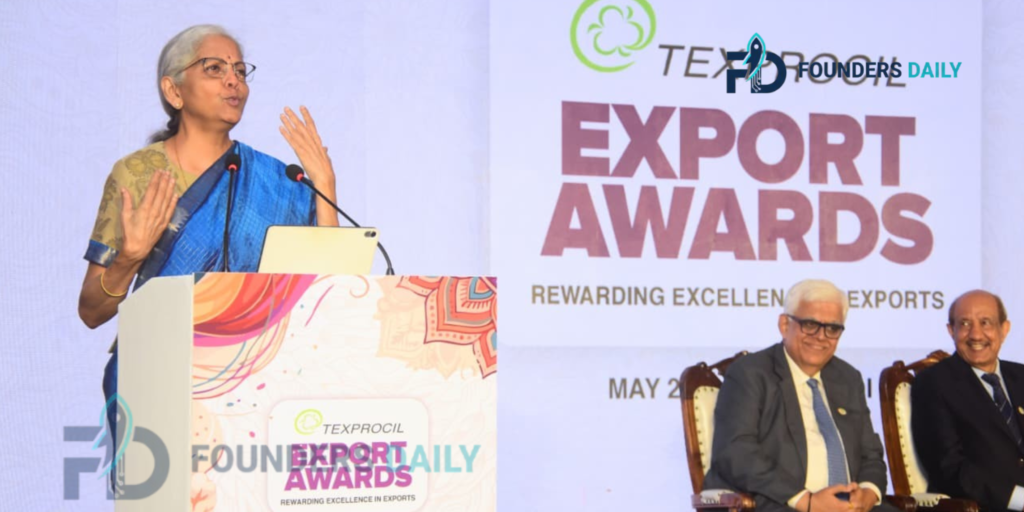
Addressing the TEXPROCIL Export Awards 2023–24 ceremony in Mumbai, the Finance Minister emphasized the need to strengthen the textile value chain “from farm to fibre, factory, fashion and foreign markets” to create a globally competitive and employment-intensive textile ecosystem.
The event was organised by The Cotton Textiles Export Promotion Council (TEXPROCIL), which honoured leading exporters for achievements in export performance, innovation, sustainability initiatives, employment generation, and e-commerce excellence.
Also Read: India, Canada Reaffirm $50 Billion Trade Goal as Piyush Goyal Pushes CEPA During Toronto Visit
Textile Sector Critical to India’s Growth Vision
Sitharaman said India’s vision of becoming a developed economy under the “Viksit Bharat 2047” roadmap would require accelerated growth in sectors capable of generating large-scale employment and export revenues — with textiles playing a central role.
India’s textile and apparel industry remains one of the country’s largest employment-generating sectors, supporting nearly six crore livelihoods directly and indirectly.
The Finance Minister highlighted that India is currently the world’s sixth-largest textile exporter, with the industry contributing approximately 2.3% to the country’s GDP and nearly 12% of total export earnings.
According to the minister, India’s textile exports reached around USD 33.5 billion in FY26, underscoring the scale of opportunity available for future expansion.
Government Targets Massive Scale Expansion
The government’s target of achieving USD 100 billion in textile exports by 2030 represents nearly a threefold increase from current levels.
To support this growth, the Centre is focusing on:
- Infrastructure development
- Technology modernisation
- Skill development
- Sustainability initiatives
- Global market expansion
- Supply chain integration
Sitharaman said the goal is to build a robust textile ecosystem capable of competing with leading textile manufacturing nations such as China, Bangladesh, Vietnam, and Turkey.
PM MITRA Parks to Boost Manufacturing
One of the government’s flagship initiatives for the sector is the PM MITRA Parks scheme.
Under this initiative, seven mega textile parks are being developed across different states to create integrated textile manufacturing ecosystems with world-class infrastructure.
The Finance Minister said investment memorandums worth over ₹27,000 crore have already been signed under the scheme.
These parks aim to reduce logistics costs, improve supply chain efficiency, and strengthen India’s position as a global textile sourcing destination.
The integrated model is designed to bring together:
- Spinning
- Weaving
- Processing
- Dyeing
- Garment manufacturing
- Logistics and exports
within a single ecosystem.
Focus on Technology and Modernisation
The government is also prioritizing technology upgrades across the textile sector.
Sitharaman highlighted the role of the Amended Technology Upgradation Fund Scheme (ATUFS), launched in 2016 to encourage modernisation and automation.
The scheme provides capital and interest subsidies to textile businesses investing in advanced machinery and technology upgrades.
Modernisation is becoming increasingly important as global buyers demand:
- Faster production cycles
- Sustainable manufacturing
- Higher quality standards
- Traceability and compliance
- ESG-focused supply chains
Skilling and Employment Initiatives
The Finance Minister also discussed the importance of workforce development in supporting long-term growth.
The Samarth Scheme was highlighted as a major initiative aimed at training and empowering workers, particularly women and marginalised communities.
Textiles remain one of India’s largest labour-intensive industries, making skill development crucial for employment generation and social inclusion.
According to industry estimates, the sector supports approximately 35 million jobs within the broader cotton textile ecosystem alone.
India’s Textile Heritage and Global Identity
During her address, Sitharaman referred to India’s ancient textile traditions dating back to the Sindhu-Saraswati civilisation, citing archaeological evidence of weaving and textile craftsmanship.
She noted that India’s textile heritage continues to shape the country’s global identity, from handlooms and cotton fabrics to premium apparel and sustainable textile products.
India has historically been known for:
- Cotton and khadi
- Silk and handlooms
- Traditional weaving clusters
- Sustainable natural fibres
- Artisanal craftsmanship
The government now aims to combine this heritage with modern manufacturing and technology capabilities.
Sustainability Emerging as Key Focus Area
Sustainability and traceability are increasingly becoming critical factors in global textile trade.
TEXPROCIL Chairman Vijay Agarwal highlighted efforts to strengthen India’s sustainable textile positioning through the promotion of Kasturi Cotton.
The initiative focuses on:
- Cotton branding
- Certification systems
- Traceability
- Sustainable sourcing
as India attempts to strengthen its reputation in environmentally responsible textile manufacturing.
Global fashion brands and retailers are increasingly prioritizing ethical sourcing, sustainable production, and ESG compliance in their supply chains.
New Export Training Programme Launched
During the event, Sitharaman also launched TEXPROCIL’s Advanced Certificate Programme in International Trade (ACPIT).
The programme has been designed to strengthen India’s export ecosystem by improving industry capabilities in:
- International trade practices
- Export compliance
- Documentation
- Trade finance
- Global market competitiveness
The initiative aligns with broader government efforts to boost India’s export readiness and improve competitiveness in international markets.
Industry at a Turning Point
India’s textile sector is entering a crucial phase as global supply chains undergo transformation.
Factors such as:
- China-plus-one sourcing strategies
- Rising global demand for sustainable textiles
- Digital trade expansion
- Supply chain diversification
are creating new opportunities for Indian manufacturers and exporters.
At the same time, competition from countries such as Bangladesh and Vietnam remains intense, making infrastructure, productivity, and quality improvements essential.
Also Read: Customer Retention Will Matter More Than Acquisition in 2026
Road Ahead
With ambitious export targets, infrastructure investments, skilling programmes, and sustainability initiatives, India is positioning itself for a larger role in the global textile economy.
If successfully implemented, the government’s roadmap could significantly boost manufacturing, exports, employment generation, and India’s position in global supply chains over the coming decade.
The textile sector’s transformation is also expected to play a major role in supporting India’s broader economic ambition of becoming a developed economy by 2047.