
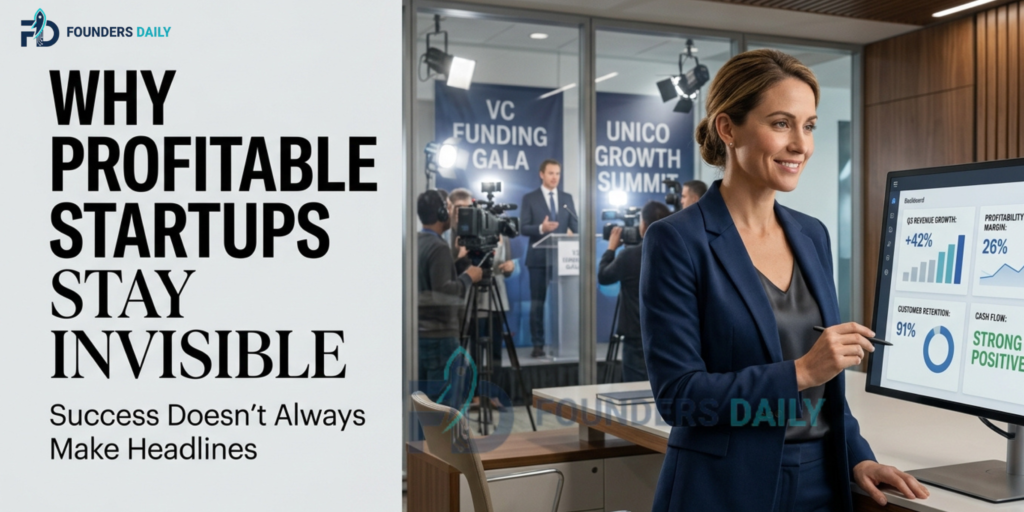
The Startup Ecosystem Celebrates Funding. The Market Rewards Profitability.
In today’s startup ecosystem, visibility and success are often treated as interchangeable concepts. Funding announcements dominate headlines. Unicorn valuations generate social media excitement. Founders who raise large rounds are celebrated as industry leaders. Yet beneath the surface of this highly visible startup economy exists another category of companies that rarely receive the same attention.
These are profitable startups.
They are businesses generating healthy cash flows, serving real customers, and building sustainable operations. They may not announce massive funding rounds or appear regularly in startup rankings, but they often possess something many high-profile companies struggle to achieve. They make money consistently.
This creates an interesting paradox. Some of the most financially healthy businesses in the startup ecosystem remain largely invisible, while companies losing millions of dollars receive widespread media attention. The question is not whether profitable startups exist. The question is why they receive so little recognition.
The answer reveals important truths about how modern entrepreneurship is measured, marketed, and understood.
Also Read: 2026 Funding Landscape: What VCs Are Actually Betting On
The Attention Economy Rewards Growth Stories
Startup visibility is heavily influenced by the economics of attention.
Investors, journalists, industry analysts, and social media audiences are naturally drawn toward stories that signal rapid change. A startup raising a large funding round represents a narrative of ambition, scale, and future potential. Funding announcements provide clear numbers, recognizable investors, and compelling growth projections.
Profitability is different.
A profitable startup often grows gradually. Revenue increases steadily. Customer retention improves. Margins expand over time. These developments may be impressive from a business perspective, but they are less dramatic from a storytelling perspective.
As a result, profitability rarely generates the same level of attention as funding.
The startup ecosystem has become exceptionally effective at celebrating future possibilities. It is often less effective at recognizing present financial performance.
This imbalance shapes public perception of what startup success actually looks like.
Why Investors and Media Focus on Funding
The relationship between venture capital and media attention plays a significant role in startup visibility.
When investors commit millions of dollars to a company, the investment itself becomes newsworthy. Funding rounds provide measurable milestones that journalists can report. Investors gain visibility. Founders gain credibility. Companies gain exposure.
This creates a cycle.
Media coverage attracts talent, customers, and additional investor interest. Increased visibility generates more opportunities for growth. Companies become known not only for what they have achieved but also for what investors believe they might achieve in the future.
Profitable startups often operate outside this cycle.
Many bootstrap their growth. They rely on customer revenue rather than external capital. They focus on operational efficiency rather than aggressive expansion. As a result, they have fewer newsworthy events that attract media attention.
Ironically, the absence of publicity often reflects financial strength rather than weakness.
The Quiet Strength of Capital Efficient Businesses
Capital efficiency rarely receives the recognition it deserves.
In a funding-driven environment, raising money is frequently viewed as evidence of success. However, capital efficient startups demonstrate a different kind of achievement. They create value without relying heavily on external funding.
These companies learn to prioritize customer needs because customers become their primary source of growth capital. They develop disciplined financial practices because profitability matters from the beginning. They make decisions based on sustainability rather than short-term valuation increases.
Over time, this discipline often becomes a competitive advantage.
When economic conditions become challenging, capital efficient businesses tend to have greater flexibility. They are less dependent on investor sentiment. They face fewer pressures related to fundraising cycles. They can focus on serving customers rather than constantly securing new capital.
Yet these strengths frequently remain invisible because they do not generate the headlines associated with venture-backed growth.
Profitability Does Not Fit the Startup Myth
The startup world has long been influenced by a particular narrative.
According to this narrative, successful companies prioritize growth above everything else. Profitability can wait. Market share matters more than margins. Expansion takes precedence over efficiency.
This approach has produced some remarkable businesses. It has also created a perception that profitability is somehow less ambitious than rapid growth.
In reality, profitability and ambition are not opposites.
Some founders deliberately choose sustainable growth because it provides greater control over their businesses. Others focus on profitability because it creates resilience during uncertain market conditions. Many recognize that long-term value creation often depends on balancing growth with financial discipline.
The challenge is that these stories do not always align with popular startup mythology.
As a result, profitable companies frequently receive less attention despite demonstrating exceptional business fundamentals.
Customer Revenue Is Often More Valuable Than Investor Capital
One of the most overlooked realities in entrepreneurship is that customer revenue represents validation in its purest form.
Investors fund potential. Customers fund value.
When customers repeatedly pay for a product or service, they provide direct evidence that the business solves a meaningful problem. Revenue becomes a signal of market demand, customer trust, and operational effectiveness.
Profitable startups depend heavily on this type of validation.
Rather than optimizing primarily for investor expectations, they optimize for customer satisfaction and retention. Every dollar earned reflects a successful exchange of value.
This creates a stronger connection between business performance and customer outcomes.
Yet customer-funded growth often attracts less attention than investor-funded growth, even though it may represent a more sustainable foundation for long-term success.
Why Founders Sometimes Prefer Staying Invisible
Not every startup wants attention.
Many founders intentionally avoid the spotlight because visibility introduces new challenges. Public attention can create pressure, distractions, and unrealistic expectations. It can shift focus away from customers and toward perception management.
Profitable founders often prioritize execution over publicity.
They spend less time building personal brands and more time improving products. They focus on profitability metrics instead of social media engagement. They invest energy into operations rather than public relations.
This approach may limit visibility, but it often strengthens business fundamentals.
Some of the most successful entrepreneurs operate quietly for years before the broader market recognizes their achievements. By the time attention arrives, the business is already highly resilient and financially healthy.
Their invisibility was not accidental. It was strategic.
The Market Is Beginning to Reevaluate Success
Recent economic uncertainty has prompted a shift in how startup performance is evaluated.
Investors are paying closer attention to profitability, cash flow management, and operational efficiency. Growth remains important, but sustainable growth is becoming increasingly valuable.
This shift reflects a broader recognition that business resilience matters.
Companies capable of generating profits, retaining customers, and managing resources effectively are often better positioned to navigate challenging environments. As a result, many previously overlooked startups are gaining new appreciation.
The conversation is changing.
Entrepreneurs, investors, and industry observers are beginning to recognize that visibility and value are not always connected. Some highly visible businesses struggle financially. Some largely invisible businesses generate extraordinary results.
Understanding this distinction may become increasingly important as the startup ecosystem matures.
The Future May Belong to the Quiet Builders
The next generation of startup success stories may look different from those that dominated previous decades.
Rather than pursuing visibility at all costs, many founders are focusing on durability. Rather than optimizing exclusively for fundraising, they are prioritizing profitability. Rather than chasing attention, they are concentrating on customer value.
These entrepreneurs understand that headlines do not pay salaries. Social media engagement does not guarantee sustainability. Public recognition does not automatically create business success.
Customers do.
Revenue does.
Profitability does.
The founders building enduring companies often recognize these truths early and structure their businesses accordingly.
Also Read: Why Only Disciplined Startups Will Survive
Conclusion
Profitable startups stay invisible for many reasons. Media incentives favor funding announcements. Venture capital creates attention. Growth narratives dominate entrepreneurship discussions. Meanwhile, sustainable businesses quietly focus on customers, profitability, and long-term value creation.
Yet invisibility should not be mistaken for insignificance.
Many of the strongest companies in the startup ecosystem operate far from the spotlight. They generate profits, create jobs, solve meaningful problems, and build resilient business models without attracting constant attention.
As the startup world continues to evolve, profitability may become one of the most important indicators of success.
And when that happens, the invisible companies of today may become the most respected businesses of tomorrow.