Why India’s Next Healthcare Transformation Could Happen Far Beyond Its Biggest Cities
India’s healthcare story has traditionally been written from its largest cities. Mumbai, Delhi, Bengaluru, Hyderabad, Chennai and Pune have emerged as centres of advanced hospitals, specialist medicine, health-tech startups and medical research, creating an ecosystem in which technology and capital increasingly converge around urban consumers. Yet some of the country’s most consequential healthcare innovations are beginning to emerge outside this familiar geography. The next phase of India’s healthcare transformation may not be defined by how sophisticated its metropolitan hospitals become, but by how effectively technology and new delivery models can take quality care closer to the millions of people who live beyond the country’s major urban centres.
That shift is important because India’s healthcare challenge has never been simply a question of medical capability. The country has world-class doctors, hospitals, pharmaceutical companies and increasingly sophisticated health-tech businesses. The larger difficulty has been distribution. A specialist may exist in a major city, a diagnostic facility may have the required equipment and a digital health platform may be capable of connecting a patient with a doctor, but these capabilities do not automatically translate into accessible healthcare for someone living several hours away from the nearest urban centre. Distance, affordability, fragmented records, limited diagnostic infrastructure and shortages of specialised medical professionals continue to influence how quickly and effectively patients can receive care.
Also Read: Every Purchase Is a Decision for the Planet: Pushkar Deshpande on Rethinking Sustainable Consumption
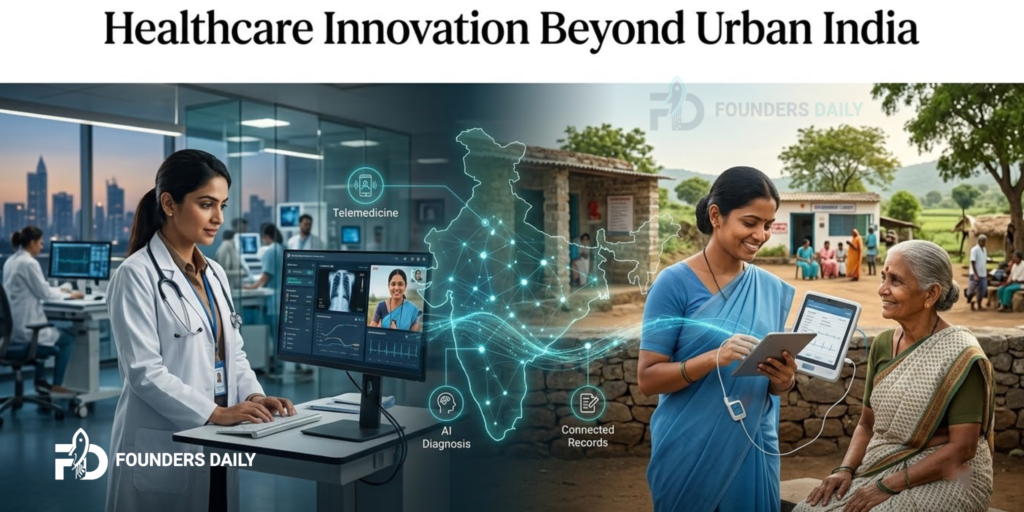
Technology is beginning to alter that equation. Telemedicine, artificial intelligence, portable diagnostics, digital health records and connected medical devices are creating the possibility of a healthcare system in which expertise does not necessarily have to be physically located where the patient is. India’s Ayushman Bharat Digital Mission is an important part of this transition. By August 2025, the government reported that more than 79.9 crore ABHA accounts had been created, alongside more than 4.18 lakh registered health facilities and 6.79 lakh healthcare professionals on the digital health ecosystem. The significance of these numbers extends beyond digitisation itself: they point towards an emerging infrastructure through which patient information and healthcare services can increasingly move across institutions and geographies.
But the real test of digital healthcare will not be the number of accounts created or consultations conducted online. It will be whether these systems can become part of the everyday healthcare journey of patients who have historically remained outside India’s most sophisticated medical networks.
That is where the role of the local healthcare worker becomes particularly important.
Rather than replacing the human element of healthcare, technology could strengthen it. An ASHA worker, nurse, pharmacist or community health professional equipped with appropriate digital tools can become the connecting layer between a patient and a much larger medical ecosystem. A basic screening performed locally could potentially be reviewed remotely; an AI-enabled system could assist with preliminary identification of abnormalities; a specialist could provide a consultation from another city; and the patient’s medical information could remain available digitally for subsequent consultations. In such a model, the technology does not attempt to eliminate the distance between the patient and the healthcare system overnight. Instead, it progressively reduces the friction created by that distance.
This distinction matters because rural healthcare cannot simply be an urban healthcare model transported to a different geography. The economics and operating conditions are fundamentally different. Connectivity can be inconsistent, devices can be expensive, specialist availability can be limited and patients may prefer interacting with healthcare workers they already know and trust. A successful solution therefore has to be designed around the realities of the market rather than around the capabilities of the technology itself.
Artificial intelligence could become particularly significant in this environment. Much of the current conversation around AI in healthcare focuses on sophisticated hospitals and advanced clinical applications, but its broader impact may come from its ability to extend limited healthcare capacity. AI-assisted screening, medical imaging, triage, documentation and decision-support systems could allow healthcare professionals to process more information and identify potential risks earlier. Initiatives such as Wadhwani AI’s HealthVaani demonstrate how multilingual AI tools are being developed to support frontline health workers, indicating a direction in which AI becomes an augmentation layer rather than a replacement for human healthcare professionals.
Diagnostics could be another major frontier. In many parts of India, the difficulty is not necessarily reaching a doctor for a consultation; it is obtaining the diagnostic information required to make that consultation clinically meaningful. Portable diagnostic devices and point-of-care testing can change this equation by moving certain capabilities closer to the patient. As these technologies become cheaper and more reliable, primary healthcare centres, mobile medical units and community-level facilities could potentially perform tests that previously required patients to travel to larger towns or cities.
Even logistics is becoming part of healthcare innovation. The emergence of drone-based medical delivery models illustrates how companies are attempting to address one of the less visible barriers to rural healthcare: moving medicines, vaccines and medical samples across difficult terrain and long distances. NITI Aayog has documented the use of hybrid e-VTOL drones for healthcare delivery in remote areas, highlighting how emerging mobility technologies can complement rather than replace conventional healthcare infrastructure.
Yet the most important question is not whether India possesses these technologies. Increasingly, it does. The question is whether they can be integrated into a financially sustainable and clinically reliable system.
That will require a different kind of thinking from healthcare companies, technology businesses and policymakers. Building a sophisticated application is relatively straightforward compared with creating the infrastructure, partnerships, training mechanisms and referral networks required to make that application useful in a remote community. The winning models are therefore unlikely to be those that simply add another digital layer to healthcare. They will be those that connect patients, frontline workers, diagnostics, specialists, pharmacies, hospitals and public health infrastructure into a single, dependable network.
There is also a significant business opportunity embedded in this transition. As healthcare demand expands across Tier-2 and Tier-3 cities, the market beyond the metros is becoming increasingly relevant to hospitals, diagnostic companies, medtech manufacturers, health-tech startups and investors. The opportunity is not simply to build smaller versions of metropolitan hospitals. It is to rethink the delivery architecture itself—combining physical infrastructure with digital services, remote expertise, decentralised diagnostics and technology-enabled follow-up care. NITI Aayog has previously identified the expansion of private healthcare into Tier-2 and Tier-3 markets, along with opportunities in diagnostics, medical devices and telemedicine, as important areas of potential growth.
However, innovation without trust can become another barrier. As AI increasingly enters clinical workflows, questions around patient consent, data governance, accountability, clinical validation and liability will become more important. The healthcare industry cannot afford to treat these issues as secondary considerations. A patient who does not understand how their information is being used, or a doctor who cannot determine who is accountable for an AI-assisted recommendation, will ultimately undermine adoption no matter how sophisticated the underlying technology may be.
The opportunity, therefore, is much larger than digitising rural healthcare.
It is about redesigning how healthcare reaches people.
For decades, the conventional model has required patients to move towards healthcare infrastructure. The emerging model offers the possibility of moving a greater share of healthcare capability towards the patient. That could mean a diagnostic device travelling to a village rather than a patient travelling to a city; a specialist consultation crossing state boundaries digitally rather than a family spending an entire day travelling; or a frontline healthcare worker using technology to identify a potential health risk before it becomes an emergency.
This is where India’s healthcare innovation story becomes particularly significant. The country’s scale makes it difficult to solve access purely by building more hospitals, more laboratories and more specialist centres. Physical infrastructure will remain essential, but technology can potentially make each layer of that infrastructure reach further.
The next decade, therefore, may produce a very different healthcare map of India. The country’s largest cities will continue to be centres of medical excellence, but innovation will increasingly be judged by what happens outside them. The most valuable healthcare companies may not necessarily be those that build the most impressive facilities; they may be those that successfully connect fragmented pieces of the healthcare system and make quality care available closer to where people actually live.
Also Read: Why AI Strategy Is a Leadership Issue
India’s healthcare revolution will ultimately be measured not by how advanced its best hospitals can become, but by how far the benefits of that advancement can travel.
That is the real opportunity beyond urban India: not simply to take healthcare technology to the last mile, but to build a healthcare system in which the last mile is no longer the forgotten mile.