Introduction
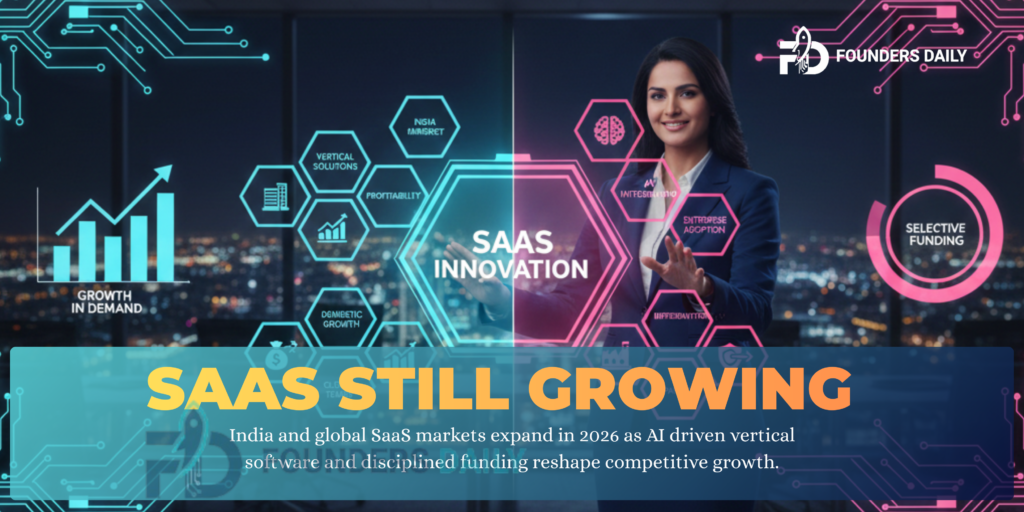
The narrative that the software as a service market is saturated has gained momentum in recent years, particularly as thousands of new tools enter the market each quarter. However, industry data from India and global markets suggests a more nuanced reality. While competition has intensified, demand for differentiated and industry specific SaaS solutions continues to expand.
In 2026, both Indian and global SaaS ecosystems are demonstrating growth, but with clear structural shifts. The issue facing many startups is not market saturation, but the absence of product depth, vertical specialization, and sustainable unit economics.
Global SaaS Market Continues to Expand
Globally, enterprise spending on cloud based software remains strong, driven by artificial intelligence integration, cybersecurity needs, and digital transformation mandates. Industry research firms estimate that global SaaS revenue will continue to grow at double digit rates through the end of the decade, supported by enterprise modernization and automation initiatives.
Large enterprises are replacing legacy systems with subscription based SaaS platforms that offer scalability and data intelligence. At the same time, small and medium businesses are increasing adoption of SaaS tools for accounting, customer relationship management, workflow automation, and remote collaboration.
Despite increased competition, analysts note that churn rates remain lower for companies that focus on vertical SaaS or deliver measurable return on investment. This indicates that demand persists for high value solutions, even in crowded categories.
India’s SaaS Ecosystem Shows Structural Maturity
India has emerged as one of the fastest growing SaaS markets globally. According to multiple industry reports, Indian SaaS companies are expanding both domestically and internationally, with a growing number generating revenue from North America and Europe.
However, funding patterns have shifted. Venture capital investment in Indian SaaS startups has become more selective, with investors prioritizing profitability, customer retention, and efficient capital use over aggressive growth at any cost.
This shift has created the perception of saturation among early stage founders. In reality, the ecosystem is entering a phase of maturity. Investors are backing companies that demonstrate strong unit economics, lower customer acquisition costs, and high net revenue retention.
The Indian market also presents a dual opportunity. Domestic small and medium enterprises are increasingly digitizing operations, while globally competitive Indian SaaS startups are exporting software services worldwide. This dual market dynamic continues to create space for innovation.
Also Read: https://foundersdailyg.com/technology/ai-as-a-business-model
The Rise of Vertical SaaS in India and Abroad
One of the most significant global trends in 2026 is the rise of vertical SaaS. Rather than building broad horizontal tools, startups are targeting specific industries such as healthcare, fintech, logistics, manufacturing, and education.
In India, vertical SaaS platforms addressing compliance, GST automation, supply chain digitization, and regional language integration are gaining traction. These solutions address localized pain points that generic global platforms often overlook.
Globally, vertical SaaS companies are achieving higher customer lifetime value and stronger retention rates because they integrate deeply into industry workflows. Analysts suggest that industry specialization increases switching costs and creates defensible competitive advantages.
The shift toward specialization suggests that while generic software categories may appear crowded, niche markets remain under served.
AI Integration Changes Competitive Dynamics
Artificial intelligence has further transformed the SaaS landscape. AI powered analytics, predictive automation, and workflow optimization are becoming standard features across software platforms.
However, the presence of AI does not automatically create differentiation. Market observers note that many startups simply layer AI interfaces onto existing workflows without fundamentally improving outcomes.
Successful companies, both in India and globally, are embedding AI in ways that reduce operational costs, improve decision accuracy, or automate high friction processes. In sectors such as financial services and ecommerce, AI driven SaaS platforms are demonstrating measurable gains in efficiency and revenue optimization.
The distinction between trend driven products and problem driven innovation remains central to long term success.
Funding Environment Reflects Quality Over Quantity
The global venture capital environment has become more disciplined compared to the previous funding cycle. Investors now emphasize profitability timelines, sustainable growth, and realistic valuation metrics.
In India, several SaaS startups have achieved profitability without raising significant external capital, demonstrating that capital efficiency remains achievable in the sector. Globally, late stage SaaS companies are focusing on margin expansion and enterprise expansion revenue.
This environment may discourage opportunistic founders but continues to reward those with strong fundamentals. Analysts argue that market corrections often remove weaker products while strengthening serious operators.
Why the Saturation Narrative Persists
The perception of saturation largely stems from the visibility of similar tools in highly competitive segments such as project management, marketing automation, and CRM software.
Search engine results display dozens of comparable solutions, giving the impression that new entrants have little room. However, customer dissatisfaction with existing tools remains common, particularly regarding onboarding complexity, pricing transparency, and customer support responsiveness.
In both India and global markets, businesses continue to seek alternatives that better fit their operational models. This ongoing demand suggests that competition does not eliminate opportunity. Instead, it raises the bar for execution.
Also Read: https://foundersdailyg.com/technology/rise-of-zero-code-startups-2026
Outlook for 2026 and Beyond
Industry experts believe the SaaS sector will continue to grow, but with increasing emphasis on depth, specialization, and measurable business impact. AI integration, regulatory changes, cybersecurity concerns, and industry digitization will continue to generate new software needs.
For Indian founders, global market access remains a significant advantage. The ability to build cost efficient engineering teams while selling to international markets continues to strengthen India’s position in the SaaS economy.
Globally, enterprise modernization cycles and automation mandates provide structural demand that supports continued expansion.
The broader conclusion emerging from India and global comparisons is clear. The SaaS market is not saturated in absolute terms. It is competitive, disciplined, and increasingly outcome driven. Companies that deliver clear value continue to find traction, funding, and long term viability.