
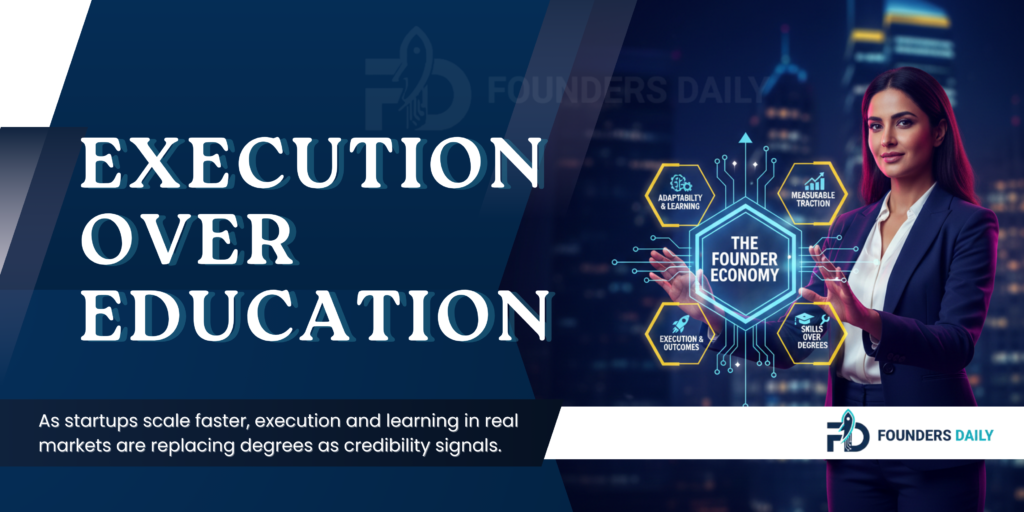
For much of the last century, academic degrees served as the primary gateway to professional credibility. They were widely accepted as proof of competence, discipline, and readiness for responsibility. However, the rapid expansion of the founder economy is challenging this long-standing assumption. Across startups, digital enterprises, and new-age businesses, degrees are increasingly viewed as optional rather than essential.
This shift reflects a broader transformation in how value is created and evaluated in modern economies. As entrepreneurship becomes more accessible and markets evolve at unprecedented speed, the emphasis is moving away from formal credentials toward execution, adaptability, and measurable outcomes.
The Rise of the Founder Economy
The founder economy refers to a landscape in which individuals can build companies with limited institutional support. Cloud infrastructure, digital distribution, global payment systems, and open-source tools have reduced the cost of starting and scaling businesses. As a result, founders today operate in environments where speed and decision-making matter more than traditional qualifications.
In such settings, success is determined by traction, customer adoption, and operational effectiveness. Degrees, while still respected, no longer function as decisive signals of capability. This is one of the central reasons degrees are losing value in the founder economy.
A Growing Disconnect Between Academia and Market Needs
One of the most significant factors contributing to this shift is the widening gap between academic curricula and real-world business demands. University programs often struggle to keep pace with rapid changes in technology, consumer behavior, and regulatory frameworks. Skills related to artificial intelligence, digital growth, data-driven decision-making, and product execution frequently evolve faster than formal education systems can adapt.
Founders, on the other hand, are required to learn continuously in real market conditions. They acquire knowledge through experimentation, failure, and iteration. This hands-on learning process produces practical judgment and resilience that are difficult to replicate through theoretical instruction alone.
Execution as the Primary Measure of Competence
In the founder economy, execution has emerged as the most credible form of validation. Investors, partners, and customers place greater trust in demonstrated results than in academic credentials. Metrics such as revenue growth, customer retention, scalability, and operational efficiency now carry more weight than degrees earned years earlier.
This emphasis on outcomes has reshaped how credibility is established. A founder who has built and scaled a product successfully is often considered more reliable than someone with strong academic qualifications but limited execution experience. As this mindset becomes more widespread, degrees naturally lose their dominance as markers of professional worth.
Shifting Attitudes Among Investors and Employers
Investment behavior provides further evidence of this transformation. Venture capital firms increasingly evaluate founders based on clarity of vision, market understanding, and adaptability rather than formal education. Many high-profile entrepreneurs have publicly stated that their degrees played little role in their entrepreneurial journeys.
Hiring practices within startups reflect similar priorities. Employers now focus on skill demonstration, problem-solving ability, and cultural alignment. Portfolios, project experience, and real-world performance are frequently valued more than academic transcripts, particularly in early-stage and growth-focused organizations.
The Emergence of Alternative Learning Pathways
As degrees lose relative importance, alternative education models are gaining traction. Online programs, industry bootcamps, mentorship networks, and peer-based learning communities offer targeted, practical knowledge aligned with current market needs. These pathways allow founders and professionals to acquire specific skills quickly and apply them immediately.
This shift toward continuous and modular learning aligns closely with the demands of entrepreneurship. Instead of viewing education as a one-time prerequisite, founders increasingly treat learning as an ongoing process tied directly to execution.
Degrees Are Evolving, Not Disappearing
Despite these trends, degrees have not become irrelevant. In regulated fields such as medicine, law, and engineering, formal education remains essential. Degrees also contribute to critical thinking, structured analysis, and long-term intellectual development.
However, within the founder economy, degrees have transitioned from being primary credentials to supplementary assets. They may enhance a founder’s profile, but they rarely determine success on their own. Execution, adaptability, and market impact now define professional credibility more clearly than formal qualifications.
Redefining How Value Is Assessed
At a broader level, the declining emphasis on degrees reflects a fundamental change in how societies assess competence. Trust is increasingly built through transparency, public work, and consistent delivery of results. Personal brands, documented experience, and visible impact now serve as powerful indicators of authority.
For aspiring founders, this evolution offers both opportunity and responsibility. While traditional barriers have lowered, expectations around performance and accountability have risen. Success is no longer granted through credentials alone, but earned through sustained execution.
Conclusion
The founder economy has reshaped the relationship between education and opportunity. Degrees continue to hold value, but they no longer define professional legitimacy or entrepreneurial potential. In an environment driven by speed, innovation, and outcomes, execution has become the true currency of credibility.
As entrepreneurship continues to expand, the ability to learn continuously, adapt quickly, and deliver measurable impact will matter far more than formal qualifications. Degrees may open doors, but in the founder economy, it is execution that determines how far one goes.