
For years, founder burnout has been discussed as a personal issue. Long hours, emotional fatigue, and constant pressure were framed as the private cost of ambition. If a founder struggled, the assumption was simple. They needed better time management, thicker skin, or more resilience. The business itself was rarely seen as being at risk.
That assumption no longer holds.
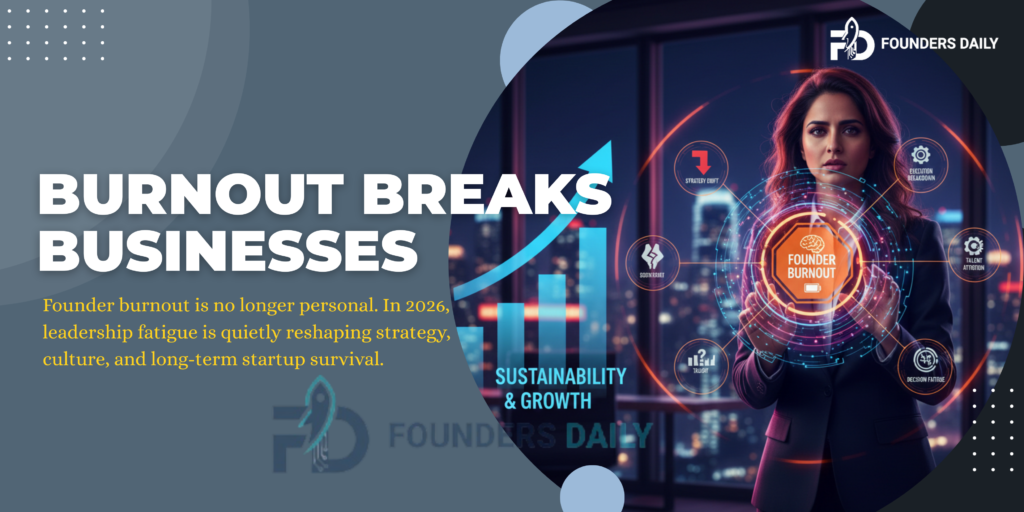
In 2026, founder burnout is emerging as a structural business risk, one that directly affects strategy, execution, and long-term survival. As startups operate in tighter capital environments and longer growth cycles, leadership endurance has become as critical as product vision or market fit. When founders burn out, companies do not just slow down. They quietly lose clarity, coherence, and competitive edge.
This shift is forcing investors, boards, and founders themselves to reconsider how leadership sustainability shapes outcomes.
Burnout Does Not Announce Itself
One reason founder burnout remains underestimated is that it rarely appears dramatic. There is no single breaking point. Instead, burnout creeps in gradually, disguised as dedication. Founders continue working, continue showing up, and continue making decisions, but with diminishing clarity and emotional bandwidth.
The earliest signs are subtle. Decision making becomes slower or excessively cautious. Founders avoid complex trade-offs and default to familiar patterns. Conversations with teams become transactional rather than directional. Strategic thinking gives way to short-term problem solving.
From the outside, the company may still appear functional. Metrics might hold steady. Funding conversations may continue. Internally, however, the quality of leadership begins to erode, and that erosion compounds over time.
Why Burnout Translates Into Business Risk
Leadership is not only about effort. It is about judgment. Judgment depends on cognitive capacity, emotional regulation, and perspective. Burnout undermines all three.
A burned-out founder struggles to hold long-term vision alongside short-term constraints. This leads to reactive decisions. Hiring happens to plug immediate gaps rather than build durable teams. Partnerships are accepted for short-term relief rather than strategic alignment. Product roadmaps drift as founders respond to pressure instead of conviction.
Over time, this pattern introduces inconsistency. Teams lose confidence in direction. Middle leadership fills the vacuum with its own interpretations. Execution slows not because people are incapable, but because the signal from the top becomes unclear.
At scale, this is not a wellness issue. It is an operational one.
The Cultural Cost Is Often Invisible
Company culture mirrors founder behaviour more closely than most leaders realise. When founders are energised, present, and clear, teams tend to take ownership. When founders are exhausted, distracted, or emotionally unavailable, teams adjust accordingly.
Burnout often manifests as reduced patience and limited availability. Founders cancel meetings, delay feedback, or disengage from day-to-day conversations. Employees interpret this as disinterest or instability, even if that was never the intent.
High performers are usually the first to notice. Many quietly disengage or leave, sensing a lack of direction or momentum. Those who remain become more cautious. Innovation slows. Risk-taking declines. The organisation becomes functional but conservative.
By the time cultural drift becomes visible, the root cause is often traced to execution issues rather than leadership fatigue.
Early-Stage Founders Carry a Different Kind of Risk
Founder burnout is particularly acute in early-stage companies. At this stage, founders are the system. There are few buffers between leadership stress and organisational impact.
Founders handle fundraising, hiring, product decisions, customer escalations, and internal communication simultaneously. The intensity is high, and recovery time is limited. In many cases, early traction masks burnout risk. Momentum creates adrenaline, allowing founders to push through fatigue.
When growth slows or external pressure increases, the emotional cost surfaces quickly. Decision quality drops precisely when the company needs clarity most. Because early-stage startups rely heavily on founder judgment, burnout at this stage can alter the company’s trajectory permanently.
Experience Does Not Eliminate Burnout
Second-time founders are not immune. In fact, they often carry a different burden. Prior outcomes create expectations from investors, teams, and themselves. The pressure to perform better, faster, and more decisively can be intense.
Experienced founders may recognise burnout symptoms but underestimate their impact. Familiarity with startup cycles can lead to overconfidence in personal endurance. Many continue operating at unsustainable levels, assuming they can recover later.
This makes burnout among experienced founders harder to detect. Performance remains outwardly strong, while internal capacity erodes quietly. When the impact finally becomes visible, it often coincides with strategic missteps or stalled growth.
Investors Are Paying Attention, Quietly
While founder wellbeing is rarely discussed openly in pitch rooms, investor attitudes are shifting. In 2026, sophisticated investors evaluate founder sustainability alongside vision and execution capability.
Leadership volatility introduces risk. Inconsistent decision making, communication breakdowns, or visible exhaustion affect investor confidence, even when numbers look healthy. Burnout raises questions about long-term leadership continuity and organisational resilience.
As a result, investors increasingly value founders who demonstrate self-awareness, delegation discipline, and structured decision processes. These signals suggest that leadership can be sustained across cycles, not just sprinted through early growth.
Burnout Is Not About Working Less
A common misconception is that burnout prevention requires reduced ambition. In reality, it requires better systems.
Founders who build decision frameworks, delegate authority meaningfully, and create leadership layers reduce cognitive overload. Clear role boundaries prevent constant context switching. Time for reflection improves strategic quality rather than reducing productivity.
Burnout resilience is not about balance in the abstract. It is about designing leadership in a way that can endure pressure without distortion.
The Long-Term Survival Question
Most startups do not fail because founders stop caring. They fail because leadership capacity becomes misaligned with the complexity of the business. Burnout accelerates this misalignment.
Companies led by burned-out founders struggle to adapt. They react slower to market shifts, miss early warning signs, and lose talent momentum. In contrast, founders who manage energy intentionally build organisations that compound steadily.
Understanding why founder burnout is a business risk is essential for anyone building or backing companies today. Leadership sustainability is no longer a soft concern. It is a competitive advantage.
Where This Leaves Founders in 2026
The startup journey has become longer and more demanding. Capital is cautious. Markets are crowded. The margin for error is smaller. In this environment, intensity alone is insufficient.
Founders who treat burnout as a signal rather than a failure protect their companies from invisible erosion. They build clarity where others burn out. They preserve judgment when pressure rises.
Quietly, this is becoming a defining difference between companies that endure and those that fade.