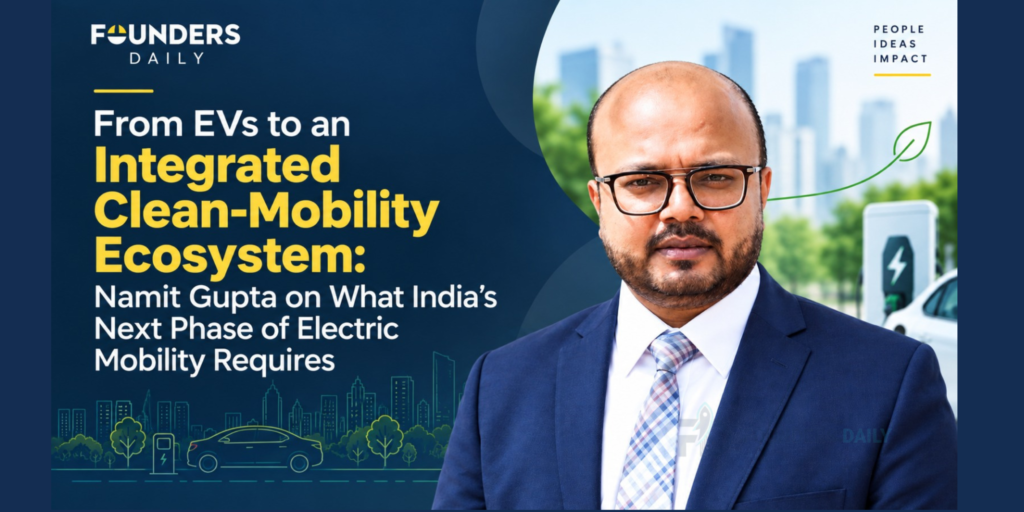
In an exclusive interaction with Founders Daily, Namit Gupta, Director, Futurex Group, organiser of the India International EV Show, discusses how India’s electric mobility opportunity is moving beyond vehicles, why batteries, energy and charging must be viewed as interconnected systems, and what the industry needs to do to achieve scale.
India’s electric mobility story is entering a different phase. The conversation is no longer limited to whether electric vehicles can become a viable alternative to conventional mobility. Increasingly, the focus is shifting towards the ecosystem required to make that transition scalable, spanning vehicles, batteries, charging infrastructure, components, software, energy storage and manufacturing.
For Namit Gupta, Director, Futurex Group, this represents one of the most significant changes in the industry over the past few years. In his view, EVs are no longer simply an emerging technology but are becoming an important part of India’s broader mobility and energy ecosystem.
“The biggest change is that EVs are no longer viewed simply as an emerging technology; they are becoming an important part of India’s mobility and energy ecosystem,” Gupta says. “We are seeing greater participation across vehicles, batteries, charging, components and software. The opportunity now lies in building a complete ecosystem that can support scale, affordability and long-term adoption.”
That shift in perspective is also reflected in the way industry platforms are being structured. The upcoming India International EV Show 2026, organised by Futurex Group, is being held from October 2–4, 2026 at the Auto Cluster Exhibition Centre in Pimpri-Chinchwad, Pune. alongside the India International Battery Show 2026 and India International Solar Show 2026. The decision reflects a broader understanding that electric mobility cannot be separated from the systems that power and support it.
“Electric mobility cannot be looked at in isolation,” Gupta explains. “The future of mobility is closely connected with batteries, energy generation, storage and charging infrastructure.” Bringing these three technology ecosystems together, he adds, gives industry stakeholders an opportunity to understand their interconnections and explore opportunities across the complete clean-energy ecosystem.
Also Read: Why Profitable Startups Stay Invisible
Pune’s Manufacturing Advantage
The choice of Pune and Pimpri-Chinchwad as the venue for the exhibition also carries significance. The region has a deep automotive and engineering base, supported by manufacturers, suppliers and technology companies.
“Pune has a strong automotive and engineering ecosystem, along with a deep base of manufacturers, suppliers and technology companies,” Gupta says. “Pimpri-Chinchwad adds another important dimension through its industrial and manufacturing capabilities.”
For India’s next phase of electric and cleaner mobility, that combination provides a natural foundation. The transition is not simply about introducing new vehicle technologies; it also requires manufacturing capabilities, engineering expertise, component ecosystems and technology providers capable of supporting the sector as it scales.
This broader participation is increasingly visible at industry exhibitions as well. According to Gupta, the profile of companies engaging with the EV ecosystem has changed considerably compared with the early years of the industry.
“The nature of participation today is much broader than it was a few years ago,” he says. Interest now spans vehicles, components, batteries, charging, energy solutions and technology. For Gupta, that breadth is an indication that the ecosystem is moving beyond experimentation towards commercial opportunities and larger-scale adoption.
There Will Be No Single Winner
As the industry matures, attention is increasingly moving beyond the vehicle itself. Batteries, charging infrastructure, components, software and energy storage are all becoming critical pieces of the larger mobility puzzle.
Gupta does not see one particular technology emerging as the sole winner.
“I don’t think there will be one single winner,” he says. “Batteries, charging infrastructure, components, software and energy storage will increasingly work together to determine how quickly the ecosystem scales.”
The implication is important for businesses entering the sector. The strongest opportunities may not necessarily come from individual technologies operating independently, but from solutions capable of addressing multiple parts of the ecosystem reliably and cost-effectively.
“The companies that can deliver reliable, cost-effective and integrated solutions will have a significant role in shaping the next phase of electric mobility,” Gupta adds.
Building the Value Chain, Not Just the Market
For India, the opportunity also extends beyond creating a large domestic EV market. Supply-chain resilience and domestic capabilities will increasingly influence how sustainable that growth can be.
Gupta sees stronger domestic capabilities across battery manufacturing, components, recycling and related technologies as fundamental to India’s EV ambitions. Building these capabilities, he argues, can both reduce vulnerabilities and create new industrial opportunities.
“India has the potential to build not just an EV market, but a stronger value chain around it,” he says.
That value-chain perspective becomes particularly relevant as the sector moves from early adoption towards wider commercialisation. Technology alone will not determine how quickly the market develops. Affordability, reliable charging infrastructure, stronger supply chains and continued technology development will all have to advance together.
At the same time, the economics of adoption matter. Businesses need viable models that make the transition commercially attractive rather than relying solely on technological enthusiasm.
“Sustainable growth will come when technology, infrastructure and economics move forward together,” Gupta says.
From Product Demonstrations to Business Opportunities
This is where Gupta sees an important role for industry platforms such as IIEV. An exhibition, in his view, should offer more than a space for companies to demonstrate products. Its greater value lies in creating connections that can translate into business opportunities.
At IIEV 2026, the expectation is for conversations between manufacturers, dealers, distributors, technology companies, investors and other ecosystem stakeholders to move towards partnerships and commercial possibilities.
“Manufacturers can connect with dealers and distributors, technology companies can identify partners, and investors can understand emerging opportunities across the ecosystem,” Gupta says. “Creating these meaningful connections is one of the most important roles an industry platform can play.”
That also changes what success should look like for participants. Visitors should leave with a clearer understanding of technologies and market direction, while exhibitors should be able to generate conversations that continue beyond the exhibition itself.
“The objective should be to leave with more than just information,” Gupta says. “Visitors should discover technologies, identify potential partners and understand where the market is heading.”
For exhibitors, he believes the real value should be “meaningful business conversations, stronger industry connections and opportunities that continue beyond the three days.”
India’s EV Challenge Is an Ecosystem Challenge
India has ambitious ambitions for electric mobility and clean energy, but Gupta believes it would be too simplistic to identify a single missing piece—whether technology, infrastructure, policy, investment or consumer adoption—as the industry’s biggest challenge.
“I would look at it as an ecosystem gap rather than a single gap,” he says.
Technology is progressing, but infrastructure, supply chains, financing, awareness and adoption must develop alongside it. The next stage of India’s EV journey will therefore depend not only on individual advances but on how effectively the different components of the ecosystem come together.
That interconnectedness is likely to become even more visible over the next five years. Gupta expects electric mobility to become much more integrated into India’s mainstream automotive and energy landscape.
For platforms such as IIEV, that creates a role that extends beyond an annual exhibition. By bringing different parts of the ecosystem together, creating business connections and giving emerging technologies a space to be discovered, such platforms can contribute to collaboration and market development.
Building the Future Together
Ultimately, Gupta’s view of India’s EV opportunity comes back to the idea of an ecosystem rather than an individual technology or company.
“The future of electric mobility is being built by an ecosystem, not by one company or one technology,” he says.
That, he believes, is also the central reason for industry professionals, manufacturers, dealers, investors and technology companies to participate in IIEV 2026.
“IIEV brings that ecosystem together in one place, manufacturers, technology providers, dealers, distributors, investors and industry stakeholders,” Gupta says. “If you want to understand where the market is heading and identify opportunities within it, this is the platform to be part of.”
For an industry moving from experimentation towards commercial scale, the next opportunity may therefore lie less in proving that electric mobility works and more in building the interconnected infrastructure, capabilities and business relationships required to make it work at scale.