Artificial Intelligence has rapidly evolved from being an emerging technology to becoming a strategic priority for enterprises worldwide. Organizations are investing billions of dollars in cloud platforms, analytics, automation, and Generative AI with the expectation that these technologies will improve efficiency, enhance customer experiences, and unlock new sources of growth.
Yet despite these investments, many businesses continue to struggle with one fundamental challenge: transforming the enormous amount of data they generate into faster, smarter, and more consistent business decisions.
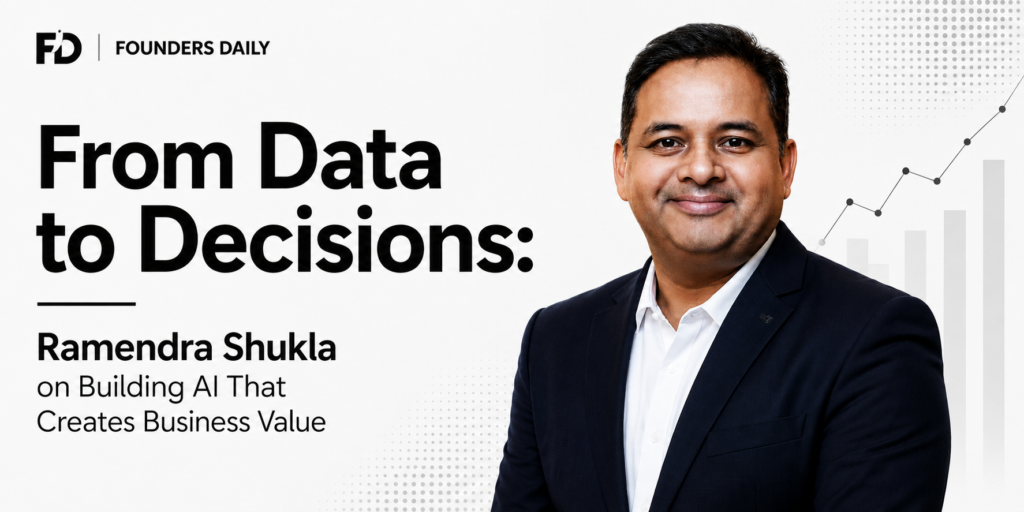
According to Ramendra Shukla, CEO of Exponentia.ai, the issue is not the availability of data but the inability of organizations to connect that data with meaningful decision-making. While businesses have significantly improved the way they collect, store, and visualize information, they have not made equivalent progress in improving how decisions are actually made.
“The gap exists because most organizations have improved how they collect data, but not how they make decisions,” says Shukla. “They have more reports, dashboards, and metrics than ever before, but that does not automatically create clarity or speed.”
He believes three common challenges continue to slow enterprises down. Many organizations begin by asking what data they have instead of identifying the business decision they want to improve. Data often remains fragmented across multiple systems and departments, leading leaders to spend valuable time debating which numbers are accurate rather than acting on insights.
Also Read: Why Profitable Startups Stay Invisible
In addition, unclear ownership means reports frequently result in more meetings instead of faster action. “The real issue is not a lack of data. It is a lack of decision discipline,” he explains.
This philosophy also explains why some companies derive significant value from data while others simply continue collecting it. Successful organizations view data as a strategic business asset rather than a reporting requirement. They begin with clearly defined business objectives, whether improving customer experience, increasing revenue, reducing operational costs, or strengthening risk management, and then build AI and analytics capabilities around those goals.
More importantly, they embed insights directly into everyday business functions such as pricing, sales, customer service, supply chain management, operations, and risk assessment instead of limiting them to presentations or monthly review meetings. Continuous learning, clear ownership, and measurable outcomes ensure that data changes how the business operates rather than merely describing what has already happened.
While business intelligence platforms have traditionally focused on helping leaders understand historical performance, Shukla believes Artificial Intelligence represents a significant shift from reporting to decision intelligence. Conventional analytics explains what happened, whereas AI can forecast what may happen next, recommend possible actions, identify emerging risks, and even automate routine operational decisions where appropriate. AI is capable of forecasting customer demand, predicting fraud, detecting operational anomalies, automating data preparation, and analyzing diverse forms of information, including documents, images, text, and logs that conventional analytics tools often struggle to process.
However, he emphasizes that AI is not designed to replace people but to support stronger human judgment by presenting patterns, options, and trade-offs more effectively.
The emergence of Generative AI has accelerated this transformation even further. Instead of relying solely on dashboards or technical teams to interpret complex reports, business leaders can now interact with enterprise data through natural language. They can ask simple questions about changing business conditions, emerging risks, or operational performance and receive clear explanations, summaries, and recommendations almost instantly. Generative AI also brings together structured and unstructured information, from reports and customer feedback to emails and operational documents, allowing leaders to explore different business scenarios and compare alternatives before making critical decisions.
Despite these capabilities, Shukla stresses that Generative AI strengthens leadership judgment rather than replacing it, enabling executives to make faster and more informed decisions while retaining full accountability.
According to Shukla, one of the biggest misconceptions surrounding AI is that organizations often ask for the technology before identifying the business outcomes they expect it to deliver.
Instead of asking, “How do we implement AI?” leaders should ask, “Which business outcomes do we want AI to improve?” Whether the objective is increasing revenue, improving margins, enhancing customer experience, reducing costs, or minimizing risk, every AI initiative should be linked to measurable business goals.
Equally important is redesigning workflows, governance frameworks, leadership capabilities, and operating models to support AI adoption. Without these changes, organizations risk launching isolated AI pilots that never deliver enterprise-wide value.
As enterprises expand AI adoption, data quality and governance become critical success factors. Shukla believes even the most advanced AI models will fail if they are built on incomplete, inconsistent, or unreliable data. Strong governance provides clarity around ownership, accountability, explainability, privacy, and regulatory compliance, creating the trust required for AI to scale across an organization.
At the same time, responsible AI requires balancing innovation with appropriate controls. Organizations should begin with lower-risk, high-value use cases before expanding AI into more sensitive business functions, while ensuring privacy, security, and governance remain embedded from the outset. Responsible AI, he argues, is not about slowing innovation but creating enough trust for innovation to scale safely across the enterprise.
Looking ahead, Shukla believes enterprise decision-making will increasingly be supported by AI agents capable of continuously monitoring business conditions, detecting anomalies, recommending actions, and automating routine operational decisions within clearly defined guardrails. Activities such as inventory replenishment, fraud detection, scheduling, pricing recommendations, and service prioritization are likely to become increasingly autonomous over the next five years.
However, he is equally clear that human judgment will become even more important as AI capabilities grow. While AI excels at processing information and evaluating alternatives, it cannot fully understand organizational context, stakeholder impact, ethics, or long-term strategic consequences. Business leaders will therefore continue to own high-impact decisions while using AI to ask better questions, evaluate recommendations, and ensure decisions remain aligned with business objectives and organizational values.
This philosophy is reflected in Exponentia.ai’s own approach to enterprise transformation. Rather than focusing solely on AI models, the company helps organizations modernize data platforms, establish AI-ready architectures, implement governance frameworks, and build AI products linked directly to measurable business outcomes. One example involved a leading insurance enterprise where fragmented reporting and inconsistent KPIs were limiting decision-making.
Exponentia.ai unified more than 26 terabytes of enterprise data, standardized business metrics, and embedded predictive AI into operational workflows. The result was nearly a 50 percent reduction in reporting time, significant improvements in engineering efficiency, reduced manual reconciliation, and faster underwriting and claims decisions supported by more reliable insights. For Shukla, this demonstrates that successful AI initiatives should ultimately be measured not by sophisticated algorithms or impressive demonstrations but by tangible improvements in business performance.
As organizations prepare for the next phase of enterprise AI, Shukla believes the difference between market leaders and laggards will not be access to technology but the ability to embed AI into everyday operations with discipline, trust, and clear business ownership. Companies that invest in strong data foundations, governance, workforce capability, and outcome-driven AI strategies will be better positioned to create sustainable competitive advantage.
Also Read: Why AI Strategy Is a Leadership Issue
His advice to CEOs beginning their AI journey is simple yet powerful- treat AI as a business transformation initiative rather than a technology experiment. Start with business outcomes that matter, define clear ownership and measurable success metrics, invest in data quality and governance, and lead AI adoption from the very top of the organization. Only then can enterprises truly move from collecting data to creating lasting business value.