
Introduction
Manufacturing automation is no longer a futuristic concept reserved for global automotive giants or billion-dollar corporations. Across industries, from automotive and electronics to pharmaceuticals and consumer goods, manufacturers are increasingly adopting automation technologies to improve efficiency, reduce operational costs, and remain competitive in a rapidly evolving market.
Yet despite significant advancements in industrial automation, many misconceptions continue to influence decision-making within manufacturing organizations. Business leaders often delay automation investments because of outdated beliefs about cost, workforce impact, implementation complexity, and return on investment.
The reality is far different from what many manufacturers assume.
Modern automation solutions have become more accessible, scalable, and intelligent than ever before. Small and medium-sized manufacturers are now deploying robotics, artificial intelligence, predictive maintenance systems, machine vision technologies, and smart factory solutions to improve production outcomes and address persistent operational challenges.
Understanding the difference between manufacturing automation myths and reality is becoming increasingly important for organizations seeking long-term growth and operational resilience.
This article explores the most common automation myths, examines the realities shaping today’s industrial landscape, and explains how manufacturers can make informed decisions about their digital transformation journey.
Also Read: RouteMatic Partners With Green SM to Accelerate EV Adoption in Corporate Transportation
The Growing Importance of Manufacturing Automation
Manufacturing environments have changed dramatically over the past decade. Global competition, labor shortages, rising production costs, customer expectations, and sustainability goals are forcing manufacturers to rethink traditional operating models.
Automation is no longer viewed solely as a cost-reduction tool. Instead, it has become a strategic business capability that supports productivity, quality improvement, operational flexibility, and business continuity.
Smart manufacturing systems now enable factories to collect real-time production data, identify inefficiencies, predict equipment failures, optimize workflows, and improve overall equipment effectiveness.
Organizations that successfully integrate automation technologies are often better positioned to respond to market fluctuations, supply chain disruptions, and changing customer requirements.
However, despite these benefits, several myths continue to slow adoption across the manufacturing sector.
Myth 1: Automation Eliminates Human Jobs
One of the most widespread concerns surrounding manufacturing automation is the belief that robots and machines will completely replace human workers.
This perception has existed for decades and remains one of the biggest barriers to automation adoption.
Reality: Automation Changes Jobs More Than It Eliminates Them
In practice, automation typically transforms job roles rather than removing them entirely.
Most manufacturing environments deploy automation to handle repetitive, physically demanding, hazardous, or highly precise tasks. This allows employees to focus on higher-value activities such as quality management, process optimization, equipment supervision, maintenance, problem-solving, and production planning.
For example, an automotive manufacturer may introduce robotic welding systems to improve consistency and safety. Rather than eliminating workers, employees often transition into robot programming, inspection, maintenance, or production management roles.
Modern factories still require skilled operators, engineers, technicians, analysts, and supervisors to ensure systems function effectively.
As automation adoption increases, demand for technical and digital manufacturing skills continues to grow across industries.
Myth 2: Automation Is Only for Large Manufacturers
Many small and medium-sized enterprises assume automation is only practical for multinational corporations with extensive capital resources.
This misconception prevents many businesses from exploring technologies that could significantly improve operational performance.
Reality: Automation Is Becoming Increasingly Accessible
Advances in manufacturing technology have dramatically reduced barriers to entry.
Cloud-based software platforms, collaborative robots, modular automation systems, and subscription-based industrial solutions have made automation more affordable for businesses of all sizes.
Today, even small manufacturers can implement automated inspection systems, robotic material handling, predictive maintenance software, and production monitoring platforms without making massive infrastructure investments.
A packaging company with a limited workforce, for instance, can deploy automated sorting systems to improve throughput and reduce manual handling requirements.
Automation is no longer defined by company size. Instead, successful adoption depends on identifying specific operational challenges and implementing targeted solutions.
Myth 3: Automation Is Too Expensive
Cost concerns remain one of the most frequently cited reasons for delaying automation projects.
Many decision-makers focus exclusively on initial investment requirements without considering long-term business benefits.
Reality: The Cost of Not Automating Can Be Higher
While automation requires investment, the long-term returns often outweigh implementation costs.
Manufacturers frequently experience measurable improvements in productivity, quality, equipment utilization, energy efficiency, and labor allocation after deploying automation solutions.
Consider a factory experiencing frequent downtime due to unexpected machine failures. Implementing predictive maintenance software may require upfront investment, but preventing repeated production disruptions can generate significant savings over time.
Similarly, automated quality inspection systems can reduce scrap rates, improve customer satisfaction, and lower warranty-related expenses.
Organizations that evaluate automation solely through initial cost often overlook substantial operational gains and competitive advantages.
Myth 4: Automation Is Too Complex to Implement
Many manufacturers fear that automation projects will disrupt operations, require extensive technical expertise, or create implementation challenges that outweigh potential benefits.
Reality: Modern Automation Solutions Are Easier Than Ever to Deploy
Today’s automation platforms are designed with usability and scalability in mind.
Technology providers increasingly offer intuitive interfaces, remote support capabilities, cloud integration, and training programs that simplify implementation.
Manufacturers no longer need large internal technology teams to begin their automation journey.
Many successful projects start with a single production line, process, or operational challenge. Organizations can test solutions, evaluate results, and expand gradually based on performance outcomes.
This phased approach minimizes risk while allowing teams to build confidence and experience.
Automation is no longer an all-or-nothing decision. It is often a step-by-step transformation process.
Myth 5: Robots Deliver Perfect Results Every Time
Automation advocates sometimes create unrealistic expectations by suggesting that automated systems completely eliminate errors.
Reality: Automation Improves Consistency but Requires Oversight
Robots, software systems, and automated production equipment significantly improve consistency and precision.
However, automation does not eliminate the need for monitoring, maintenance, calibration, and continuous improvement.
Manufacturing systems still depend on accurate programming, proper setup, reliable data, and effective operational management.
A machine vision inspection system, for example, can identify product defects more consistently than manual inspection. However, it still requires periodic validation and performance monitoring.
Successful manufacturers view automation as a tool that enhances operational excellence rather than a substitute for management and expertise.
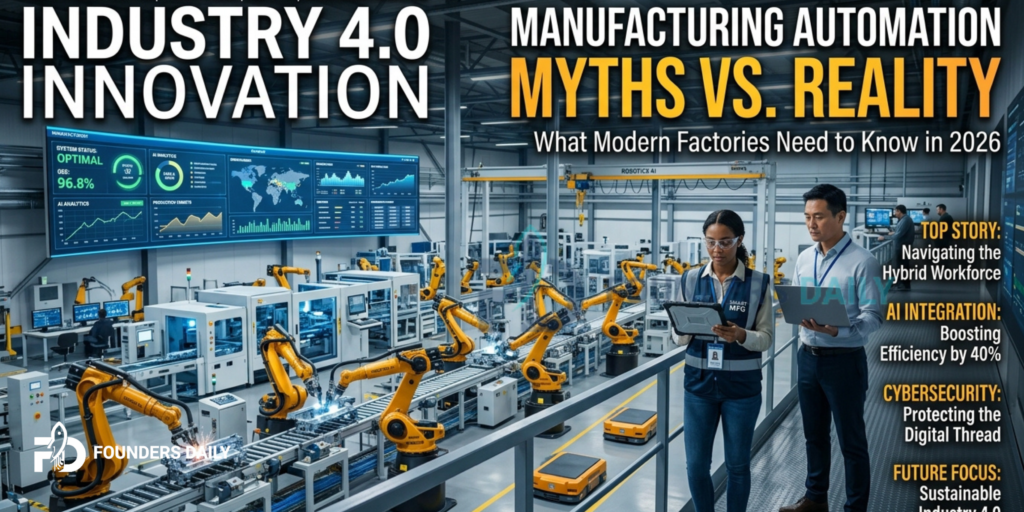
The Rise of Smart Manufacturing and Industry 4.0
The conversation around manufacturing automation has expanded significantly with the emergence of Industry 4.0 technologies.
Modern automation extends beyond robotics and machinery. It includes connected systems that generate valuable insights and support data-driven decision-making.
Smart manufacturing combines sensors, industrial internet technologies, artificial intelligence, machine learning, cloud computing, and advanced analytics to create more responsive and intelligent production environments.
These capabilities allow manufacturers to monitor operations in real time, identify bottlenecks, optimize resource allocation, and improve production planning.
As digital transformation accelerates, manufacturers are increasingly recognizing that automation and data intelligence work best together.
Why Manufacturers Are Accelerating Automation Investments
Several market forces are driving increased automation adoption across industries.
Labor shortages continue to affect production capacity in many regions. Skilled manufacturing talent remains difficult to recruit and retain.
At the same time, customer expectations around quality, speed, customization, and reliability continue to increase.
Automation helps manufacturers address these challenges while supporting long-term growth objectives.
Organizations are also pursuing sustainability goals that require greater efficiency and resource optimization.
Automated systems can reduce energy consumption, minimize waste generation, improve material utilization, and support environmental performance targets.
For many businesses, automation is no longer optional. It is becoming an essential component of competitive strategy.
Building a Successful Automation Strategy
Manufacturers considering automation should begin by evaluating operational challenges rather than focusing exclusively on technology.
The most successful automation initiatives solve specific business problems.
Organizations should identify areas with recurring inefficiencies, quality issues, safety concerns, downtime challenges, or labor constraints.
From there, manufacturers can prioritize opportunities based on potential business impact and implementation feasibility.
A structured roadmap helps ensure investments align with broader operational and strategic objectives.
Automation should support business outcomes, not simply technology adoption.
The Future of Manufacturing Automation
The future of manufacturing automation will be shaped by increasing connectivity, artificial intelligence, advanced robotics, and real-time data intelligence.
Factories will become more adaptive, predictive, and autonomous.
Human workers will continue to play a critical role, but their responsibilities will increasingly focus on decision-making, optimization, innovation, and oversight.
Organizations that embrace automation strategically will be better positioned to improve resilience, competitiveness, and long-term growth.
The question is no longer whether automation belongs in manufacturing.
The question is how quickly manufacturers can separate myth from reality and begin capturing its benefits.
Also Read: The Role of Innovation in Cost Reduction
Conclusion
Manufacturing automation continues to be surrounded by myths that no longer reflect today’s industrial reality. Modern automation solutions are more accessible, flexible, and impactful than ever before. Rather than replacing people, automation empowers workforces, strengthens operational performance, and supports long-term business growth.
Manufacturers that separate fact from fiction can make smarter investment decisions and position themselves for success in an increasingly competitive global market. As Industry 4.0 technologies continue to evolve, organizations that embrace automation strategically will be better prepared to improve productivity, enhance resilience, and unlock new opportunities for innovation.