
Introduction
Over the past decade, the Indian startup ecosystem has gone through a dramatic transformation. There was a time when raising capital felt almost predictable. If a startup showed strong growth numbers, funding rounds followed quickly, often at increasing valuations. However, the reality of late-stage funding in India has changed significantly, especially in the current economic and investor climate.
Today, founders are facing a very different environment. Late-stage funding in India is no longer driven by aggressive growth narratives alone. Investors have become more cautious, more analytical, and far more selective about where they deploy capital. This shift has created a gap between expectations and reality, particularly for startups that scaled rapidly during the boom years.
Understanding this new landscape is not optional anymore. Founders, operators, and even early-stage investors must rethink how businesses are built and scaled. In this article, we explore the true reality of late-stage funding in India, what has changed, why it matters, and what founders must do to stay relevant and fundable in 2026 and beyond.
The Evolution of Late-Stage Funding in India
The journey of late-stage funding in India reflects the maturity of the entire startup ecosystem. In earlier years, capital was abundant, and global investors were actively looking to tap into India’s high-growth potential. This led to a surge in large funding rounds, unicorn valuations, and aggressive expansion strategies across multiple sectors.
Startups were encouraged to grow fast, capture market share, and outpace competition. Profitability was often pushed to the background, as long as the growth story remained compelling. For many companies, this approach worked in the short term, but it also created structural inefficiencies that are now becoming visible.
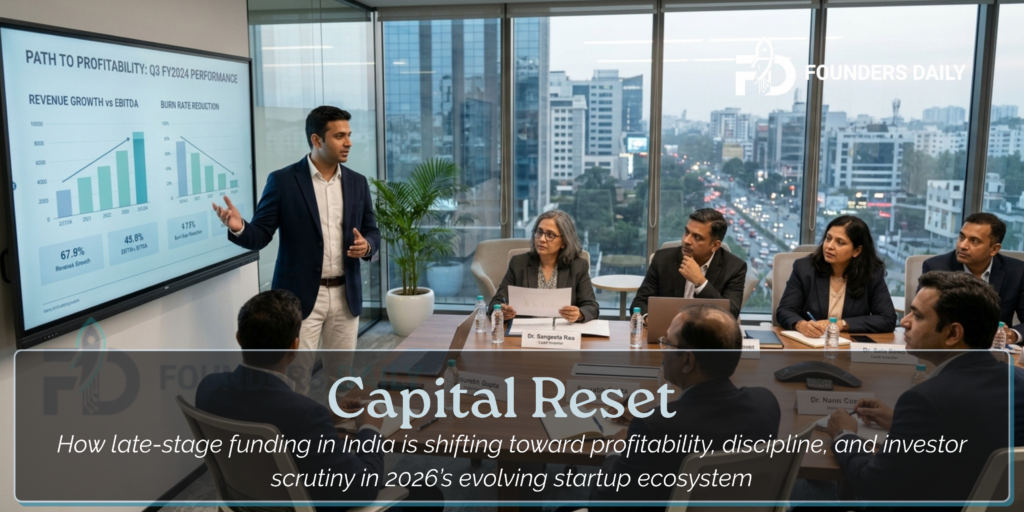
In the current phase, the ecosystem is correcting itself. Late-stage funding in India is becoming more disciplined, with a stronger focus on business fundamentals. Investors are no longer chasing growth at any cost. Instead, they are backing companies that demonstrate resilience, operational efficiency, and a clear path to profitability. This transition marks a significant shift from a capital-driven ecosystem to a performance-driven one.
Also Read: The Rise of Digital-Only Founders in 2026
Why Late-Stage Funding in India Has Become More Selective
One of the biggest reasons behind the changing reality of late-stage funding in India is the global macroeconomic environment. Over the past few years, rising interest rates and tighter liquidity conditions have reduced the availability of easy capital. Large institutional investors are now more cautious, which directly impacts funding flows into emerging markets like India.
At the same time, there has been a noticeable shift in investor mindset. Earlier, investors were willing to take higher risks in exchange for potential high returns. Today, the focus has shifted toward risk management and sustainable growth. This means startups are being evaluated more rigorously before funding decisions are made.
Another important factor is the increased visibility into startup operations. With more data available and more experienced investors entering the ecosystem, there is less room for inefficiencies or inflated projections. Founders are expected to back their claims with solid data and consistent performance. As a result, late-stage funding in India has become highly selective, favoring companies that are well-structured and execution-focused.
The Shift from Growth to Profitability
Perhaps the most defining change in late-stage funding in India is the transition from growth-first strategies to profitability-driven models. During the funding boom, startups often prioritized scaling over sustainability. Customer acquisition costs were high, and losses were accepted as part of the growth journey.
However, the current reality demands a different approach. Investors now want to see how efficiently a company operates. They are looking for strong unit economics, healthy margins, and a clear roadmap to profitability. This shift is forcing founders to revisit their business models and make necessary adjustments.
For example, many startups are now focusing on improving customer retention instead of aggressively acquiring new users. Others are optimizing their cost structures to reduce burn rates. These changes may slow down growth in the short term, but they create a stronger foundation for long-term success. In this new environment, profitability is no longer optional. It is a critical requirement for securing late-stage funding in India.
What Investors Really Look for Today
In today’s funding landscape, investors are asking deeper and more meaningful questions. They are no longer impressed by vanity metrics or short-term growth spikes. Instead, they are focused on understanding the core strength of the business.
One of the key areas of evaluation is unit economics. Investors want to know whether each transaction or customer adds value to the business over time. A startup that can demonstrate positive unit economics is seen as more sustainable and less risky.
Another important factor is governance and transparency. Investors are paying close attention to how companies are managed, how decisions are made, and how financial information is reported. Strong governance builds trust, which plays a crucial role in funding decisions.
Finally, scalability remains important, but it is now viewed through a different lens. Instead of rapid expansion, investors are looking for scalable systems that can grow efficiently without compromising profitability. This balanced approach defines the new reality of late-stage funding in India.
Sector-Wise Insights in the Current Funding Climate
Different sectors are experiencing the impact of these changes in unique ways. Technology-driven businesses, particularly SaaS companies, continue to attract interest due to their scalable models and predictable revenue streams. These companies are often better positioned to meet investor expectations around profitability and efficiency.
On the other hand, sectors like ecommerce and consumer brands are facing greater scrutiny. High operational costs and intense competition have made it challenging for these businesses to demonstrate sustainable profitability. As a result, only the most efficient and differentiated players are able to secure late-stage funding in India.
Fintech remains a strong sector, but it is evolving rapidly. Regulatory requirements and risk management have become critical considerations. Investors are focusing on companies that can navigate these complexities while maintaining growth and stability.
How Founders Can Adapt to This New Reality
For founders, adapting to the changing dynamics of late-stage funding in India requires a shift in mindset. The focus must move from rapid expansion to disciplined growth. This means building businesses that are not only scalable but also sustainable.
Financial discipline is one of the most important aspects of this transition. Founders must have a clear understanding of their cost structures, revenue streams, and profitability timelines. Managing cash flow effectively can make a significant difference in how investors perceive the business.
Equally important is building trust with investors. This goes beyond numbers. It involves consistent communication, transparency, and a strong track record of execution. Founders who can demonstrate reliability and clarity are more likely to attract long-term investors.
Another critical factor is strategic decision-making. In a capital-constrained environment, every decision matters. Founders must prioritize initiatives that create long-term value and avoid distractions that do not contribute to core growth.
Founder Perspective: A Necessary Reset for the Ecosystem
While the current funding environment may seem challenging, it is important to view it as a necessary reset rather than a setback. The reality of late-stage funding in India is pushing the ecosystem toward maturity. It is encouraging better business practices, stronger governance, and more sustainable growth models.
For founders, this is an opportunity to build companies that are truly resilient. Instead of relying on external capital, they can focus on creating value through efficient operations and strong customer relationships. This approach not only improves funding prospects but also strengthens the overall business.
In the long run, this shift will benefit the entire ecosystem. It will lead to more stable companies, better investor confidence, and a healthier startup environment. Founders who embrace this change will be better positioned to succeed in the years ahead.
Also Read: How Founders Can Build High-Trust Teams That Scale Faster in 2026
Conclusion
The reality of late-stage funding in India has changed in a way that demands clarity, discipline, and strategic thinking from founders. The era of easy capital is over, and the focus has shifted toward building sustainable and resilient businesses.
This shift may slow down some startups, but it also creates a stronger foundation for long-term success. Founders who understand this transition and adapt accordingly will not only secure funding but also build companies that can thrive in any environment.
In 2026 and beyond, success will not be defined by how fast a company grows, but by how well it sustains that growth. That is the true reality of late-stage funding in India.