
Introduction
In 2026, the startup ecosystem looks glamorous from the outside. Funding announcements dominate headlines. Valuations trend on social media. Founders celebrate million-dollar rounds as badges of credibility. At the same time, a quiet wave of profitable bootstrapped startups is building sustainable businesses without raising a single dollar in venture capital.
This contrast has reignited one of the most important debates in modern entrepreneurship: bootstrapped vs funded. Yet most discussions around this topic remain shallow. They focus on speed versus control, or growth versus profitability. What they rarely examine are the deeper economic realities that shape long-term founder wealth, risk exposure, ownership dilution, capital efficiency, and exit outcomes.
The real question is not which model sounds more impressive. The real question is which economic structure aligns with your business model, market timing, and personal goals. In this in-depth analysis, we break down the true financial mechanics behind bootstrapped startups and funded startups, and explain the real economics founders often ignore.
The Structural Difference Between Bootstrapped and Funded Startups
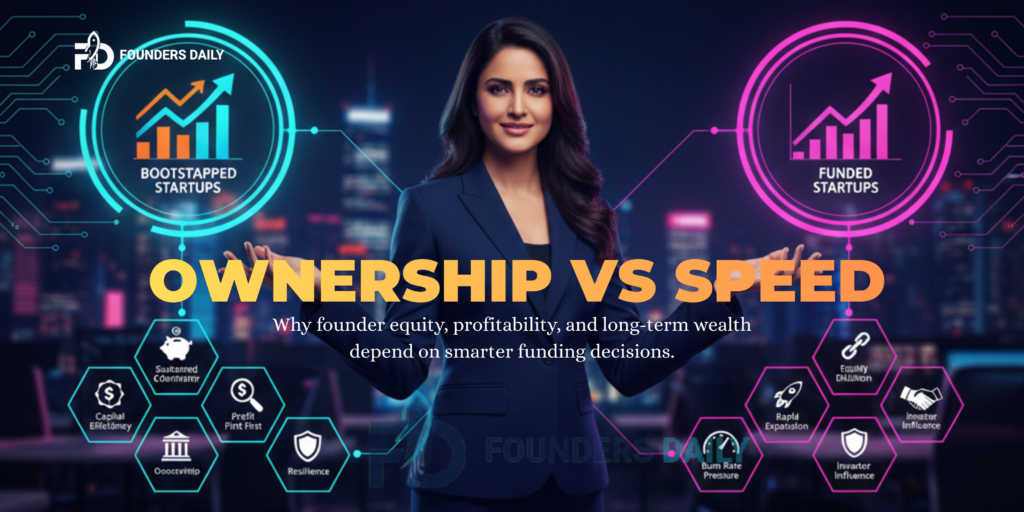
At its core, the difference between bootstrapped vs funded startups lies in capital origin and growth philosophy.
A bootstrapped startup relies on personal savings, early revenue, or minimal external financing to grow. Every expense must be justified by cash flow. Growth is reinvestment-driven. The founder retains majority ownership and maintains strategic independence.
A funded startup raises venture capital or angel investment in exchange for equity. The capital accelerates hiring, marketing, product development, and expansion. However, equity dilution begins immediately, and strategic decisions become influenced by investor expectations.
This structural distinction shapes how companies operate from day one. Bootstrapped startups optimize for sustainability and profitability. Funded startups optimize for speed and scale. These two optimization strategies produce entirely different economic trajectories.
Also Read: https://foundersdailyg.com/finance/vc-funding-is-not-dead
Capital Efficiency in Bootstrapped Startups
One of the most overlooked advantages in the bootstrapped vs funded debate is capital efficiency. Bootstrapped startups are forced to develop financial discipline early. Without investor capital cushioning mistakes, founders must prioritize revenue-generating activities and control burn rate carefully.
This constraint often leads to stronger business fundamentals. Customer acquisition cost must remain realistic. Pricing must support margins. Teams remain lean and productivity-driven. Instead of chasing vanity metrics such as app downloads or press mentions, bootstrapped founders focus on revenue, retention, and recurring income.
Over time, this disciplined approach compounds. A bootstrapped SaaS startup generating consistent annual recurring revenue with healthy margins may grow slower than a venture-backed competitor, but it often becomes more resilient during market downturns.
In 2026, as capital markets tighten and funding cycles become unpredictable, capital efficiency is no longer optional. It is strategic survival.
The Hidden Cost of Venture Capital and Dilution
In funded startups, access to capital creates momentum. However, venture capital is not free money. It is structured investment expecting high returns, often targeting tenfold outcomes within specific timelines.
Every funding round introduces dilution. Founders begin with full ownership, but after seed, Series A, Series B, and subsequent rounds, equity may shrink dramatically. While the company valuation increases, the founder’s percentage ownership decreases.
This dilution becomes economically significant during exit. A founder owning 15 percent of a 200 million dollar company may generate strong personal wealth. However, liquidation preferences, investor protections, and preferred equity structures can alter payout distribution.
Many founders focus on valuation headlines without calculating post-dilution ownership value. The true economics of bootstrapped vs funded startups only become clear when exit scenarios are modeled realistically.
Burn Rate, Runway, and Growth Pressure
Funded startups operate within defined burn rate and runway cycles. Capital raised must generate measurable growth. Investors expect aggressive scaling, increased market share, and revenue expansion.
This creates pressure to spend. Marketing budgets expand. Hiring accelerates. Customer acquisition cost tolerance rises because the goal is dominance, not immediate profitability.
While this strategy can produce exponential growth in network-driven markets, it also increases vulnerability. If growth slows or funding markets contract, the same burn rate becomes a liability.
Bootstrapped startups, in contrast, align spending with revenue generation. Their runway is tied to performance rather than funding rounds. This reduces dependency on external capital cycles.
In unstable economic environments, this difference becomes critical.
Market Dynamics and Funding Fit
The bootstrapped vs funded decision should always be evaluated within market context.
Industries requiring heavy research and development, such as biotechnology or deep technology, often demand external funding. Hardware manufacturing or infrastructure platforms may not survive without large upfront capital.
However, digital products, niche SaaS businesses, service-based companies, and community-driven platforms often thrive under bootstrapped models. In these cases, profitability can be achieved early, and growth can be funded internally.
Market timing also matters. In winner-takes-all environments, speed is competitive advantage. Venture capital can act as an accelerant. But in fragmented markets where customer loyalty depends on trust and consistent value delivery, sustainable growth may outperform aggressive expansion.
Understanding market structure prevents founders from adopting funding strategies misaligned with business realities.
Founder Psychology and Long-Term Autonomy
Economics is not purely financial. It also involves control, autonomy, and mental resilience.
Bootstrapped founders answer primarily to customers. Decision-making remains independent. Strategic pivots can happen without board approval. This autonomy can reduce stress and encourage long-term thinking.
Funded founders operate within governance structures. Board meetings, investor updates, and milestone accountability add layers of oversight. While mentorship and strategic input from investors can be valuable, it also shifts control dynamics.
The psychological cost of scaling under venture expectations is rarely discussed openly. Yet founder burnout in funded startups has become increasingly visible in recent years.
In the broader bootstrapped vs funded conversation, lifestyle alignment and personal risk tolerance should not be ignored.
Profitability vs Valuation: A Fundamental Tradeoff
Modern startup culture often glorifies valuation growth. However, valuation does not equal liquidity. A funded startup valued at 100 million dollars may still be unprofitable and cash constrained.
Bootstrapped startups prioritize net income and positive cash flow. This allows founders to draw dividends, reinvest confidently, and build real financial stability.
The tradeoff becomes clear when markets shift. During funding slowdowns, profitable companies maintain operational strength. Companies dependent on continuous funding may struggle to sustain growth.
The real economics of bootstrapped vs funded models reveal that valuation growth and profitability follow different trajectories. Sustainable wealth often emerges from profitability, not headline numbers.
Exit Outcomes and Founder Wealth
Exit scenarios differ dramatically between bootstrapped and funded companies.
Bootstrapped startups often exit through strategic acquisitions or private equity transactions. Because founders retain large ownership stakes, even moderate exit valuations can generate meaningful personal wealth.
Funded startups aim for larger exit multiples to satisfy investor return expectations. While successful IPOs or acquisitions create massive outcomes, they represent a small percentage of funded ventures.
Founder wealth ultimately depends on ownership percentage multiplied by exit value, adjusted for dilution and liquidation structures. This simple equation often receives less attention than funding announcements.
Also Read: https://foundersdailyg.com/finance/2026-funding-landscape-vc-betting
The Future of Startup Economics in 2026
The global startup landscape in 2026 shows a noticeable shift toward sustainable growth models. Investors increasingly value capital efficiency and clear paths to profitability. Bootstrapped startups are receiving renewed attention as examples of disciplined execution.
At the same time, venture capital remains powerful in sectors requiring rapid innovation and market capture.
The conversation around bootstrapped vs funded is evolving from emotional preference to strategic analysis. Founders are asking better questions. They are evaluating funding not as validation, but as a tool aligned with specific growth objectives.
Conclusion
The debate between bootstrapped vs funded startups is not about ideology. It is about economics, strategy, and alignment.
Bootstrapped startups emphasize ownership, profitability, and sustainability. Funded startups emphasize speed, scale, and market capture. Both paths can succeed. Both paths can fail.
What founders often ignore is the deeper economic structure beneath the surface. Dilution, burn rate, capital efficiency, exit math, and psychological resilience shape outcomes more than funding headlines.
Before choosing between bootstrapped and funded growth, founders must ask a fundamental question. What kind of company are you building, and what kind of life do you want to lead while building it?
The right funding decision is not the one that impresses the market. It is the one that aligns with your long-term economic reality.