Introduction
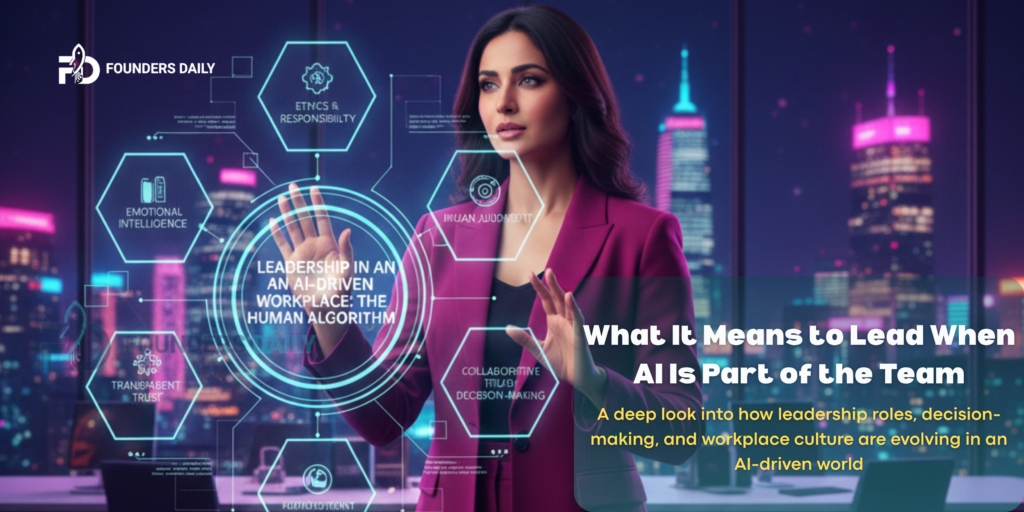
Leadership is quietly being rewritten. Not with loud announcements or dramatic revolutions, but through everyday decisions leaders are forced to make as artificial intelligence becomes part of normal work life. Algorithms now assist with hiring, forecasting, customer support, content creation, and even performance reviews. This shift is not just about technology adoption. It is about how leaders think, act, communicate, and earn trust in a workplace where humans and machines collaborate daily.
Many leaders still believe AI is only an efficiency tool. Something that automates tasks and reduces costs. In reality, AI is changing the emotional, ethical, and strategic responsibilities of leadership itself. Employees no longer look to leaders only for direction. They look for clarity, judgment, and reassurance in a world where decisions are increasingly data-driven but consequences remain deeply human.
In this article, you will learn how leadership in an AI-driven workplace is being redefined, which skills matter most now, how trust and culture must evolve, and what modern leaders must do to stay relevant, credible, and effective in the age of intelligent systems.
Why Traditional Leadership Models Are No Longer Enough
For decades, leadership models were built around authority, experience, and hierarchical decision-making. The leader was expected to know more than the team, make the final call, and set direction based on past success. In an AI-driven workplace, this model breaks down quickly. Machines often know more about patterns, probabilities, and predictions than any single human ever could.
When employees see algorithms outperforming managers in forecasting demand or identifying risks, blind authority loses its power. Leadership can no longer rely on positional control. It must shift toward interpretation, judgment, and responsibility. Leaders are now valued not for having all the answers, but for asking better questions and making sense of what AI produces.
This does not reduce the importance of leaders. It increases it. Someone must decide how AI insights are used, where they should be challenged, and when human values must override machine logic. That responsibility cannot be automated.
The Role of Human Judgment in an AI-Driven Workplace
AI excels at speed, scale, and pattern recognition. What it cannot do is understand context the way humans do. It cannot grasp moral nuance, cultural sensitivity, or emotional impact. In an AI-driven workplace, leadership is defined by the ability to apply human judgment on top of machine intelligence.
Consider a real example from global hiring teams. AI tools can shortlist candidates based on performance indicators and historical success patterns. A leader’s role is not to blindly approve that list. It is to question bias, ensure diversity, and assess long-term potential that data may not capture. The leader becomes the ethical filter between algorithmic output and real-world consequences.
This balance between data and discretion is becoming the core leadership skill. Employees trust leaders who understand AI deeply enough to challenge it, not just use it.
Emotional Intelligence Becomes a Strategic Leadership Skill
As AI takes over analytical and repetitive tasks, emotional intelligence becomes a competitive advantage for leaders. In an AI-driven workplace, employees often feel uncertainty about job security, relevance, and future growth. Leaders who ignore these emotions lose credibility quickly.
Modern leadership requires listening more than instructing. It requires empathy during transformation, transparency during automation, and reassurance during change. Teams want to know not just what is changing, but why it matters and how they fit into the future.
A leader who can clearly explain how AI augments human roles rather than replaces them builds trust. A leader who acknowledges fear without dismissing it builds loyalty. Emotional intelligence is no longer a soft skill. It is a core leadership capability in the AI era.
Decision Making Shifts From Control to Collaboration
In the past, leaders were decision bottlenecks. Today, AI democratizes access to insights across teams. Analysts, managers, and frontline employees can all see similar dashboards, predictions, and reports. Leadership in an AI-driven workplace is less about controlling information and more about facilitating alignment.
The best leaders encourage teams to challenge AI outputs, share interpretations, and debate implications. This collaborative decision-making process improves outcomes and increases ownership. When people feel involved, they trust both the system and the leadership behind it.
Leaders who cling to control often slow organizations down. Leaders who foster intelligent collaboration unlock the real value of AI.
Ethics and Responsibility Define Modern Leadership
AI introduces ethical questions that leadership can no longer avoid. Who is accountable when an algorithm makes a wrong decision. How transparent should AI-based evaluations be. What data is acceptable to collect and analyze. These are leadership questions, not technical ones.
In an AI-driven workplace, leaders are the moral compass. They set boundaries, define acceptable use, and ensure fairness. Employees watch closely how leaders respond when AI systems fail or create unintended harm. Silence or deflection erodes trust instantly.
Strong leaders take responsibility even when decisions are machine-assisted. They communicate openly about limitations and continuously refine governance frameworks. Ethical leadership is becoming a brand asset for organizations in the age of AI.
Redefining Trust in the Age of Intelligent Systems
Trust used to be built through consistency and competence. Today, trust also depends on transparency. Employees want to know how AI decisions are made, what data is used, and how outcomes affect them.
Leadership in an AI-driven workplace requires explaining complex systems in simple, honest language. Leaders do not need to be engineers, but they must understand enough to communicate confidently and clearly.
When leaders openly share how AI supports decisions and where human oversight exists, teams feel safer. When leaders hide behind algorithms, trust collapses. Transparency is the new trust currency.
Continuous Learning Becomes a Leadership Responsibility
AI evolves quickly. Tools that were cutting edge last year may be outdated today. Leaders who stop learning fall behind faster than ever before. In an AI-driven workplace, continuous learning is not optional. It is a leadership obligation.
Great leaders model curiosity. They attend workshops, ask technical teams questions, and admit what they do not know. This behavior signals psychological safety and encourages teams to learn without fear.
Leadership credibility now depends on adaptability. Those who learn publicly and evolve continuously inspire the same behavior across the organization.
Leading Hybrid Human and AI Teams
Modern teams include both human contributors and AI systems working side by side. Leadership must recognize this hybrid reality. Tasks are no longer assigned only to people. They are distributed between humans and machines based on strengths.
Leaders must design workflows that maximize collaboration rather than competition. Humans handle creativity, strategy, and relationships. AI handles analysis, automation, and optimization. When this balance is clear, productivity rises and resistance drops.
Leadership in an AI-driven workplace is about orchestration, not supervision.
How Leadership Culture Must Change
Culture is shaped by what leaders reward, tolerate, and model. In the AI era, cultures that punish experimentation or curiosity struggle. AI thrives in environments where testing, feedback, and iteration are encouraged.
Leaders must create safe spaces for questioning AI outputs and proposing alternatives. Mistakes should be treated as learning opportunities, not failures. This mindset allows organizations to adapt faster and avoid blind reliance on technology.
Culture is no longer built only through values statements. It is built through everyday leadership behavior in how AI is introduced and governed.
The New Leadership Skill Stack
Leadership in an AI-driven workplace requires a different mix of skills than before. Technical literacy matters, but so does ethics, communication, and emotional intelligence. Strategic thinking must integrate data insights with human intuition.
The most effective leaders are translators. They translate AI insights into business action, technical complexity into human understanding, and uncertainty into direction. This ability separates modern leaders from outdated ones.
Conclusion
The new definition of leadership in an AI-driven workplace is not about competing with machines. It is about complementing them. As AI reshapes how work gets done, leadership becomes more human, not less. Judgment, empathy, ethics, and clarity matter more than ever.
Leaders who embrace this shift will build trust, resilience, and long-term success. Those who resist it risk becoming irrelevant in a world that no longer waits. The future of leadership belongs to those who can lead humans confidently alongside intelligent machines.