
Introduction
For more than a decade, India’s startup story revolved around Bengaluru, Delhi NCR, and Mumbai. Venture capital, talent, media attention, and ambition were tightly clustered inside these metro bubbles. But by 2026, that narrative has cracked wide open.
Today, Indian Tier-2 startup founders are not just participating in the ecosystem—they are shaping its culture, economics, and future direction. From Indore to Coimbatore, Jaipur to Surat, founders are building profitable, globally relevant businesses without chasing vanity valuations or Silicon Valley playbooks.
This shift is not accidental. It is the result of structural changes in technology, capital discipline after funding winters, cultural confidence, and a new founder mindset focused on sustainability over speed. In this article, you’ll learn why Tier-2 founders are winning in 2026, how they operate differently, and what this means for the future of the Indian startup ecosystem.
The Rise of Tier-2 Cities in the Indian Startup Landscape
India’s Tier-2 startup ecosystem has matured quietly while metro ecosystems were busy scaling burn-heavy models. Improved digital infrastructure, affordable talent, and policy support have transformed these cities into serious innovation hubs.
High-speed internet, cloud tools, AI-powered platforms, and remote-first work culture removed the need to be physically present in metros. A founder in Rajkot today can sell SaaS products globally, manage distributed teams, and access the same technology stack as a founder in Bengaluru.
What truly differentiates Tier-2 cities in India is cost efficiency without compromise. Office space, hiring, marketing, and even experimentation costs are significantly lower. This allows founders to test ideas longer, pivot intelligently, and reach profitability faster—advantages that matter deeply in the 2026 startup culture.
Why Indian Tier-2 Startup Founders Think Differently
The mindset gap between metro founders and Tier-2 startup founders in India is one of the most under-discussed success factors.
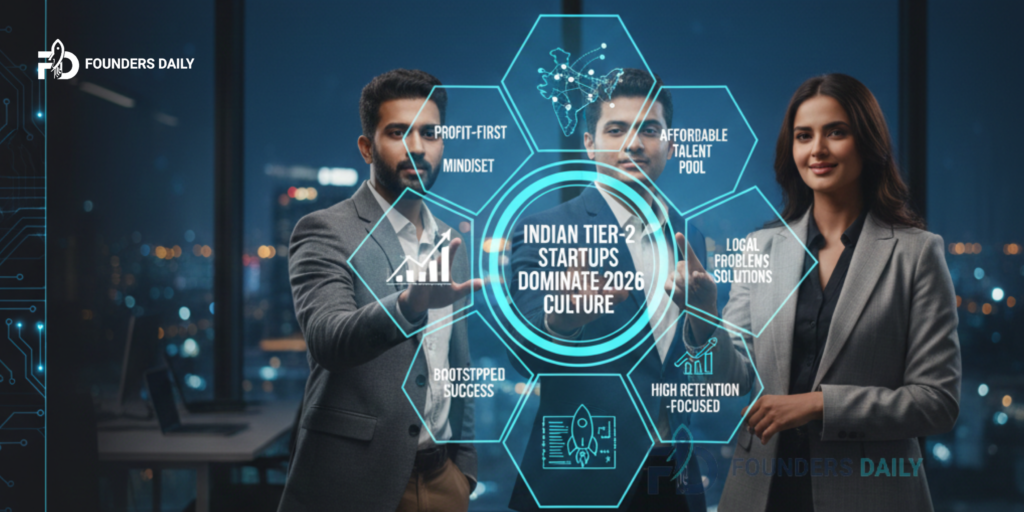
Tier-2 founders often build businesses with a profit-first mentality. Many come from family businesses, middle-class backgrounds, or service industries where cash flow discipline is non-negotiable. Growth is important, but survival and sustainability come first.
Instead of chasing aggressive funding rounds, these founders focus on customer revenue, retention, and unit economics. In 2026, as investors prioritize fundamentals over hype, this mindset has become a competitive edge rather than a limitation.
This cultural grounding also reflects in decision-making. Hiring is deliberate. Expansion is calculated. Marketing focuses on ROI rather than buzz. These traits are redefining what “smart entrepreneurship” looks like in India.
Bootstrapped Startups Are the New Power Players
One of the strongest patterns in Indian startup culture 2026 is the dominance of bootstrapped startups from Tier-2 cities.
From SaaS tools and D2C brands to manufacturing-tech hybrids, founders are building revenue-led businesses without external funding—or raising capital only after proving profitability. This approach gives them control, flexibility, and long-term clarity.
Bootstrapping forces sharper product thinking. When capital is limited, founders obsess over customer pain points, pricing, and retention. This creates stronger products and more loyal user bases, especially in competitive global markets.
Investors are now actively scouting Tier-2 cities for such founders, not because they are “undervalued,” but because they are execution-focused and resilient—qualities the ecosystem desperately needs post-2024 funding corrections.
Tier-2 Cities Are Producing Stronger Founder-Operator Hybrids
Another defining trait of Indian Tier-2 startup founders is their ability to operate deeply within their businesses. Many founders wear multiple hats—sales, product, operations, and finance—well into later stages.
This hands-on approach creates sharper feedback loops. Founders understand customers directly instead of relying on layers of management. Decisions are faster, grounded, and practical rather than theoretical.
In Tier-2 startup ecosystems, titles matter less than outcomes. This culture produces leaders who are adaptable, grounded, and execution-oriented—qualities that scale far better than pedigree-driven leadership.
As companies grow, these founders transition into strategic roles with a stronger foundation than peers who outsourced core learning too early.
Local Problems, Global Businesses
Tier-2 startup founders in India often start by solving local, real-world problems. Ironically, this local-first approach is what gives them global relevance.
Whether it’s supply-chain inefficiencies, regional language content, MSME digitization, or affordable SaaS tools, these problems exist across emerging markets worldwide. Solutions built in Tier-2 India are naturally cost-effective, scalable, and adaptable.
In 2026, global markets are increasingly receptive to products that balance affordability with performance. Tier-2 founders, shaped by constraint-driven innovation, are uniquely positioned to meet this demand.
This is why Indian SaaS startups from smaller cities are expanding into Southeast Asia, the Middle East, Africa, and even Europe—without massive capital outlays.
The Role of Talent and Community in Tier-2 Growth
Talent is no longer centralized. Engineers, designers, marketers, and operators increasingly prefer Tier-2 cities for better quality of life, lower costs, and meaningful work.
Indian Tier-2 startup founders benefit from higher talent loyalty. Attrition is lower, teams are more stable, and cultural alignment is stronger. This stability compounds execution speed and institutional knowledge over time.
Local founder communities, coworking spaces, incubators, and state-backed initiatives have also matured. Knowledge sharing is practical rather than performative. Mentorship is accessible. Competition is collaborative.
This ecosystem depth ensures that startups don’t just launch—they endure.
How Tier-2 Founders Are Redefining Startup Culture in 2026
Startup culture in 2026 is no longer about flashy offices, unsustainable growth, or social media hype. It is about clarity, resilience, and long-term value creation.
Indian Tier-2 startup founders embody this shift. They prioritize mental health, family stability, and sustainable work cultures. Hustle still exists, but it is purpose-driven rather than performative.
Work-from-anywhere models, asynchronous collaboration, and outcome-based performance are standard practices. Founders lead by example, not pressure. This cultural maturity attracts better talent and builds stronger brands.
In many ways, Tier-2 founders are humanizing entrepreneurship again.
Investor Attention Is Shifting—Quietly but Clearly
While media narratives still focus on metro unicorns, smart capital is moving silently toward Tier-2 startup ecosystems in India.
Investors in 2026 value predictable growth, strong unit economics, and founder integrity. Tier-2 startup founders check these boxes consistently. They are less likely to inflate metrics, overpromise, or burn capital recklessly.
As a result, funding conversations are more balanced. Founders negotiate from strength, not desperation. Equity dilution is lower. Strategic alignment is higher.
This dynamic is creating a healthier founder-investor relationship—one based on partnership rather than pressure.
Conclusion: The Future of Indian Startups Is Decentralized
The dominance of Indian Tier-2 startup founders in 2026 is not a temporary trend—it is a structural evolution. These founders are building companies that last, cultures that scale, and products that matter.
As the Indian startup ecosystem matures, success will no longer be measured by valuation headlines but by durability, impact, and execution quality. Tier-2 founders are already operating in this future.
For aspiring entrepreneurs, investors, and policymakers, the message is clear: the next chapter of India’s startup story will be written beyond the metros.
If you’re building—or backing—the future, this is where you should be looking.
FAQs
They focus on profitability, customer-centric products, and sustainable growth rather than hype-driven scaling.
Indore, Jaipur, Coimbatore, Surat, Kochi, Nagpur, and Chandigarh are leading the shift.
Yes. Their cost-efficient models and disciplined execution appeal strongly to global funds in 2026.
Not entirely. They raise capital selectively, usually after achieving revenue stability.
SaaS, D2C, manufacturing-tech, MSME solutions, and regional digital platforms.