Introduction
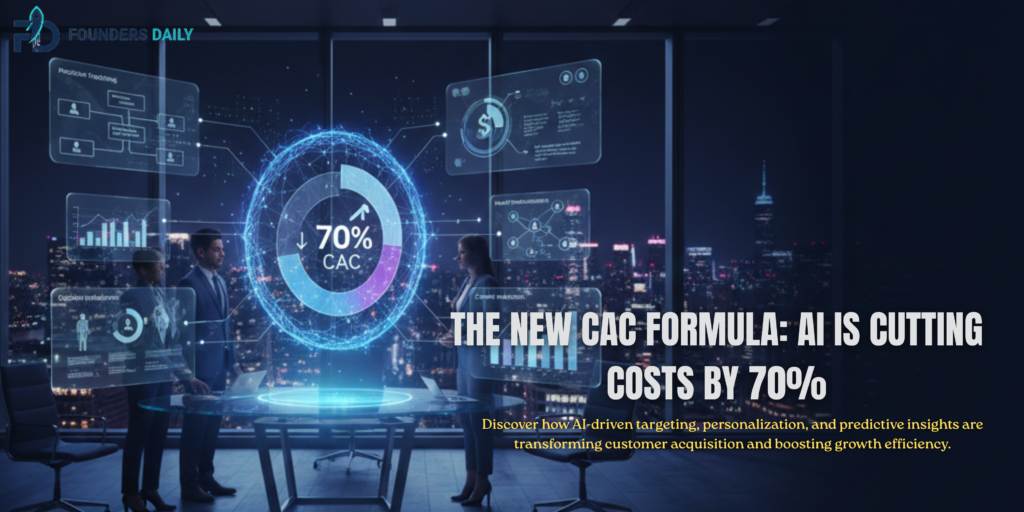
Customer acquisition has always been one of the most challenging aspects of business growth. For decades, founders and marketers have accepted high acquisition costs as a necessary tradeoff for expansion. Paid campaigns, social ads, and influencer partnerships were the standard tools, but increasingly, these approaches are becoming inefficient. The rise of artificial intelligence is transforming this landscape, allowing businesses to reach the right customers faster, more efficiently, and at a fraction of the cost. The new CAC formula demonstrates that, with AI, brands can significantly reduce acquisition costs, sometimes by as much as seventy percent, while simultaneously improving customer targeting and engagement. In this article, we explore how AI is redefining customer acquisition, why traditional CAC models are becoming obsolete, and how marketers can adopt AI-driven strategies responsibly to build sustainable, long-term growth.
Why Traditional CAC Models Are No Longer Effective
Traditional CAC models rely heavily on trial-and-error spending and broad audience targeting, assuming that scale will eventually deliver conversions. Historically, brands could rely on ad networks, mass email campaigns, and generic landing pages to reach their ideal customer. However, with digital competition increasing and consumer attention becoming scarce, these strategies are no longer sufficient. Users now expect relevance, personalization, and context in every interaction. When they don’t get it, conversion rates drop and acquisition costs rise. The traditional CAC formula, which focuses primarily on dividing total spend by new customers, fails to capture the nuances of user intent, engagement quality, and lifetime value. AI solves this by providing more precise targeting and actionable insights, allowing brands to focus resources on prospects who are already primed to engage or convert.
How AI is Redefining the CAC Formula
The new CAC formula is not a mere mathematical adjustment; it is a strategic approach that emphasizes efficiency, intent, and personalization. AI enables brands to analyze enormous volumes of behavioral, demographic, and contextual data to identify potential customers who are most likely to convert. By targeting audiences with precision and delivering highly relevant messaging, brands can avoid wasted spend on low-intent users. This precision targeting, combined with automation and predictive analytics, dramatically lowers acquisition costs. In essence, AI transforms customer acquisition from a scattergun approach to a highly focused, cost-efficient strategy. Companies adopting this model often see reductions in CAC as high as seventy percent, with conversion rates simultaneously increasing due to more meaningful engagement.
Identifying High-Intent Audiences with AI
One of the major breakthroughs in AI-driven customer acquisition is the ability to detect high-intent users earlier in the buying journey. Traditional marketing often casts a wide net, hoping to catch interested users after repeated exposures. AI flips this paradigm by analyzing search behaviors, engagement patterns, social interactions, and other signals to predict which users are most likely to convert. For instance, an AI system can distinguish between someone casually exploring a solution and someone actively comparing products or services. This distinction allows marketers to tailor messaging to the right audience at the right time, increasing efficiency and significantly lowering acquisition costs. By concentrating resources on high-intent prospects, businesses can reduce unnecessary impressions, improve ROI, and achieve a much more predictable and sustainable CAC.
Personalization at Scale: Making Every Interaction Count
Personalization has traditionally been expensive and time-consuming, requiring segmentation, manual content creation, and constant A/B testing. AI has changed that by enabling real-time personalization across channels, from website experiences to email campaigns and ad copy. By delivering content that resonates with individual user behaviors, preferences, and contexts, brands can create stronger engagement and higher conversion rates. When users feel understood and valued, trust builds naturally, reducing friction in the acquisition process. This human-centric approach, powered by AI, allows companies to scale personalized experiences efficiently, which is a core reason why acquisition costs drop dramatically under the new CAC formula.
Predictive Analytics: Smarter Budget Allocation
AI also provides the ability to forecast performance before money is spent. Traditional acquisition strategies are reactive, often adjusting campaigns after results have already been observed. Predictive analytics powered by AI allows marketers to allocate budgets proactively, prioritizing channels, creatives, and audience segments with the highest probability of success. By anticipating which campaigns will perform best, businesses can avoid wasting resources and reduce unnecessary spending. Over time, this predictive approach compounds, allowing companies to optimize CAC with precision while increasing overall ROI. Predictive analytics ensures that the new CAC formula is not just reactive cost management, but a forward-looking growth strategy that maximizes efficiency at every stage.
Eliminating Operational Inefficiencies
Human error, inconsistent decision-making, and delayed optimizations are hidden drivers of higher acquisition costs. AI reduces these inefficiencies by automating repetitive tasks, continuously monitoring campaigns, and executing real-time adjustments. This automation does not replace marketers; rather, it empowers them to focus on strategic initiatives and creative problem-solving. Teams can now direct attention toward refining messaging, improving user experience, and strengthening brand trust, while AI handles precision targeting and execution. This synergy between human judgment and machine intelligence is central to achieving lower CAC without sacrificing quality or engagement.
Organic Growth and Content Intelligence
AI-driven acquisition is not limited to paid channels. Organic growth is equally transformed by AI-powered content intelligence. Brands can identify high-intent, low-competition keywords, optimize content for SEO, and analyze engagement metrics to understand which topics drive conversions. By attracting the right audience organically, brands can reduce dependency on paid acquisition channels, further lowering blended CAC. AI tools help businesses create content that is not only discoverable but also actionable, driving long-term growth while supporting the new CAC formula. Over time, this combination of paid and AI-optimized organic acquisition creates a compounding effect, making growth more sustainable and predictable.
Real-World Example: SaaS Acquisition Transformation
Consider a mid-sized SaaS company struggling with rising acquisition costs despite consistent traffic growth. By integrating AI-driven audience segmentation and predictive targeting, the company shifted focus from broad campaigns to high-intent users identified through behavioral data. Within six months, their ad spend decreased while conversion rates rose sharply, resulting in a nearly 65% reduction in CAC. The key difference was precision. AI enabled them to understand who their audience truly was, when they were ready to convert, and which messages would resonate most effectively. This real-world example demonstrates that the new CAC formula is both actionable and transformative, not just theoretical.
Trust and Ethical AI in Acquisition
Reducing acquisition costs is only part of the story. Brands must maintain trust and ethical responsibility when deploying AI in acquisition. Aggressive automation without consideration for privacy, consent, or user experience can damage credibility and long-term brand equity. Successful AI-driven strategies focus on delivering value, context, and transparency. When AI supports meaningful engagement rather than manipulation, trust strengthens, engagement improves, and CAC decreases sustainably. The new CAC formula is therefore not just a financial model; it is a framework for building ethical, effective, and human-aligned customer acquisition systems.
Why Founders Must Rethink Growth Metrics
Founders often focus on top-line growth without considering acquisition quality, lifetime value, and retention. AI-driven CAC optimization encourages a holistic perspective that balances acquisition efficiency with customer experience. It prioritizes sustainable growth rather than short-term spikes and aligns marketing investment with long-term business objectives. By adopting the new CAC formula, founders can make smarter decisions about where to invest resources, how to structure teams, and how to create predictable, profitable customer pipelines.
The Future of AI-Driven Acquisition
The evolution of AI in marketing signals a fundamental shift in acquisition economics. Brands that embrace AI early gain a competitive advantage, leveraging data and predictive insights to reduce CAC while enhancing customer engagement. Those who resist AI risk higher costs, inefficient targeting, and lower conversion rates. The new CAC formula is not a temporary trend; it represents a structural change in how businesses approach customer acquisition. Precision, personalization, predictive analytics, and ethical automation are now core to sustainable growth. The future will reward brands that integrate these principles responsibly and consistently.
Conclusion
The new CAC formula proves that smarter acquisition is possible without overspending or compromising quality. AI is transforming how brands identify high-intent users, personalize engagement, and optimize budgets, resulting in cost reductions of up to 70 percent. However, this efficiency works best when combined with human oversight, ethical practices, and a focus on trust. By adopting AI-powered strategies thoughtfully, businesses can achieve predictable growth, improve ROI, and build stronger customer relationships. The future of acquisition is not about spending more—it is about spending smarter, connecting meaningfully, and letting AI enhance human-driven strategy.