
Introduction
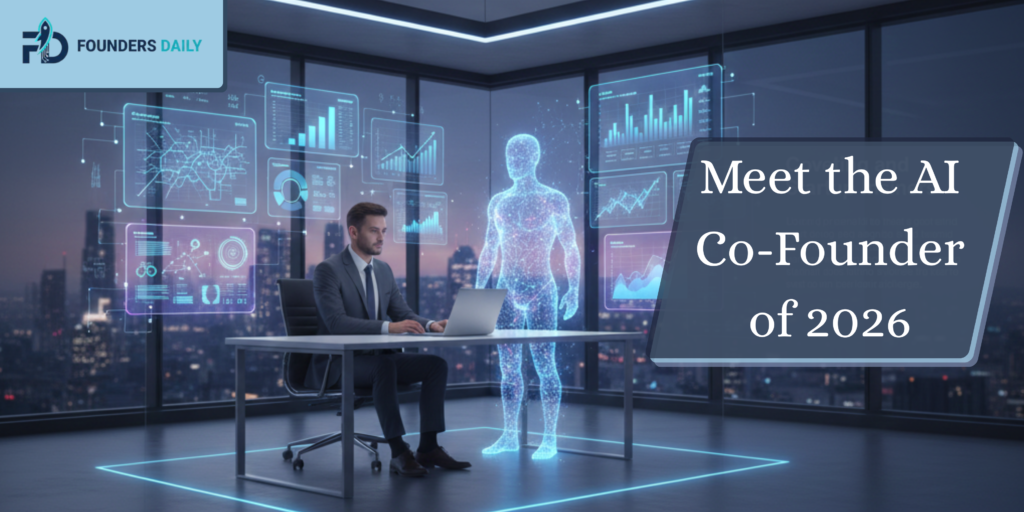
In the early days of startups, a co-founder usually meant a trusted friend, a college batchmate, or a professional partner who shared the same vision and risk appetite. But as we move closer to 2026, a powerful shift is happening in the startup ecosystem. Founders are no longer limiting themselves to human-only partnerships. A new kind of partner is entering boardrooms, strategy meetings, and daily operations. These partners do not take equity dinners, do not sleep, and do not burn out. They are AI co-founders, and they are quietly redefining how companies are built from day one.
Today’s founders face intense pressure. Competition is global, capital is cautious, customers expect instant personalization, and teams need to move faster than ever. Hiring senior talent early is expensive, and wrong decisions can kill momentum. This is where AI co-founders step in, not as replacements for humans, but as intelligent collaborators that amplify a founder’s thinking, execution speed, and decision-making power.
In this blog, you will learn what AI co-founders really are, why they are becoming a core trend for 2026, how founders are already using them in real businesses, and what this means for entrepreneurship, startups, and leadership in the near future. If you are building a company or planning to start one, understanding AI co-founders is no longer optional. It is a strategic advantage.
What Are AI Co-Founders and Why the Term Is Gaining Momentum
Understanding the Concept of AI Co-Founders
The idea of AI co-founders goes far beyond using a chatbot or an automation tool. An AI co-founder is a deeply integrated artificial intelligence system that actively participates in core business decisions. It helps founders with strategy, product development, marketing, finance, hiring, customer insights, and long-term planning. Unlike traditional software, AI co-founders learn continuously from data, user behavior, and market signals, becoming smarter and more aligned with the founder’s vision over time.
Founders are calling these systems co-founders because they behave like one. They challenge assumptions, surface blind spots, suggest data-backed strategies, and operate at a level that feels collaborative rather than mechanical. This shift in language reflects a shift in mindset. AI is no longer a tool you use occasionally. It becomes a thinking partner you rely on daily.
Why 2026 Will Be the Breakout Year for AI Co-Founders
While AI adoption has been growing for years, 2026 is expected to be the tipping point for AI co-founders. The reason is simple. AI models are becoming more contextual, more industry-specific, and more capable of handling complex reasoning tasks. At the same time, founders are becoming more comfortable trusting AI-driven insights, especially when they consistently outperform intuition-based decisions.
Another major driver is cost efficiency. Early-stage startups often cannot afford a full leadership team. AI co-founders fill this gap by offering strategic input at a fraction of the cost. As venture capital firms also begin to encourage leaner teams and sustainable growth, AI co-founders fit perfectly into this new startup philosophy.
How AI Co-Founders Are Changing the Startup Journey
From Idea Validation to Product Market Fit
One of the hardest phases for any founder is validating an idea before committing serious resources. Traditionally, this required market research firms, surveys, interviews, and weeks of analysis. AI co-founders compress this process dramatically. They analyze search trends, competitor positioning, customer reviews, social media conversations, and industry reports within minutes.
Founders using AI co-founders can test multiple ideas quickly, refine value propositions, and identify niche opportunities with high demand and low competition. This level of insight early on significantly increases the chances of achieving product market fit, which remains one of the biggest predictors of startup success.
Decision Making Without Emotional Bias
Human founders bring passion, creativity, and intuition. They also bring emotional bias. AI co-founders operate differently. They evaluate decisions based on data patterns, probabilities, and outcomes rather than ego or fear. When founders feel stuck or overly attached to an idea, AI co-founders provide a neutral perspective that often leads to better decisions.
This does not mean founders blindly follow AI suggestions. Instead, the relationship works best when human judgment and AI analysis complement each other. Many founders describe this dynamic as having a calm, logical partner who balances their emotional energy.
Real World Examples of AI Co-Founders in Action
Solo Founders Scaling Faster With AI Co-Founders
In recent years, the number of solo founders has increased significantly. Many of them credit AI co-founders for making this possible. A solo SaaS founder, for example, might rely on an AI co-founder to design pricing models, optimize onboarding flows, write sales emails, and forecast revenue. Tasks that once required a team of specialists are now handled by a single founder working alongside AI.
These founders often report faster execution, clearer priorities, and reduced burnout. The AI co-founder becomes a silent engine that keeps the business moving forward, even when human energy dips.
AI Co-Founders in E-commerce and D2C Brands
E-commerce founders are also embracing AI co-founders aggressively. From demand forecasting to personalized product recommendations, AI co-founders help optimize every stage of the customer journey. They analyze buying patterns, suggest inventory strategies, and even help design marketing creatives that convert better.
One D2C founder shared how their AI co-founder identified a specific customer segment that was previously ignored. By tailoring messaging and offers to that segment, revenue increased without increasing ad spend. Stories like this are becoming increasingly common.
The Role of AI Co-Founders in Key Business Functions
Strategy and Vision Alignment
Many people assume AI cannot understand vision or long-term goals. In reality, modern AI co-founders excel at aligning daily decisions with long-term strategy. By constantly referencing business goals, market trends, and performance metrics, they help founders stay focused on what truly matters.
An AI co-founder can simulate different strategic paths and predict outcomes, allowing founders to choose directions with greater confidence. This level of foresight was once reserved for large corporations with dedicated strategy teams.
Marketing, Growth, and Customer Acquisition
Marketing is one of the areas where AI co-founders deliver immediate value. They analyze ad performance, SEO opportunities, content gaps, and audience behavior in real time. Instead of relying on guesswork, founders get actionable insights backed by data.
AI co-founders also adapt quickly. If a campaign underperforms, they identify why and suggest improvements instantly. This continuous optimization leads to higher ROI and more sustainable growth.
Trust, Ethics, and the Human Side of AI Co-Founders
Can Founders Truly Trust AI Co-Founders
Trust is a major concern when delegating critical decisions to AI. Successful founders treat AI co-founders as advisors rather than dictators. They verify outputs, question assumptions, and set clear boundaries. Over time, as the AI consistently delivers accurate insights, trust naturally builds.
Transparency also plays a key role. Founders should understand how their AI co-founder processes data and reaches conclusions. This clarity strengthens the partnership and reduces dependency risks.
Ethical Use of AI Co-Founders
As AI co-founders become more powerful, ethical considerations become essential. Responsible founders ensure that AI-driven decisions respect customer privacy, avoid bias, and comply with regulations. Ethical use is not just a moral choice. It is a business necessity, especially as consumers become more aware of how companies use AI.
Founders who prioritize ethical AI gain long-term trust from customers, investors, and employees. This trust becomes a competitive advantage in a crowded market.
Why Investors Are Paying Attention to AI Co-Founders
Lean Teams and Capital Efficiency
Investors increasingly favor startups that achieve more with fewer resources. AI co-founders enable lean operations without sacrificing strategic depth. Startups that demonstrate effective use of AI often show better margins, faster experimentation, and clearer scalability.
Some investors even ask founders how they are using AI co-founders during pitch meetings. It signals forward-thinking leadership and operational maturity.
Better Risk Management and Forecasting
AI co-founders excel at identifying risks early. Whether it is churn signals, cash flow issues, or market shifts, they provide early warnings that allow founders to act proactively. This capability reduces surprises and improves long-term stability, making startups more attractive to investors.
How Founders Can Start Working With AI Co-Founders Today
Choosing the Right AI Co-Founder Setup
Not all AI solutions qualify as AI co-founders. Founders should look for systems that integrate across multiple functions, learn from business-specific data, and offer strategic insights rather than generic outputs. Customization and adaptability are key.
Founders who treat AI as a long-term partner, investing time in training and alignment, see the greatest benefits.
Building a Healthy Human AI Partnership
The most successful founders do not replace human creativity with AI. They enhance it. They use AI co-founders to handle analysis, repetition, and optimization, freeing human minds for vision, storytelling, and leadership.
This balance creates a powerful synergy where technology amplifies human potential instead of diminishing it.
Conclusion
The rise of AI co-founders is not a passing trend. It represents a fundamental shift in how businesses are built and scaled. By 2026, founders who ignore this shift may find themselves at a serious disadvantage. AI co-founders offer speed, clarity, and strategic depth that modern startups need to survive and thrive.
The future belongs to founders who know how to collaborate with intelligence, both human and artificial. If you are building a company today, the question is no longer whether you will work with an AI co-founder. The real question is how soon you will start.