
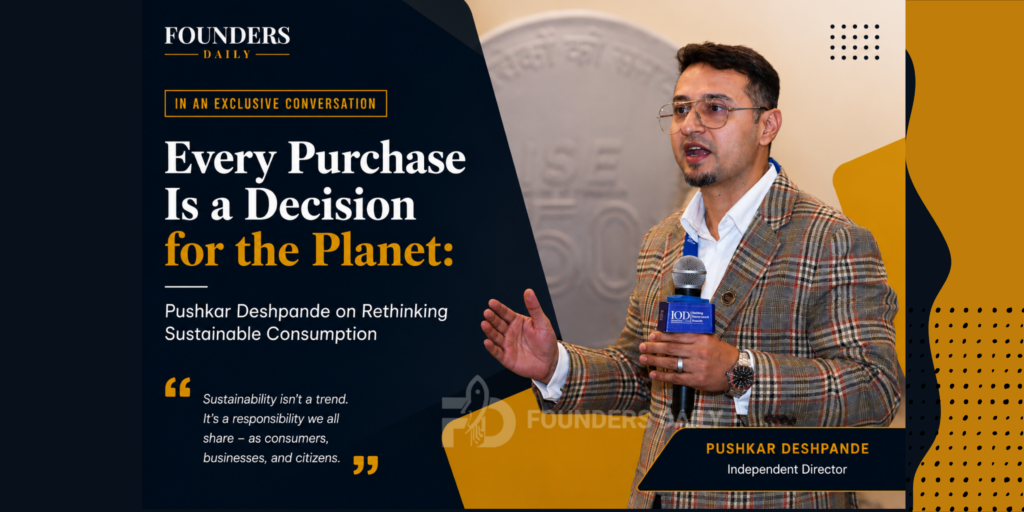
In an exclusive conversation, Pushkar Deshpande, an independent director, discusses why sustainability must move beyond ESG reporting and recycling, and become a shared responsibility for businesses, governments and consumers.
Sustainability is often discussed in the context of governments, corporations, investors and ESG frameworks. Yet many of the decisions that shape environmental outcomes are made much closer to everyday life, when people decide what to buy, what to use, what to repair and what to discard.
At the heart of the conversation around responsible consumption lies a simple but important question, who is ultimately responsible for the planet?
Is it governments that create policy, businesses that manufacture products, investors who allocate capital, or consumers whose choices drive demand?
In an exclusive conversation, Pushkar Deshpande argues that responsibility cannot rest with any one group. His perspective begins with the belief that every individual, in some sense, has a role to play in determining how the planet’s resources are used.
Also Read: Why Every Founder Should Learn to Think Like an Independent Director
He describes this idea by saying that every person is a “board director of Planet Earth.”
“It means every one of us has a duty of care. Our choices on what we buy, waste, eat, travel with, and discard are effectively decisions about the planet’s resources. We may not hold a formal board seat, but we all influence the future through demand.”
This perspective challenges the tendency to treat sustainability primarily as a corporate or governmental responsibility. Institutions undoubtedly possess the scale, capital and influence required to drive systemic change. But consumers influence markets through the choices they make, while businesses respond to changing expectations and governments respond to public priorities.
At the same time, the burden cannot simply be shifted onto individuals. When companies benefit from high levels of consumption, responsible change requires businesses, governments and consumers to move together.
“It is fair only when responsibility is shared. Businesses must design better products and avoid manipulative or wasteful practices; governments must set fair rules and infrastructure; consumers must use their purchasing power with greater awareness. None can outsource responsibility to the others.”
That shared responsibility also extends to the boardroom. Sustainability cannot remain confined to an ESG report, a communications strategy or a compliance exercise if businesses are serious about long-term value creation. Environmental considerations increasingly affect supply chains, regulation, insurance costs, customer expectations and business continuity.
The real question for corporate leaders, therefore, is not simply whether sustainability represents an additional cost. It is whether businesses can continue to create value over the long term without recognising the environmental limits within which they operate.
“The task is not to choose profit or planet; it is to build business models that remain viable because they respect planetary limits.”
This requires a more fundamental shift in how companies approach ESG. Reporting and disclosure have undoubtedly increased awareness, but genuine sustainability must be visible in the operational decisions a company makes.
“Genuine ESG shows up in what a company produces, sources, ships, finances, measures, rewards, and is prepared to stop doing.”
The distinction is particularly relevant at a time when sustainability is increasingly associated with ratings, disclosures and commitments. Real transformation, however, depends on whether environmental considerations influence capital allocation, product design, procurement, incentives and long-term strategy.
The conversation around responsible consumption also requires a rethink of where sustainability actually begins. Too often, the focus is placed on what happens after a product has been consumed, particularly recycling. But by the time a product reaches the recycling bin, many of the most important decisions have already been made.
“Sustainability begins before checkout, not at the recycling bin.”
The more relevant questions arise before making a purchase. Is the product genuinely necessary? How long will it last? Can it be repaired or reused? What is it made from? And what happens to it once its useful life ends?
This is also where the limits of recycling become apparent. Recycling remains important, but it cannot become a justification for unlimited consumption. A more responsible hierarchy begins with refusing what is unnecessary, reducing what is used and extending the life of products through reuse and repair.
“The more effective order is to refuse what is unnecessary, reduce what we use, reuse and repair what we own, and recycle only what remains.”
The same principle applies to the growing conversation around the circular economy. Keeping materials in circulation is an important objective, but circularity should not become an excuse for producing unnecessary products more efficiently.
“Before we ask how to circulate a product, we should ask whether it needs to be produced at all. The most sustainable item is often the one never manufactured.”
For responsible consumption to become mainstream, however, sustainable choices cannot remain expensive alternatives available only to a small section of consumers. They need to become practical, accessible and economically viable. Better product design, durable-product standards, repair infrastructure, producer responsibility and transparent information can all make it easier for people to make more responsible decisions.
Every product also carries a much larger story than the consumer may see.
“Every item carries a supply-chain story: raw-material extraction, manufacturing energy, packaging, warehousing, shipping, last-mile delivery, and disposal.”
This interconnectedness is what makes responsible consumption both an individual and systemic challenge. Citizens can make mindful choices, but they must also be supported by businesses designing better products, governments building the right infrastructure and institutions creating transparent systems.
“Citizens should make mindful choices, but they should also expect better products, credible regulation, transparent information, and institutions that do not shift the burden downward.”
Ultimately, the case for sustainable consumption is not about expecting individuals to make perfect choices. It is about recognising that consumption itself is a form of influence. Every purchase contributes to a larger pattern of demand, and over time, those patterns shape the products businesses create and the markets they serve.
The most important change may therefore begin with a simple pause.
“Pause before purchasing.”
Before buying, consider whether something is necessary, durable, repairable and responsible at the end of its life. It is a small action, but multiplied across millions of consumers, it has the potential to influence markets in ways that policies and corporate commitments alone cannot.
The future of sustainability will not be determined only in boardrooms, policy discussions or international climate forums. It will also be shaped through everyday decisions, by businesses deciding what to produce, governments deciding what systems to enable and consumers deciding what is truly worth consuming.
Also Read: How to Build AI-Augmented Teams (Human + Machine Collaboration Model)
That is where responsible consumption moves beyond being an environmental ideal and becomes a shared economic and social responsibility.