
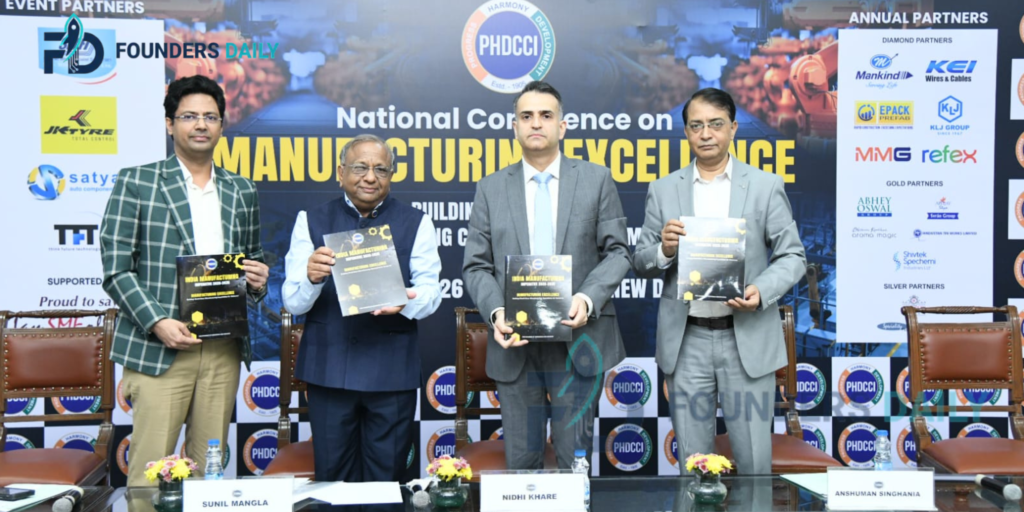
New Delhi: The PHD Chamber of Commerce and Industry (PHDCCI) hosted the National Conference on “Manufacturing Excellence: Building World-Class Manufacturing Capabilities for Tomorrow” on May 12, 2026, at PHD House in New Delhi.
The conference brought together government representatives, industry leaders, technology experts, academia, and manufacturing stakeholders to discuss strategies for strengthening India’s manufacturing ecosystem, quality infrastructure, and global industrial competitiveness.
Also Read: What CXOs Should Measure to Understand the Real Impact of AI
Delivering the opening remarks, Mr. Sunil Mangla, Chair, Manufacturing Committee, PHDCCI, stated that manufacturing remains one of the key pillars of India’s economic transformation and contributes nearly 25 percent to the country’s GDP aspirations under the vision of Viksit Bharat 2047.
He said India currently possesses strong capital availability, world-class infrastructure, and a skilled workforce, positioning the country as a leading global manufacturing destination.
Highlighting the importance of quality manufacturing, he said global markets are increasingly demanding not only low-cost products but also low-cost quality products, making globally accepted testing and certification systems essential for Indian industries.
He further emphasized the need for manufacturing hubs, integrated supply chains, and collaborative industrial ecosystems to improve productivity, quality control, and competitiveness.
Addressing the gathering as Chief Guest, Smt. Nidhi Khare, Secretary, Department of Consumer Affairs, Government of India, said India is entering a defining phase in its manufacturing journey and that globally trusted manufacturing capabilities rooted in quality, innovation, safety, and sustainability will be critical for achieving the vision of Viksit Bharat 2047.
She stated that the future of Indian manufacturing lies not only in increasing production but also in integrating advanced technologies, smart manufacturing systems, and product lifecycle management to improve global competitiveness.
Emphasizing the importance of Quality Control Orders (QCOs) and standards, she noted that regulations should function as catalysts for manufacturing excellence, consumer trust, and fair trade practices.
She also urged industry stakeholders to actively participate in standards formulation to ensure alignment with India’s industrial and climatic conditions.
Highlighting efforts to strengthen the country’s quality ecosystem, she said India is modernizing testing infrastructure through faster methodologies, expanded laboratory networks, adoption of AI and robotics, and development of testing corridors.
Citing sectors including toys and footwear, she said quality-driven regulations have contributed significantly to domestic manufacturing growth, exports, and global acceptance of Indian products.
Mr. Anshuman Singhania, Co-Chair, Manufacturing Committee, PHDCCI, stated that quality and innovation would play a major role in positioning India as a globally competitive manufacturing hub.
He highlighted that customer-centricity, technological innovation, and sustainability have become essential pillars of modern manufacturing.
Referring to advancements in smart manufacturing systems and sensor-enabled technologies, he said Indian industry must adopt digital transformation and collaborative innovation to remain globally competitive.
Mr. Kunal Singhal, Co-Chair, Manufacturing Committee, PHDCCI, emphasized that AI is no longer a future concept but a present-day necessity capable of transforming manufacturing efficiency, supply chains, and industrial competitiveness.
Referring to ongoing global uncertainties and supply chain disruptions, he highlighted the need for India to technologically strengthen its manufacturing ecosystem and emerge as a major global supplier.
The conference also witnessed the launch of the knowledge report titled “India Manufacturing Imperative 2026-2035: Manufacturing Excellence – Building World-Class Manufacturing Capabilities for Tomorrow.”
The report was prepared under the leadership of Ms. Satish Dev Jain, Chair of the Haryana Chapter, PHDCCI, and focused on manufacturing aspirations, sustainability goals, industrial transformation priorities, policy recommendations, and strategies for strengthening global manufacturing competitiveness.
Also Read: The Real Cost of Scaling Too Fast in Startups
The inaugural session was followed by technical discussions on Design for Manufacturing (DFM), Value Engineering, and Digital Transformation in Manufacturing.
The conference concluded with a call for deeper collaboration among government, industry, academia, and technology leaders to build a globally competitive, innovation-driven, and sustainable manufacturing ecosystem aligned with India’s vision of becoming a developed economy by 2047.