
By Ramendra Shukla, Founder & CEO, Exponentia.ai
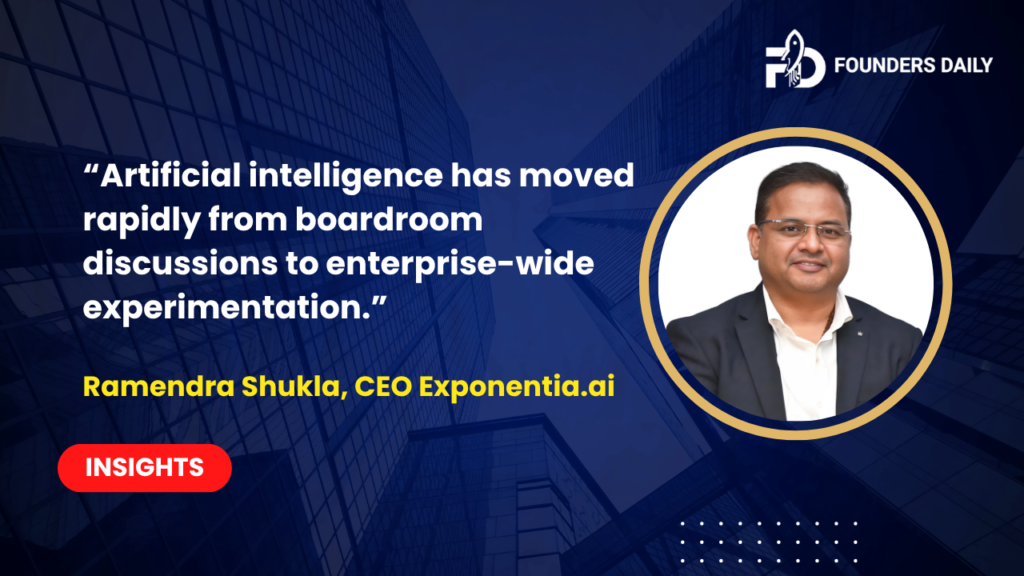
Artificial intelligence has moved rapidly from boardroom discussions to enterprise-wide experimentation. Across industries, organizations are investing in AI to improve efficiency, enhance decision-making, and unlock new growth opportunities.
Despite this momentum, a fundamental question continues to challenge leadership teams:
How do we measure the real impact of AI?
For many CXOs, AI success is still assessed through fragmented indicators, number of use cases deployed, pilot programs completed, or models built. While these metrics may signal activity, they rarely reflect true business value.
To understand the real impact of AI, organizations need to move beyond technical metrics and focus on outcomes that align with business performance, operational efficiency, and strategic advantage.
Also Read: The Next Phase of India’s Startup Ecosystem
Moving Beyond Pilot Success
One of the most common challenges enterprises face is the gap between AI pilots and enterprise-scale impact.
Many organizations successfully build proof-of-concept models but struggle to translate them into measurable business outcomes. In such cases, success is often defined by whether a model works technically, not whether it delivers value in real-world operations.
CXOs must, therefore, shift focus from:
- “Did the model perform well?”
to - “Did it improve business outcomes?”
This shift requires defining metrics that connect AI initiatives directly to operational and financial impact.
Measuring Operational Efficiency Gains
At its core, AI is often introduced to improve how work gets done.
One of the most tangible ways to measure its impact is through operational efficiency:
- Reduction in manual effort
- Faster turnaround times
- Improved process consistency
For example, AI-driven automation in areas such as data processing, reporting, or customer service can significantly reduce cycle times. But the real metric is not just automation; it is how that automation translates into time saved, cost reduced, and output improved.
Efficiency gains provide one of the earliest and most measurable indicators of AI success.
Evaluating Decision-Making Effectiveness
Beyond efficiency, AI is increasingly influencing how organizations make decisions.
Traditional decision-making often relies on historical data, intuition, and periodic analysis. AI introduces the ability to process large volumes of data in real time, identify patterns, and generate predictive insights.
The question CXOs should ask is:
Are decisions becoming faster, more accurate, more consistent and resulting in desired outcomes?
Metrics in this area may include:
- Reduction in decision turnaround time
- Improvement in forecast accuracy
- Better alignment between predictions and outcomes
The true value of AI lies not just in generating insights, but in enabling better decisions at scale.
Tracking Business Impact and ROI
Ultimately, AI investments must translate into measurable business value.
This could include:
- Revenue growth driven by better targeting or personalization
- Cost savings from optimized operations
- Reduction in errors, rework, or inefficiencies
However, measuring ROI in AI is not always straightforward. Unlike traditional investments, AI outcomes often compound over time as models learn and improve.
CXOs need to adopt a longer-term view of value creation, focusing not only on immediate returns but also on how AI capabilities strengthen competitive positioning.
Adoption and Usage Across the Organization
Even the most advanced AI systems fail to deliver value if they are not adopted by users.
A critical but often overlooked metric is adoption:
- Are teams actively using AI-driven tools?
- Are insights being integrated into workflows?
- Do employees trust the outputs generated by AI systems?
Low adoption often indicates deeper challenges, lack of training, poor integration, or limited trust in the system.
Measuring adoption helps organizations understand whether AI is truly becoming part of everyday work or remaining a disconnected initiative.
Data Readiness and Quality
AI outcomes are only as strong as the data that powers them.
CXOs must also evaluate the quality, accessibility, and governance of enterprise data:
- Is data consistent and reliable across systems?
- Can it be accessed in real time?
- Are there clear governance frameworks in place?
Poor data quality can limit the effectiveness of even the most sophisticated AI models. Measuring improvements in data readiness is therefore a critical part of assessing AI impact.
Building a Learning Organization
One of the most important, yet less tangible, indicators of AI impact is how it transforms the organization itself.
Are teams becoming more data-driven?
Are employees more comfortable experimenting with new tools?
Is there a culture of continuous learning and adaptation?
AI is not just a technology investment; it is a catalyst for organizational change.
Companies that succeed with AI are often those that build learning-oriented cultures, where teams continuously refine processes, improve models, and adapt to new possibilities.
From Metrics to Meaningful Impact
Measuring AI success requires a shift in mindset.
It is not about counting models or tracking isolated use cases. It is about understanding how AI influences:
- How work gets done
- How decisions are made
- How value is created across the enterprise
We see this transition closely while working with organizations across industries. The most successful AI journeys are those where measurement is aligned with business outcomes from the outset, not treated as an afterthought.
As AI adoption continues to accelerate, CXOs have a critical role to play in ensuring that investments translate into real impact.
Also Read: Building Brand Trust in an AI-Dominated Content World
The organizations that succeed will be those that:
- Define clear outcome-driven metrics
- Focus on adoption and integration
- Build strong data foundations
- Foster a culture of continuous learning
Because in the end, the real impact of AI is not defined by how advanced the technology is.
It is defined by how meaningfully it improves the way the organization operates, decides, and grows.