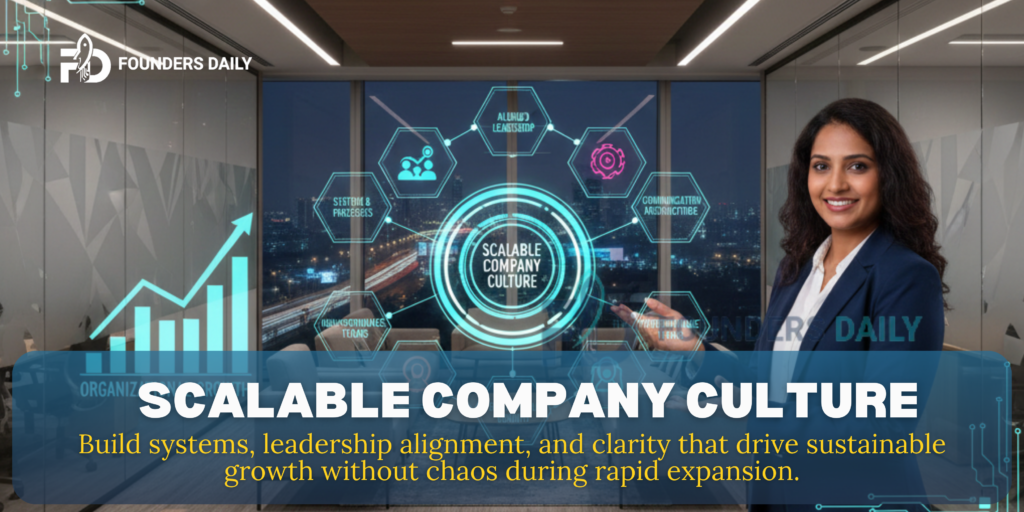
Growth is seductive. Revenue climbs, hiring accelerates, investors lean in, and the market starts paying attention. Yet behind the scenes of many high growth companies lies a quieter struggle. Teams expand faster than alignment. Communication fragments. Decision making slows. What once felt like focused momentum turns into internal friction. For founders and executives navigating 2026, building company culture that scales is no longer a soft leadership topic. It is a strategic imperative.
In boardrooms across technology, manufacturing, fintech, and SaaS companies, leaders are recognizing that operational excellence alone does not guarantee sustainable growth. Organizational growth today demands clarity of values, disciplined execution, and a high performance work culture that survives expansion. This article explores how building company culture that scales prevents chaos, strengthens leadership development, and creates a durable competitive advantage.
The Hidden Cost of Growth Without Cultural Infrastructure
In early stage startups, culture forms organically. Founders sit close to every decision. Teams share context informally. Alignment feels natural because everyone is in the same room or Slack channel. However, once headcount doubles or triples, that intimacy disappears. Informal alignment collapses under complexity.
Companies that neglect scalable company culture often experience predictable symptoms. Managers interpret priorities differently. Departments optimize for their own targets rather than shared outcomes. New hires receive inconsistent onboarding experiences. Over time, employee engagement drops and productivity slows, even though talent quality remains high.
The issue is rarely competence. It is coherence. Building company culture that scales provides the connective tissue that holds expanding teams together. Without it, growth magnifies weaknesses instead of strengths.
Also Read: Skill Based Education Will Replace Degree Based Hiring
Why Building Company Culture That Scales Matters More in 2026
The business environment in 2026 amplifies complexity. Hybrid work models are standard. AI powered workflows redefine roles. Global hiring expands access to talent but increases cultural diversity. Market cycles shift faster, and capital efficiency is under scrutiny.
In this environment, company culture strategy becomes a stabilizing force. A clearly defined workplace culture helps distributed teams make consistent decisions without constant supervision. When employees understand the company’s principles and decision making framework, they move faster with less friction.
Research from global consulting firms consistently shows that organizations with strong cultural alignment outperform peers in profitability and retention. Culture directly influences hiring for cultural fit, leadership development, and performance management systems. It shapes how conflicts are resolved and how innovation is encouraged. In high growth environments, culture is not a decorative statement. It is infrastructure.
Defining Culture Beyond Slogans
Many companies claim values such as integrity, innovation, and excellence. Yet these words often lack operational meaning. Building company culture that scales requires translating abstract ideals into observable behaviors.
For example, if a company values ownership, what does ownership look like in practice. Does it mean employees proactively flag risks. Does it mean teams take responsibility for outcomes rather than blaming other departments. Unless values are behaviorally defined, they remain branding tools rather than strategic assets.
A robust company culture strategy connects values to daily decisions. In meetings, leaders reference principles explicitly. In performance reviews, managers evaluate not only results but also how those results were achieved. When values shape promotions and recognition, they become embedded in the organizational DNA.
Leadership Alignment as the First Lever
Culture scales only when leadership alignment is strong. If executives interpret priorities differently, employees receive mixed signals. Inconsistent behavior at the top erodes trust across the organization.
High performing companies invest in leadership development before aggressive expansion. Executive teams participate in structured workshops to clarify mission, operating principles, and decision rights. They align on how to communicate strategy and how to handle conflict.
Building company culture that scales means leaders must embody the standards they promote. Employees observe leaders closely. When executives demonstrate transparency during difficult quarters, teams mirror that honesty. When leaders prioritize collaboration over internal politics, silos weaken.
Leadership modeling is the multiplier. Without it, documented values lose credibility.
Designing Systems That Reinforce Scalable Company Culture
Culture cannot rely solely on inspiration. It requires systems. As organizations grow, repeatable processes ensure consistency across departments and geographies.
Structured hiring processes are central. Instead of relying on instinct, companies integrate cultural alignment questions into interviews. Candidates are assessed on problem solving, collaboration, and ethical decision making. This approach strengthens hiring for cultural fit and reduces long term friction.
Performance management systems must also align with culture. If bonuses reward only short term revenue without recognizing teamwork, collaboration will decline. Building company culture that scales involves aligning incentives with desired behaviors. Recognition programs, promotions, and feedback mechanisms must reinforce cultural priorities.
Documentation plays a powerful role. Clear playbooks, onboarding guides, and decision making frameworks reduce ambiguity. New hires integrate faster because expectations are explicit. Over time, documentation protects culture during periods of rapid organizational growth.
Communication as the Architecture of Alignment
In scaling organizations, communication becomes more complex. Teams operate across time zones and digital platforms. Without intentional design, information becomes fragmented.
Companies that excel at building company culture that scales establish transparent communication norms. Leadership shares strategic updates consistently. Town halls create visibility into performance metrics. Feedback channels allow employees to raise concerns safely.
Psychological safety is essential. Employees must feel comfortable challenging ideas without fear of retaliation. This environment encourages innovation and strengthens remote team culture. When people trust that their voices matter, engagement rises.
Effective communication reduces the risk of parallel narratives forming within the organization. Everyone understands not only what is happening but why it matters.
Decentralizing Decision Making Without Losing Control
As companies expand, centralized control becomes a bottleneck. Founders cannot approve every initiative. However, decentralization without guardrails invites chaos.
Building company culture that scales provides those guardrails. Clear authority matrices define decision rights. Teams know where autonomy begins and where escalation is required. Shared values guide judgment calls when ambiguity arises.
This balance between autonomy and accountability is a hallmark of high performance work culture. Employees feel empowered, yet aligned. Innovation accelerates because decisions do not wait for executive sign off, while strategic coherence remains intact.
A Case Study in Cultural Transformation
Consider a mid stage technology company that expanded from 30 to 300 employees in under four years. Initially, rapid hiring fueled product growth. Yet internal friction soon surfaced. Product and sales teams clashed over priorities. Managers interpreted performance standards inconsistently. Turnover began rising.
The executive team paused to reassess. They clarified core values and translated them into behavioral expectations. They redesigned the performance management system to include cultural contribution metrics. Leadership development programs trained managers in coaching and feedback.
Within twelve months, employee engagement scores improved significantly. Cross functional collaboration strengthened. Customer satisfaction metrics climbed. Revenue growth resumed, but this time supported by a cohesive scalable company culture.
The lesson was clear. Growth magnifies whatever systems exist. When culture is intentional, scale becomes sustainable.
Measuring Cultural Health
Although culture feels intangible, it can be measured. Retention rates provide insight into employee alignment. Engagement surveys reveal morale trends. Internal promotion rates reflect leadership pipeline strength.
Organizations serious about building company culture that scales track these indicators consistently. They analyze exit interviews for patterns. They correlate team productivity with leadership behaviors. Data driven insight allows proactive intervention rather than reactive damage control.
In mature organizations, culture dashboards sit alongside financial dashboards. This signals that cultural health is as important as revenue growth.
Culture as a Strategic Asset
Investors increasingly evaluate culture when assessing long term viability. Companies known for strong workplace culture attract top talent and maintain brand reputation even during downturns.
Organizational growth built on scalable company culture is more resilient. Teams navigate market volatility with clarity. Leaders make difficult decisions without fracturing trust. Innovation thrives because employees feel connected to purpose.
Building company culture that scales therefore becomes a differentiator. In saturated markets, products can be replicated. Culture cannot.
Also Read: Sonic Lamb Wins CES 2026 Innovation Award for Headphone Technology
The Founder Perspective
For founders, culture often begins as instinct. It reflects personal values and leadership style. However, instinct must evolve into architecture as the company expands.
Founders who proactively design company culture strategy avoid becoming operational bottlenecks. They empower leaders to uphold shared principles. They create an environment where decision making does not depend on constant oversight.
Most importantly, they recognize that culture is dynamic. It must adapt as the organization grows. Regular reflection, feedback, and recalibration ensure relevance in changing markets.
Conclusion
In an era defined by rapid expansion and technological disruption, building company culture that scales is not optional. It is foundational. Companies that treat culture as infrastructure rather than inspiration experience smoother organizational growth, stronger employee engagement, and sustained performance.
Chaos during scale is not inevitable. It is preventable. With aligned leadership, disciplined systems, transparent communication, and intentional leadership development, organizations can expand confidently without losing coherence.
For founders and executives shaping the next generation of companies, the message is clear. Invest in scalable company culture early. Because in the long run, culture is not just how work feels. It is how work succeeds.